{"title":"基于原子力显微镜尖端纳米划痕的波纹纳米流控芯片用于无标记脱氧核糖核酸检测","authors":"Zihan Li, Yongda Yan, Wenhan Zhu, Jiqiang Wang* and Yanquan Geng*, ","doi":"10.1021/acsanm.5c00024","DOIUrl":null,"url":null,"abstract":"<p >The nanofluidic chip holds immense potential for applications in disease diagnosis, bioanalysis, and environmental detection due to its advantageous nanoscale size. The key component enabling the performance of a nanofluidic chip is the nanochannel. In this study, we fabricated controllable and consistent arrays of nanochannels, termed nanoripple structures, using an atomic force microscopy (AFM) probe reciprocal scanning approach. Furthermore, we successfully fabricated a nanofluidic chip with a nanochannel array by combining photolithography, transfer, and bonding techniques. We verified the feasibility of the prepared nanofluidic chip through ionic conduction experiments. Additionally, we compared the performance of the nanofluidic chip with a single channel to that of a chip with a nanochannel array through ionic conduction experiments to demonstrate the high sensitivity achieved by incorporating a nanochannel array. Moreover, we conducted DNA molecule detection experiments by modifying the nanochannel surface, which lays down the foundations for expanding applications of AFM-based Nanomachining technology in nanopore sensing.</p>","PeriodicalId":6,"journal":{"name":"ACS Applied Nano Materials","volume":"8 9","pages":"4814–4823 4814–4823"},"PeriodicalIF":5.8000,"publicationDate":"2025-02-21","publicationTypes":"Journal Article","fieldsOfStudy":null,"isOpenAccess":false,"openAccessPdf":"","citationCount":"0","resultStr":"{\"title\":\"Nanofluidic Chip with Ripple Nanostructures Fabricated by Atomic Force Microscopy Tip-Based Nanoscratching for Label-Free Deoxyribonucleic Acid Detection\",\"authors\":\"Zihan Li, Yongda Yan, Wenhan Zhu, Jiqiang Wang* and Yanquan Geng*, \",\"doi\":\"10.1021/acsanm.5c00024\",\"DOIUrl\":null,\"url\":null,\"abstract\":\"<p >The nanofluidic chip holds immense potential for applications in disease diagnosis, bioanalysis, and environmental detection due to its advantageous nanoscale size. The key component enabling the performance of a nanofluidic chip is the nanochannel. In this study, we fabricated controllable and consistent arrays of nanochannels, termed nanoripple structures, using an atomic force microscopy (AFM) probe reciprocal scanning approach. Furthermore, we successfully fabricated a nanofluidic chip with a nanochannel array by combining photolithography, transfer, and bonding techniques. We verified the feasibility of the prepared nanofluidic chip through ionic conduction experiments. Additionally, we compared the performance of the nanofluidic chip with a single channel to that of a chip with a nanochannel array through ionic conduction experiments to demonstrate the high sensitivity achieved by incorporating a nanochannel array. Moreover, we conducted DNA molecule detection experiments by modifying the nanochannel surface, which lays down the foundations for expanding applications of AFM-based Nanomachining technology in nanopore sensing.</p>\",\"PeriodicalId\":6,\"journal\":{\"name\":\"ACS Applied Nano Materials\",\"volume\":\"8 9\",\"pages\":\"4814–4823 4814–4823\"},\"PeriodicalIF\":5.8000,\"publicationDate\":\"2025-02-21\",\"publicationTypes\":\"Journal Article\",\"fieldsOfStudy\":null,\"isOpenAccess\":false,\"openAccessPdf\":\"\",\"citationCount\":\"0\",\"resultStr\":null,\"platform\":\"Semanticscholar\",\"paperid\":null,\"PeriodicalName\":\"ACS Applied Nano Materials\",\"FirstCategoryId\":\"88\",\"ListUrlMain\":\"https://pubs.acs.org/doi/10.1021/acsanm.5c00024\",\"RegionNum\":2,\"RegionCategory\":\"材料科学\",\"ArticlePicture\":[],\"TitleCN\":null,\"AbstractTextCN\":null,\"PMCID\":null,\"EPubDate\":\"\",\"PubModel\":\"\",\"JCR\":\"Q2\",\"JCRName\":\"MATERIALS SCIENCE, MULTIDISCIPLINARY\",\"Score\":null,\"Total\":0}","platform":"Semanticscholar","paperid":null,"PeriodicalName":"ACS Applied Nano Materials","FirstCategoryId":"88","ListUrlMain":"https://pubs.acs.org/doi/10.1021/acsanm.5c00024","RegionNum":2,"RegionCategory":"材料科学","ArticlePicture":[],"TitleCN":null,"AbstractTextCN":null,"PMCID":null,"EPubDate":"","PubModel":"","JCR":"Q2","JCRName":"MATERIALS SCIENCE, MULTIDISCIPLINARY","Score":null,"Total":0}
Nanofluidic Chip with Ripple Nanostructures Fabricated by Atomic Force Microscopy Tip-Based Nanoscratching for Label-Free Deoxyribonucleic Acid Detection
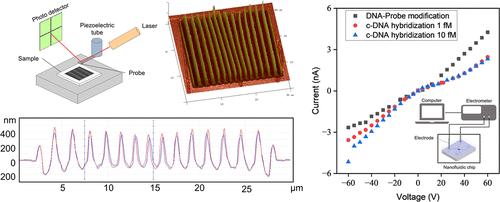
The nanofluidic chip holds immense potential for applications in disease diagnosis, bioanalysis, and environmental detection due to its advantageous nanoscale size. The key component enabling the performance of a nanofluidic chip is the nanochannel. In this study, we fabricated controllable and consistent arrays of nanochannels, termed nanoripple structures, using an atomic force microscopy (AFM) probe reciprocal scanning approach. Furthermore, we successfully fabricated a nanofluidic chip with a nanochannel array by combining photolithography, transfer, and bonding techniques. We verified the feasibility of the prepared nanofluidic chip through ionic conduction experiments. Additionally, we compared the performance of the nanofluidic chip with a single channel to that of a chip with a nanochannel array through ionic conduction experiments to demonstrate the high sensitivity achieved by incorporating a nanochannel array. Moreover, we conducted DNA molecule detection experiments by modifying the nanochannel surface, which lays down the foundations for expanding applications of AFM-based Nanomachining technology in nanopore sensing.
期刊介绍:
ACS Applied Nano Materials is an interdisciplinary journal publishing original research covering all aspects of engineering, chemistry, physics and biology relevant to applications of nanomaterials. The journal is devoted to reports of new and original experimental and theoretical research of an applied nature that integrate knowledge in the areas of materials, engineering, physics, bioscience, and chemistry into important applications of nanomaterials.




 京公网安备 11010802042870号
京ICP备2023020795号-1
京公网安备 11010802042870号
京ICP备2023020795号-1

 分享
分享
 求助内容:
求助内容: 应助结果提醒方式:
 扫码关注我们
