Kevin Salamanca-Perdigón , Diana M. Ardila , Álvaro Campos , Johan D. Lozano , Federico Ramírez , Alirio Palma , Jaime Portilla , Mario A. Macías
{"title":"一种有机-六氯斯坦酸杂化化合物的合成:一种桥接三环有机盐酸盐通过在其晶体结构中填充来稳定","authors":"Kevin Salamanca-Perdigón , Diana M. Ardila , Álvaro Campos , Johan D. Lozano , Federico Ramírez , Alirio Palma , Jaime Portilla , Mario A. Macías","doi":"10.1016/j.molstruc.2025.141942","DOIUrl":null,"url":null,"abstract":"<div><div>The use of 2-aminopyrazine in preparing organo-hexachlorostannates compounds has not been reported. Literature shows few reports related to the functionalization of this aromatic ring, indicating that the chemistry associated with this compound has not been sufficiently explored. In this work, a new organo-hexachlorostannate (OHcs) compound has been isolated using a simple experimental protocol dissolving SnCl<sub>2</sub><sup>.</sup>2H<sub>2</sub>O in concentrated hydrochloric acid. This compound is described as an isolated octahedra hexachlorostannate [SnCl<sub>6</sub>]<sup>2-</sup> anion conforming the crystal structure with the organic moiety 3,7-diamino-1,2,4a,5,8,8a-hexahydro-8,5-(epiminomethano)pyrido[3,4-<em>b</em>]pyrazin-10-ol which is present in its multi-protonated hydrochloric salt form. X ray diffraction analysis was performed to determine the structure of crystals grown by slow evaporation after the reaction process. Additionally, infrared spectroscopy (IR), high-resolution mass spectrometry (HRMS), nuclear magnetic resonance (NMR), thermogravimetric analysis (TGA), and differential scanning calorimetry (DCS) techniques were used to characterize the product. Considering the lack of reports in the literature, this work concludes that this compound is only stable in the solid state due to packing stabilization. However, a reversible reaction favoring the formation of 2-aminopyrazine hydrochloride takes place in solution. Following the results from these experiments, we propose that this organo-hexachlorostannate hybrid compound is formed through a multi-step synthesis via Stephen reduction and an inverse electron demand Diels-Alder (IEDDA) cycloaddition which opens interesting alternatives to synthesize new polycyclic compounds.</div></div>","PeriodicalId":16414,"journal":{"name":"Journal of Molecular Structure","volume":"1334 ","pages":"Article 141942"},"PeriodicalIF":4.9000,"publicationDate":"2025-07-05","publicationTypes":"Journal Article","fieldsOfStudy":null,"isOpenAccess":false,"openAccessPdf":"","citationCount":"0","resultStr":"{\"title\":\"Synthesis of an organo-hexachlorostannate hybrid compound: A case of a bridged tricyclic organic hydrochloric salt stabilized by the packing in its crystal structure\",\"authors\":\"Kevin Salamanca-Perdigón , Diana M. Ardila , Álvaro Campos , Johan D. Lozano , Federico Ramírez , Alirio Palma , Jaime Portilla , Mario A. Macías\",\"doi\":\"10.1016/j.molstruc.2025.141942\",\"DOIUrl\":null,\"url\":null,\"abstract\":\"<div><div>The use of 2-aminopyrazine in preparing organo-hexachlorostannates compounds has not been reported. Literature shows few reports related to the functionalization of this aromatic ring, indicating that the chemistry associated with this compound has not been sufficiently explored. In this work, a new organo-hexachlorostannate (OHcs) compound has been isolated using a simple experimental protocol dissolving SnCl<sub>2</sub><sup>.</sup>2H<sub>2</sub>O in concentrated hydrochloric acid. This compound is described as an isolated octahedra hexachlorostannate [SnCl<sub>6</sub>]<sup>2-</sup> anion conforming the crystal structure with the organic moiety 3,7-diamino-1,2,4a,5,8,8a-hexahydro-8,5-(epiminomethano)pyrido[3,4-<em>b</em>]pyrazin-10-ol which is present in its multi-protonated hydrochloric salt form. X ray diffraction analysis was performed to determine the structure of crystals grown by slow evaporation after the reaction process. Additionally, infrared spectroscopy (IR), high-resolution mass spectrometry (HRMS), nuclear magnetic resonance (NMR), thermogravimetric analysis (TGA), and differential scanning calorimetry (DCS) techniques were used to characterize the product. Considering the lack of reports in the literature, this work concludes that this compound is only stable in the solid state due to packing stabilization. However, a reversible reaction favoring the formation of 2-aminopyrazine hydrochloride takes place in solution. Following the results from these experiments, we propose that this organo-hexachlorostannate hybrid compound is formed through a multi-step synthesis via Stephen reduction and an inverse electron demand Diels-Alder (IEDDA) cycloaddition which opens interesting alternatives to synthesize new polycyclic compounds.</div></div>\",\"PeriodicalId\":16414,\"journal\":{\"name\":\"Journal of Molecular Structure\",\"volume\":\"1334 \",\"pages\":\"Article 141942\"},\"PeriodicalIF\":4.9000,\"publicationDate\":\"2025-07-05\",\"publicationTypes\":\"Journal Article\",\"fieldsOfStudy\":null,\"isOpenAccess\":false,\"openAccessPdf\":\"\",\"citationCount\":\"0\",\"resultStr\":null,\"platform\":\"Semanticscholar\",\"paperid\":null,\"PeriodicalName\":\"Journal of Molecular Structure\",\"FirstCategoryId\":\"92\",\"ListUrlMain\":\"https://www.sciencedirect.com/science/article/pii/S0022286025006283\",\"RegionNum\":2,\"RegionCategory\":\"化学\",\"ArticlePicture\":[],\"TitleCN\":null,\"AbstractTextCN\":null,\"PMCID\":null,\"EPubDate\":\"2025/3/4 0:00:00\",\"PubModel\":\"Epub\",\"JCR\":\"Q2\",\"JCRName\":\"CHEMISTRY, PHYSICAL\",\"Score\":null,\"Total\":0}","platform":"Semanticscholar","paperid":null,"PeriodicalName":"Journal of Molecular Structure","FirstCategoryId":"92","ListUrlMain":"https://www.sciencedirect.com/science/article/pii/S0022286025006283","RegionNum":2,"RegionCategory":"化学","ArticlePicture":[],"TitleCN":null,"AbstractTextCN":null,"PMCID":null,"EPubDate":"2025/3/4 0:00:00","PubModel":"Epub","JCR":"Q2","JCRName":"CHEMISTRY, PHYSICAL","Score":null,"Total":0}
Synthesis of an organo-hexachlorostannate hybrid compound: A case of a bridged tricyclic organic hydrochloric salt stabilized by the packing in its crystal structure
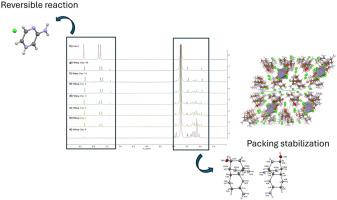
The use of 2-aminopyrazine in preparing organo-hexachlorostannates compounds has not been reported. Literature shows few reports related to the functionalization of this aromatic ring, indicating that the chemistry associated with this compound has not been sufficiently explored. In this work, a new organo-hexachlorostannate (OHcs) compound has been isolated using a simple experimental protocol dissolving SnCl2.2H2O in concentrated hydrochloric acid. This compound is described as an isolated octahedra hexachlorostannate [SnCl6]2- anion conforming the crystal structure with the organic moiety 3,7-diamino-1,2,4a,5,8,8a-hexahydro-8,5-(epiminomethano)pyrido[3,4-b]pyrazin-10-ol which is present in its multi-protonated hydrochloric salt form. X ray diffraction analysis was performed to determine the structure of crystals grown by slow evaporation after the reaction process. Additionally, infrared spectroscopy (IR), high-resolution mass spectrometry (HRMS), nuclear magnetic resonance (NMR), thermogravimetric analysis (TGA), and differential scanning calorimetry (DCS) techniques were used to characterize the product. Considering the lack of reports in the literature, this work concludes that this compound is only stable in the solid state due to packing stabilization. However, a reversible reaction favoring the formation of 2-aminopyrazine hydrochloride takes place in solution. Following the results from these experiments, we propose that this organo-hexachlorostannate hybrid compound is formed through a multi-step synthesis via Stephen reduction and an inverse electron demand Diels-Alder (IEDDA) cycloaddition which opens interesting alternatives to synthesize new polycyclic compounds.
期刊介绍:
The Journal of Molecular Structure is dedicated to the publication of full-length articles and review papers, providing important new structural information on all types of chemical species including:
• Stable and unstable molecules in all types of environments (vapour, molecular beam, liquid, solution, liquid crystal, solid state, matrix-isolated, surface-absorbed etc.)
• Chemical intermediates
• Molecules in excited states
• Biological molecules
• Polymers.
The methods used may include any combination of spectroscopic and non-spectroscopic techniques, for example:
• Infrared spectroscopy (mid, far, near)
• Raman spectroscopy and non-linear Raman methods (CARS, etc.)
• Electronic absorption spectroscopy
• Optical rotatory dispersion and circular dichroism
• Fluorescence and phosphorescence techniques
• Electron spectroscopies (PES, XPS), EXAFS, etc.
• Microwave spectroscopy
• Electron diffraction
• NMR and ESR spectroscopies
• Mössbauer spectroscopy
• X-ray crystallography
• Charge Density Analyses
• Computational Studies (supplementing experimental methods)
We encourage publications combining theoretical and experimental approaches. The structural insights gained by the studies should be correlated with the properties, activity and/ or reactivity of the molecule under investigation and the relevance of this molecule and its implications should be discussed.





 京公网安备 11010802042870号
京ICP备2023020795号-1
京公网安备 11010802042870号
京ICP备2023020795号-1

 分享
分享
 求助内容:
求助内容: 应助结果提醒方式:
 扫码关注我们
