{"title":"一水合2-氨基-3-硝基硫酸氢吡啶的IR和介电性质及DFT计算(FMOs和ELF)","authors":"Soulayma Mtar , Mirosław Mączka , Szymon Smółka , Paulina Peksa , Adam Sieradzki , Sergiu Shova , Mohamed Boujelbene","doi":"10.1016/j.molstruc.2025.141839","DOIUrl":null,"url":null,"abstract":"<div><div>This study investigates the structural, temperature-dependent IR and dielectric properties, along with the DFT calculations of 2-amino-3-nitropyridinium hydrogen sulfate monohydrate (abbreviated as 2A3NP) (C<sub>5</sub>H<sub>6</sub>N<sub>3</sub>O<sub>2</sub>)·HSO<sub>4</sub>·H<sub>2</sub>O, a compound with potential nonlinear optical applications. Single-crystal X-ray diffraction analyses confirm an orthorhombic, non-centrosymmetric structure, stabilized by hydrogen bonding between the organic cation, hydrogen sulfate anions, and water molecules. Temperature-dependent IR spectroscopy reveals shifts in vibrational modes associated with hydrogen bonding, reflecting molecular dynamics and thermal effects. Dielectric analysis shows temperature-sensitive conductivity, with proton hopping and relaxation processes. DFT calculation provides insights into the electronic structure, highlighting the HOMO-LUMO gap of 3.42 eV and electron localization, which aligns well with the optical results. These findings deepen our understanding of the temperature-dependent vibration bands and dielectric behavior of 2A3NP-based compounds and emphasize the compound's potential in electronic and optical applications where stability and controlled conductivity are essential.</div></div>","PeriodicalId":16414,"journal":{"name":"Journal of Molecular Structure","volume":"1334 ","pages":"Article 141839"},"PeriodicalIF":4.7000,"publicationDate":"2025-07-05","publicationTypes":"Journal Article","fieldsOfStudy":null,"isOpenAccess":false,"openAccessPdf":"","citationCount":"0","resultStr":"{\"title\":\"Temperature-dependent IR and dielectric properties, and DFT calculations (FMOs and ELF), of 2-amino-3-nitropyridinium hydrogen sulfate monohydrate\",\"authors\":\"Soulayma Mtar , Mirosław Mączka , Szymon Smółka , Paulina Peksa , Adam Sieradzki , Sergiu Shova , Mohamed Boujelbene\",\"doi\":\"10.1016/j.molstruc.2025.141839\",\"DOIUrl\":null,\"url\":null,\"abstract\":\"<div><div>This study investigates the structural, temperature-dependent IR and dielectric properties, along with the DFT calculations of 2-amino-3-nitropyridinium hydrogen sulfate monohydrate (abbreviated as 2A3NP) (C<sub>5</sub>H<sub>6</sub>N<sub>3</sub>O<sub>2</sub>)·HSO<sub>4</sub>·H<sub>2</sub>O, a compound with potential nonlinear optical applications. Single-crystal X-ray diffraction analyses confirm an orthorhombic, non-centrosymmetric structure, stabilized by hydrogen bonding between the organic cation, hydrogen sulfate anions, and water molecules. Temperature-dependent IR spectroscopy reveals shifts in vibrational modes associated with hydrogen bonding, reflecting molecular dynamics and thermal effects. Dielectric analysis shows temperature-sensitive conductivity, with proton hopping and relaxation processes. DFT calculation provides insights into the electronic structure, highlighting the HOMO-LUMO gap of 3.42 eV and electron localization, which aligns well with the optical results. These findings deepen our understanding of the temperature-dependent vibration bands and dielectric behavior of 2A3NP-based compounds and emphasize the compound's potential in electronic and optical applications where stability and controlled conductivity are essential.</div></div>\",\"PeriodicalId\":16414,\"journal\":{\"name\":\"Journal of Molecular Structure\",\"volume\":\"1334 \",\"pages\":\"Article 141839\"},\"PeriodicalIF\":4.7000,\"publicationDate\":\"2025-07-05\",\"publicationTypes\":\"Journal Article\",\"fieldsOfStudy\":null,\"isOpenAccess\":false,\"openAccessPdf\":\"\",\"citationCount\":\"0\",\"resultStr\":null,\"platform\":\"Semanticscholar\",\"paperid\":null,\"PeriodicalName\":\"Journal of Molecular Structure\",\"FirstCategoryId\":\"92\",\"ListUrlMain\":\"https://www.sciencedirect.com/science/article/pii/S0022286025005253\",\"RegionNum\":2,\"RegionCategory\":\"化学\",\"ArticlePicture\":[],\"TitleCN\":null,\"AbstractTextCN\":null,\"PMCID\":null,\"EPubDate\":\"2025/2/26 0:00:00\",\"PubModel\":\"Epub\",\"JCR\":\"Q2\",\"JCRName\":\"CHEMISTRY, PHYSICAL\",\"Score\":null,\"Total\":0}","platform":"Semanticscholar","paperid":null,"PeriodicalName":"Journal of Molecular Structure","FirstCategoryId":"92","ListUrlMain":"https://www.sciencedirect.com/science/article/pii/S0022286025005253","RegionNum":2,"RegionCategory":"化学","ArticlePicture":[],"TitleCN":null,"AbstractTextCN":null,"PMCID":null,"EPubDate":"2025/2/26 0:00:00","PubModel":"Epub","JCR":"Q2","JCRName":"CHEMISTRY, PHYSICAL","Score":null,"Total":0}
Temperature-dependent IR and dielectric properties, and DFT calculations (FMOs and ELF), of 2-amino-3-nitropyridinium hydrogen sulfate monohydrate
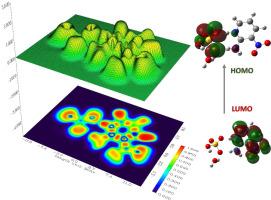
This study investigates the structural, temperature-dependent IR and dielectric properties, along with the DFT calculations of 2-amino-3-nitropyridinium hydrogen sulfate monohydrate (abbreviated as 2A3NP) (C5H6N3O2)·HSO4·H2O, a compound with potential nonlinear optical applications. Single-crystal X-ray diffraction analyses confirm an orthorhombic, non-centrosymmetric structure, stabilized by hydrogen bonding between the organic cation, hydrogen sulfate anions, and water molecules. Temperature-dependent IR spectroscopy reveals shifts in vibrational modes associated with hydrogen bonding, reflecting molecular dynamics and thermal effects. Dielectric analysis shows temperature-sensitive conductivity, with proton hopping and relaxation processes. DFT calculation provides insights into the electronic structure, highlighting the HOMO-LUMO gap of 3.42 eV and electron localization, which aligns well with the optical results. These findings deepen our understanding of the temperature-dependent vibration bands and dielectric behavior of 2A3NP-based compounds and emphasize the compound's potential in electronic and optical applications where stability and controlled conductivity are essential.
期刊介绍:
The Journal of Molecular Structure is dedicated to the publication of full-length articles and review papers, providing important new structural information on all types of chemical species including:
• Stable and unstable molecules in all types of environments (vapour, molecular beam, liquid, solution, liquid crystal, solid state, matrix-isolated, surface-absorbed etc.)
• Chemical intermediates
• Molecules in excited states
• Biological molecules
• Polymers.
The methods used may include any combination of spectroscopic and non-spectroscopic techniques, for example:
• Infrared spectroscopy (mid, far, near)
• Raman spectroscopy and non-linear Raman methods (CARS, etc.)
• Electronic absorption spectroscopy
• Optical rotatory dispersion and circular dichroism
• Fluorescence and phosphorescence techniques
• Electron spectroscopies (PES, XPS), EXAFS, etc.
• Microwave spectroscopy
• Electron diffraction
• NMR and ESR spectroscopies
• Mössbauer spectroscopy
• X-ray crystallography
• Charge Density Analyses
• Computational Studies (supplementing experimental methods)
We encourage publications combining theoretical and experimental approaches. The structural insights gained by the studies should be correlated with the properties, activity and/ or reactivity of the molecule under investigation and the relevance of this molecule and its implications should be discussed.





 京公网安备 11010802042870号
京ICP备2023020795号-1
京公网安备 11010802042870号
京ICP备2023020795号-1

 分享
分享
 求助内容:
求助内容: 应助结果提醒方式:
 扫码关注我们
