Weilong Song , Jialong Yang , Kechen Zhang, Panshen Xu, Hebin Pan, Jiapeng Deng, An Wang, Kaitao Wang, Dingsheng Lin
{"title":"2,3,5,4 ' - tetrahydroxystilbene -2- o - β - d -glucopyranoside通过PINK1/Parkin途径促进线粒体自噬,从而促进皮瓣存活","authors":"Weilong Song , Jialong Yang , Kechen Zhang, Panshen Xu, Hebin Pan, Jiapeng Deng, An Wang, Kaitao Wang, Dingsheng Lin","doi":"10.1016/j.jep.2025.119587","DOIUrl":null,"url":null,"abstract":"<div><h3>Ethnopharmacological relevance</h3><div>2,3,5,4′-Tetrahydroxystilbene-2-O-beta-D-glucopyranoside (THSG), the active compound in <em>Polygonum multiflorum</em> (PM), exhibits potential therapeutic effects, including combating oxidative stress, possessing anti-tumor properties, and protecting against ischemia-reperfusion injury. However, the influence and mechanisms by which THSG affects skin flap survival remain unclear.</div></div><div><h3>Aim of study</h3><div>To investigate the effects and underlying mechanisms of THSG to promote the survival rate of skin flap.</div></div><div><h3>Methods</h3><div>McFarlane skin flap models were created in 24 Sprague-Dawley rats, which were randomly divided into four groups: control group, low-dose THSG group (30 mg/kg/day), medium-dose THSG group (60 mg/kg/day), and high-dose THSG group (120 mg/kg/day). Seven days after postoperative administration, blood perfusion was assessed using laser Doppler, and the survival rate was calculated. Anti-tumor necrosis factor (TNF)-α was analyzed via immunofluorescence. Interleukin (IL)-6 and IL-1β were explored by enzyme-linked immunosorbent assay (ELISA). SOD activity and MDA contents in skin flap tissue were detected to evaluate oxidative stress level, while Western blotting was employed to assess proteins of the PINK1/Parkin signaling axis, apoptosis-related proteins, and vascular endothelial growth factor (VEGF).</div></div><div><h3>Results</h3><div>THSG upregulated VEGF expression, improved blood flow, and protected flap tissue by reducing inflammation, mitigating oxidative stress, and inhibiting apoptosis. Increased expression of Parkin and PINK1, along with decreased levels of COX IV, suggested that THSG mediates mitophagy via the PINK1/Parkin signaling pathway.</div></div><div><h3>Conclusions</h3><div>THSG enhances the survival rate of skin flap by promoting PINK1/Parkin-mediated mitophagy.</div></div>","PeriodicalId":15761,"journal":{"name":"Journal of ethnopharmacology","volume":"345 ","pages":"Article 119587"},"PeriodicalIF":6.8000,"publicationDate":"2025-04-09","publicationTypes":"Journal Article","fieldsOfStudy":null,"isOpenAccess":false,"openAccessPdf":"","citationCount":"0","resultStr":"{\"title\":\"2,3,5,4′-Tetrahydroxystilbene-2-O-beta-D-glucopyranoside promotes skin flap survival by promoting mitophagy through the PINK1/Parkin pathway\",\"authors\":\"Weilong Song , Jialong Yang , Kechen Zhang, Panshen Xu, Hebin Pan, Jiapeng Deng, An Wang, Kaitao Wang, Dingsheng Lin\",\"doi\":\"10.1016/j.jep.2025.119587\",\"DOIUrl\":null,\"url\":null,\"abstract\":\"<div><h3>Ethnopharmacological relevance</h3><div>2,3,5,4′-Tetrahydroxystilbene-2-O-beta-D-glucopyranoside (THSG), the active compound in <em>Polygonum multiflorum</em> (PM), exhibits potential therapeutic effects, including combating oxidative stress, possessing anti-tumor properties, and protecting against ischemia-reperfusion injury. However, the influence and mechanisms by which THSG affects skin flap survival remain unclear.</div></div><div><h3>Aim of study</h3><div>To investigate the effects and underlying mechanisms of THSG to promote the survival rate of skin flap.</div></div><div><h3>Methods</h3><div>McFarlane skin flap models were created in 24 Sprague-Dawley rats, which were randomly divided into four groups: control group, low-dose THSG group (30 mg/kg/day), medium-dose THSG group (60 mg/kg/day), and high-dose THSG group (120 mg/kg/day). Seven days after postoperative administration, blood perfusion was assessed using laser Doppler, and the survival rate was calculated. Anti-tumor necrosis factor (TNF)-α was analyzed via immunofluorescence. Interleukin (IL)-6 and IL-1β were explored by enzyme-linked immunosorbent assay (ELISA). SOD activity and MDA contents in skin flap tissue were detected to evaluate oxidative stress level, while Western blotting was employed to assess proteins of the PINK1/Parkin signaling axis, apoptosis-related proteins, and vascular endothelial growth factor (VEGF).</div></div><div><h3>Results</h3><div>THSG upregulated VEGF expression, improved blood flow, and protected flap tissue by reducing inflammation, mitigating oxidative stress, and inhibiting apoptosis. Increased expression of Parkin and PINK1, along with decreased levels of COX IV, suggested that THSG mediates mitophagy via the PINK1/Parkin signaling pathway.</div></div><div><h3>Conclusions</h3><div>THSG enhances the survival rate of skin flap by promoting PINK1/Parkin-mediated mitophagy.</div></div>\",\"PeriodicalId\":15761,\"journal\":{\"name\":\"Journal of ethnopharmacology\",\"volume\":\"345 \",\"pages\":\"Article 119587\"},\"PeriodicalIF\":6.8000,\"publicationDate\":\"2025-04-09\",\"publicationTypes\":\"Journal Article\",\"fieldsOfStudy\":null,\"isOpenAccess\":false,\"openAccessPdf\":\"\",\"citationCount\":\"0\",\"resultStr\":null,\"platform\":\"Semanticscholar\",\"paperid\":null,\"PeriodicalName\":\"Journal of ethnopharmacology\",\"FirstCategoryId\":\"3\",\"ListUrlMain\":\"https://www.sciencedirect.com/science/article/pii/S0378874125002715\",\"RegionNum\":2,\"RegionCategory\":\"医学\",\"ArticlePicture\":[],\"TitleCN\":null,\"AbstractTextCN\":null,\"PMCID\":null,\"EPubDate\":\"2025/3/3 0:00:00\",\"PubModel\":\"Epub\",\"JCR\":\"Q1\",\"JCRName\":\"CHEMISTRY, MEDICINAL\",\"Score\":null,\"Total\":0}","platform":"Semanticscholar","paperid":null,"PeriodicalName":"Journal of ethnopharmacology","FirstCategoryId":"3","ListUrlMain":"https://www.sciencedirect.com/science/article/pii/S0378874125002715","RegionNum":2,"RegionCategory":"医学","ArticlePicture":[],"TitleCN":null,"AbstractTextCN":null,"PMCID":null,"EPubDate":"2025/3/3 0:00:00","PubModel":"Epub","JCR":"Q1","JCRName":"CHEMISTRY, MEDICINAL","Score":null,"Total":0}
引用次数: 0
摘要
2,3,5,4 ' -四羟基二苯乙烯-2- o - β - d -葡萄糖吡诺苷(THSG)是何首乌(PM)中的活性化合物,具有抗氧化应激、抗肿瘤和保护缺血再灌注损伤等潜在的治疗作用。然而,THSG对皮瓣存活的影响和机制尚不清楚。目的探讨THSG促进皮瓣成活率的作用及其机制。方法将24只Sprague-Dawley大鼠随机分为4组:对照组、低剂量THSG组(30 mg/kg/d)、中剂量THSG组(60 mg/kg/d)、高剂量THSG组(120 mg/kg/d)。术后给药7 d后,激光多普勒评估血流灌注,计算生存率。免疫荧光法检测抗肿瘤坏死因子(TNF -α)。采用酶联免疫吸附试验(ELISA)检测白细胞介素(IL)-6和IL-1β。检测皮瓣组织中SOD活性和MDA含量,评估氧化应激水平,Western blotting检测PINK1/Parkin信号轴蛋白、凋亡相关蛋白和血管内皮生长因子(VEGF)。结果thsg可上调血管内皮生长因子的表达,改善血流,并通过减少炎症、减轻氧化应激、抑制细胞凋亡等方式保护皮瓣组织。Parkin和PINK1的表达增加,COX IV水平降低,表明THSG通过PINK1/Parkin信号通路介导线粒体自噬。结论thsg通过促进PINK1/ parkinson介导的有丝分裂而提高皮瓣成活率。
2,3,5,4′-Tetrahydroxystilbene-2-O-beta-D-glucopyranoside promotes skin flap survival by promoting mitophagy through the PINK1/Parkin pathway
Ethnopharmacological relevance
2,3,5,4′-Tetrahydroxystilbene-2-O-beta-D-glucopyranoside (THSG), the active compound in Polygonum multiflorum (PM), exhibits potential therapeutic effects, including combating oxidative stress, possessing anti-tumor properties, and protecting against ischemia-reperfusion injury. However, the influence and mechanisms by which THSG affects skin flap survival remain unclear.
Aim of study
To investigate the effects and underlying mechanisms of THSG to promote the survival rate of skin flap.
Methods
McFarlane skin flap models were created in 24 Sprague-Dawley rats, which were randomly divided into four groups: control group, low-dose THSG group (30 mg/kg/day), medium-dose THSG group (60 mg/kg/day), and high-dose THSG group (120 mg/kg/day). Seven days after postoperative administration, blood perfusion was assessed using laser Doppler, and the survival rate was calculated. Anti-tumor necrosis factor (TNF)-α was analyzed via immunofluorescence. Interleukin (IL)-6 and IL-1β were explored by enzyme-linked immunosorbent assay (ELISA). SOD activity and MDA contents in skin flap tissue were detected to evaluate oxidative stress level, while Western blotting was employed to assess proteins of the PINK1/Parkin signaling axis, apoptosis-related proteins, and vascular endothelial growth factor (VEGF).
Results
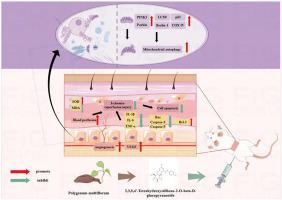
THSG upregulated VEGF expression, improved blood flow, and protected flap tissue by reducing inflammation, mitigating oxidative stress, and inhibiting apoptosis. Increased expression of Parkin and PINK1, along with decreased levels of COX IV, suggested that THSG mediates mitophagy via the PINK1/Parkin signaling pathway.
Conclusions
THSG enhances the survival rate of skin flap by promoting PINK1/Parkin-mediated mitophagy.
期刊介绍:
The Journal of Ethnopharmacology is dedicated to the exchange of information and understandings about people''s use of plants, fungi, animals, microorganisms and minerals and their biological and pharmacological effects based on the principles established through international conventions. Early people confronted with illness and disease, discovered a wealth of useful therapeutic agents in the plant and animal kingdoms. The empirical knowledge of these medicinal substances and their toxic potential was passed on by oral tradition and sometimes recorded in herbals and other texts on materia medica. Many valuable drugs of today (e.g., atropine, ephedrine, tubocurarine, digoxin, reserpine) came into use through the study of indigenous remedies. Chemists continue to use plant-derived drugs (e.g., morphine, taxol, physostigmine, quinidine, emetine) as prototypes in their attempts to develop more effective and less toxic medicinals.





 京公网安备 11010802042870号
京ICP备2023020795号-1
京公网安备 11010802042870号
京ICP备2023020795号-1

 分享
分享
 求助内容:
求助内容: 应助结果提醒方式:
 扫码关注我们
