Binxin Lv , Jiayue Yu , Fengchen Zhou , Zizi Wang , Junjun Zhang , Yifan Zhang , Yang Wu , Yong Wang , Wen Luo
{"title":"揭示双金属CuZn催化剂上CO2和硝酸盐电还原过程中尿素选择性的增强","authors":"Binxin Lv , Jiayue Yu , Fengchen Zhou , Zizi Wang , Junjun Zhang , Yifan Zhang , Yang Wu , Yong Wang , Wen Luo","doi":"10.1016/j.mcat.2025.114978","DOIUrl":null,"url":null,"abstract":"<div><div>Urea electrosynthesis plays a vital role in the nitrogen cycle, promoting carbon neutrality while also being energy-efficient. However, the complexities involved in the simultaneous of carbon and nitrogen-containing species significantly hinder the selectivity and yield of urea. In this study, we report a CuZn bimetallic catalyst that is capable of converting CO<sub>2</sub> and NO<sub>3</sub><sup>⁻</sup> into urea, with a maximum Faraday efficiency of 40% at -0.6 V vs. RHE, alongside an impressive urea yield rate of 304.8 mmol h<sup>⁻¹</sup> g<sub>cat</sub><sup>⁻¹</sup> at -0.9 V vs. RHE, surpassing the performance of both monometallic Cu and Zn catalysts. In situ spectroscopic analysis demonstrates that the Cu sites within CuZn facilitates the adsorption and activation of CO<sub>2</sub> and NO<sub>3</sub><sup>⁻</sup>, while Zn sites additionally facilitate CO<sub>2</sub> adsorption and reduces the adsorption strength of *CO and *NH<sub>2</sub> on the catalyst surface, collectively promoting the formation of *CONH<sub>2</sub> as a key intermediate in urea synthesis. This study highlights the unique role of zinc in urea synthesis, offers new insights into optimizing the performance of copper-zinc catalysts, and serves as a valuable reference for future research on the role of zinc in urea synthesis.</div></div>","PeriodicalId":393,"journal":{"name":"Molecular Catalysis","volume":"578 ","pages":"Article 114978"},"PeriodicalIF":4.9000,"publicationDate":"2025-05-01","publicationTypes":"Journal Article","fieldsOfStudy":null,"isOpenAccess":false,"openAccessPdf":"","citationCount":"0","resultStr":"{\"title\":\"Unraveling the enhanced urea selectivity in electroreduction of CO2 and nitrate over Bimetallic CuZn catalysts\",\"authors\":\"Binxin Lv , Jiayue Yu , Fengchen Zhou , Zizi Wang , Junjun Zhang , Yifan Zhang , Yang Wu , Yong Wang , Wen Luo\",\"doi\":\"10.1016/j.mcat.2025.114978\",\"DOIUrl\":null,\"url\":null,\"abstract\":\"<div><div>Urea electrosynthesis plays a vital role in the nitrogen cycle, promoting carbon neutrality while also being energy-efficient. However, the complexities involved in the simultaneous of carbon and nitrogen-containing species significantly hinder the selectivity and yield of urea. In this study, we report a CuZn bimetallic catalyst that is capable of converting CO<sub>2</sub> and NO<sub>3</sub><sup>⁻</sup> into urea, with a maximum Faraday efficiency of 40% at -0.6 V vs. RHE, alongside an impressive urea yield rate of 304.8 mmol h<sup>⁻¹</sup> g<sub>cat</sub><sup>⁻¹</sup> at -0.9 V vs. RHE, surpassing the performance of both monometallic Cu and Zn catalysts. In situ spectroscopic analysis demonstrates that the Cu sites within CuZn facilitates the adsorption and activation of CO<sub>2</sub> and NO<sub>3</sub><sup>⁻</sup>, while Zn sites additionally facilitate CO<sub>2</sub> adsorption and reduces the adsorption strength of *CO and *NH<sub>2</sub> on the catalyst surface, collectively promoting the formation of *CONH<sub>2</sub> as a key intermediate in urea synthesis. This study highlights the unique role of zinc in urea synthesis, offers new insights into optimizing the performance of copper-zinc catalysts, and serves as a valuable reference for future research on the role of zinc in urea synthesis.</div></div>\",\"PeriodicalId\":393,\"journal\":{\"name\":\"Molecular Catalysis\",\"volume\":\"578 \",\"pages\":\"Article 114978\"},\"PeriodicalIF\":4.9000,\"publicationDate\":\"2025-05-01\",\"publicationTypes\":\"Journal Article\",\"fieldsOfStudy\":null,\"isOpenAccess\":false,\"openAccessPdf\":\"\",\"citationCount\":\"0\",\"resultStr\":null,\"platform\":\"Semanticscholar\",\"paperid\":null,\"PeriodicalName\":\"Molecular Catalysis\",\"FirstCategoryId\":\"92\",\"ListUrlMain\":\"https://www.sciencedirect.com/science/article/pii/S2468823125001646\",\"RegionNum\":2,\"RegionCategory\":\"化学\",\"ArticlePicture\":[],\"TitleCN\":null,\"AbstractTextCN\":null,\"PMCID\":null,\"EPubDate\":\"2025/3/6 0:00:00\",\"PubModel\":\"Epub\",\"JCR\":\"Q2\",\"JCRName\":\"CHEMISTRY, PHYSICAL\",\"Score\":null,\"Total\":0}","platform":"Semanticscholar","paperid":null,"PeriodicalName":"Molecular Catalysis","FirstCategoryId":"92","ListUrlMain":"https://www.sciencedirect.com/science/article/pii/S2468823125001646","RegionNum":2,"RegionCategory":"化学","ArticlePicture":[],"TitleCN":null,"AbstractTextCN":null,"PMCID":null,"EPubDate":"2025/3/6 0:00:00","PubModel":"Epub","JCR":"Q2","JCRName":"CHEMISTRY, PHYSICAL","Score":null,"Total":0}
Unraveling the enhanced urea selectivity in electroreduction of CO2 and nitrate over Bimetallic CuZn catalysts
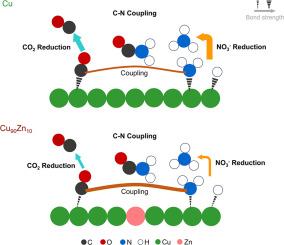
Urea electrosynthesis plays a vital role in the nitrogen cycle, promoting carbon neutrality while also being energy-efficient. However, the complexities involved in the simultaneous of carbon and nitrogen-containing species significantly hinder the selectivity and yield of urea. In this study, we report a CuZn bimetallic catalyst that is capable of converting CO2 and NO3⁻ into urea, with a maximum Faraday efficiency of 40% at -0.6 V vs. RHE, alongside an impressive urea yield rate of 304.8 mmol h⁻¹ gcat⁻¹ at -0.9 V vs. RHE, surpassing the performance of both monometallic Cu and Zn catalysts. In situ spectroscopic analysis demonstrates that the Cu sites within CuZn facilitates the adsorption and activation of CO2 and NO3⁻, while Zn sites additionally facilitate CO2 adsorption and reduces the adsorption strength of *CO and *NH2 on the catalyst surface, collectively promoting the formation of *CONH2 as a key intermediate in urea synthesis. This study highlights the unique role of zinc in urea synthesis, offers new insights into optimizing the performance of copper-zinc catalysts, and serves as a valuable reference for future research on the role of zinc in urea synthesis.
期刊介绍:
Molecular Catalysis publishes full papers that are original, rigorous, and scholarly contributions examining the molecular and atomic aspects of catalytic activation and reaction mechanisms. The fields covered are:
Heterogeneous catalysis including immobilized molecular catalysts
Homogeneous catalysis including organocatalysis, organometallic catalysis and biocatalysis
Photo- and electrochemistry
Theoretical aspects of catalysis analyzed by computational methods




 京公网安备 11010802042870号
京ICP备2023020795号-1
京公网安备 11010802042870号
京ICP备2023020795号-1

 分享
分享
 求助内容:
求助内容: 应助结果提醒方式:
 扫码关注我们
