{"title":"结核分枝杆菌d-丙氨酸:d-丙氨酸连接酶作为二聚化反应中竞争动力学同位素效应测量的案例研究","authors":"Patrick L. Fernandez, Andrew S. Murkin","doi":"10.1016/j.bioorg.2025.108332","DOIUrl":null,"url":null,"abstract":"<div><div>The small magnitudes of some kinetic isotope effects (KIEs), including those associated with <sup>13</sup>C, necessitate a highly precise experimental approach involving the competition of light and heavy substrates. Provided the reaction is first order in the labeled substrate, the product isotopologue ratio converges to the initial reactant isotopologue ratio at completion, but the same is not true for dimerization reactions simply because the product diverges into four distinct isotopologues. The relative populations of these dimers deviate from the statistical distribution under the influence of a KIE. Accordingly, the current study aims to demonstrate this concept by analyzing the relative <sup>13</sup>C placement in <span>d</span>-alanine:<span>d</span>-alanine-<span>d</span>-alanine:<span>d</span>-alanine at reaction completion for the dimerization of D-[1-<sup>13</sup>C]alanine catalyzed by <em>Mycobacterium tuberculosis</em> <span>d</span>-alanine:<span>d</span>-alanine ligase (Ddl). Using <sup>13</sup>C NMR spectroscopy and Fourier-transform ion cyclotron mass spectrometry, the relative distributions of the four dimer isotopologues were determined. The ratio of the mono-labeled dimers with <sup>13</sup>C at the C-terminus to that with <sup>13</sup>C at the N-terminus yielded a relative KIE of 1.011 ± 0.004 for the acyl carbon. This result suggests that the rate-limiting step of the Ddl-catalyzed reaction involves peptide bond formation—either nucleophilic attack by the amino group or collapse of the resulting tetrahedral intermediate. This method of analysis, to the best of our knowledge, is the first of its kind for obtaining competitive KIEs in enzyme-catalyzed dimerization reactions.</div></div>","PeriodicalId":257,"journal":{"name":"Bioorganic Chemistry","volume":"158 ","pages":"Article 108332"},"PeriodicalIF":5.1000,"publicationDate":"2025-05-01","publicationTypes":"Journal Article","fieldsOfStudy":null,"isOpenAccess":false,"openAccessPdf":"","citationCount":"0","resultStr":"{\"title\":\"Mycobacterium tuberculosis d-alanine:d-alanine ligase as a case study in the measurement of competitive kinetic isotope effects for dimerization reactions\",\"authors\":\"Patrick L. Fernandez, Andrew S. Murkin\",\"doi\":\"10.1016/j.bioorg.2025.108332\",\"DOIUrl\":null,\"url\":null,\"abstract\":\"<div><div>The small magnitudes of some kinetic isotope effects (KIEs), including those associated with <sup>13</sup>C, necessitate a highly precise experimental approach involving the competition of light and heavy substrates. Provided the reaction is first order in the labeled substrate, the product isotopologue ratio converges to the initial reactant isotopologue ratio at completion, but the same is not true for dimerization reactions simply because the product diverges into four distinct isotopologues. The relative populations of these dimers deviate from the statistical distribution under the influence of a KIE. Accordingly, the current study aims to demonstrate this concept by analyzing the relative <sup>13</sup>C placement in <span>d</span>-alanine:<span>d</span>-alanine-<span>d</span>-alanine:<span>d</span>-alanine at reaction completion for the dimerization of D-[1-<sup>13</sup>C]alanine catalyzed by <em>Mycobacterium tuberculosis</em> <span>d</span>-alanine:<span>d</span>-alanine ligase (Ddl). Using <sup>13</sup>C NMR spectroscopy and Fourier-transform ion cyclotron mass spectrometry, the relative distributions of the four dimer isotopologues were determined. The ratio of the mono-labeled dimers with <sup>13</sup>C at the C-terminus to that with <sup>13</sup>C at the N-terminus yielded a relative KIE of 1.011 ± 0.004 for the acyl carbon. This result suggests that the rate-limiting step of the Ddl-catalyzed reaction involves peptide bond formation—either nucleophilic attack by the amino group or collapse of the resulting tetrahedral intermediate. This method of analysis, to the best of our knowledge, is the first of its kind for obtaining competitive KIEs in enzyme-catalyzed dimerization reactions.</div></div>\",\"PeriodicalId\":257,\"journal\":{\"name\":\"Bioorganic Chemistry\",\"volume\":\"158 \",\"pages\":\"Article 108332\"},\"PeriodicalIF\":5.1000,\"publicationDate\":\"2025-05-01\",\"publicationTypes\":\"Journal Article\",\"fieldsOfStudy\":null,\"isOpenAccess\":false,\"openAccessPdf\":\"\",\"citationCount\":\"0\",\"resultStr\":null,\"platform\":\"Semanticscholar\",\"paperid\":null,\"PeriodicalName\":\"Bioorganic Chemistry\",\"FirstCategoryId\":\"92\",\"ListUrlMain\":\"https://www.sciencedirect.com/science/article/pii/S0045206825002123\",\"RegionNum\":2,\"RegionCategory\":\"医学\",\"ArticlePicture\":[],\"TitleCN\":null,\"AbstractTextCN\":null,\"PMCID\":null,\"EPubDate\":\"2025/3/4 0:00:00\",\"PubModel\":\"Epub\",\"JCR\":\"Q1\",\"JCRName\":\"BIOCHEMISTRY & MOLECULAR BIOLOGY\",\"Score\":null,\"Total\":0}","platform":"Semanticscholar","paperid":null,"PeriodicalName":"Bioorganic Chemistry","FirstCategoryId":"92","ListUrlMain":"https://www.sciencedirect.com/science/article/pii/S0045206825002123","RegionNum":2,"RegionCategory":"医学","ArticlePicture":[],"TitleCN":null,"AbstractTextCN":null,"PMCID":null,"EPubDate":"2025/3/4 0:00:00","PubModel":"Epub","JCR":"Q1","JCRName":"BIOCHEMISTRY & MOLECULAR BIOLOGY","Score":null,"Total":0}
Mycobacterium tuberculosis d-alanine:d-alanine ligase as a case study in the measurement of competitive kinetic isotope effects for dimerization reactions
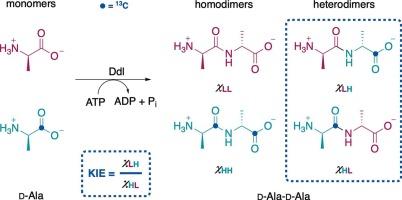
The small magnitudes of some kinetic isotope effects (KIEs), including those associated with 13C, necessitate a highly precise experimental approach involving the competition of light and heavy substrates. Provided the reaction is first order in the labeled substrate, the product isotopologue ratio converges to the initial reactant isotopologue ratio at completion, but the same is not true for dimerization reactions simply because the product diverges into four distinct isotopologues. The relative populations of these dimers deviate from the statistical distribution under the influence of a KIE. Accordingly, the current study aims to demonstrate this concept by analyzing the relative 13C placement in d-alanine:d-alanine-d-alanine:d-alanine at reaction completion for the dimerization of D-[1-13C]alanine catalyzed by Mycobacterium tuberculosisd-alanine:d-alanine ligase (Ddl). Using 13C NMR spectroscopy and Fourier-transform ion cyclotron mass spectrometry, the relative distributions of the four dimer isotopologues were determined. The ratio of the mono-labeled dimers with 13C at the C-terminus to that with 13C at the N-terminus yielded a relative KIE of 1.011 ± 0.004 for the acyl carbon. This result suggests that the rate-limiting step of the Ddl-catalyzed reaction involves peptide bond formation—either nucleophilic attack by the amino group or collapse of the resulting tetrahedral intermediate. This method of analysis, to the best of our knowledge, is the first of its kind for obtaining competitive KIEs in enzyme-catalyzed dimerization reactions.
期刊介绍:
Bioorganic Chemistry publishes research that addresses biological questions at the molecular level, using organic chemistry and principles of physical organic chemistry. The scope of the journal covers a range of topics at the organic chemistry-biology interface, including: enzyme catalysis, biotransformation and enzyme inhibition; nucleic acids chemistry; medicinal chemistry; natural product chemistry, natural product synthesis and natural product biosynthesis; antimicrobial agents; lipid and peptide chemistry; biophysical chemistry; biological probes; bio-orthogonal chemistry and biomimetic chemistry.
For manuscripts dealing with synthetic bioactive compounds, the Journal requires that the molecular target of the compounds described must be known, and must be demonstrated experimentally in the manuscript. For studies involving natural products, if the molecular target is unknown, some data beyond simple cell-based toxicity studies to provide insight into the mechanism of action is required. Studies supported by molecular docking are welcome, but must be supported by experimental data. The Journal does not consider manuscripts that are purely theoretical or computational in nature.
The Journal publishes regular articles, short communications and reviews. Reviews are normally invited by Editors or Editorial Board members. Authors of unsolicited reviews should first contact an Editor or Editorial Board member to determine whether the proposed article is within the scope of the Journal.




 京公网安备 11010802042870号
京ICP备2023020795号-1
京公网安备 11010802042870号
京ICP备2023020795号-1

 分享
分享
 求助内容:
求助内容: 应助结果提醒方式:
 扫码关注我们
