{"title":"基于半导体材料的高灵敏度太赫兹传感器用于生物传感检测","authors":"Xu Huang and Bo Wang","doi":"10.1039/D4TC04229H","DOIUrl":null,"url":null,"abstract":"<p >We propose a tri-band metamaterial sensor operating in the terahertz range, structured with a semiconductor–dielectric–semiconductor configuration. Tri-band resonance is produced by this structure at 4.216 THz, 5.210 THz, and 5.770 THz. The physical mechanism underlying these absorption peaks is elucidated through impedance matching theory. The dependence of geometric parameters on the resonant frequency is analyzed based on an LC model. Furthermore, to obtain the best sensitivity, an analysis is conducted on the influence of the analyte thickness change on the sensor performance. Additionally, we analyze the sensing performance parameters within the analyte refractive index range of 1.33 to 1.4. Our findings highlight that, for the third resonant frequency, the sensor achieves maximum sensitivity, <em>Q</em> factor, and figure of merit of 3.3512 THz RIU<small><sup>−1</sup></small>, 432.5, and 261.81 RIU<small><sup>−1</sup></small>, respectively. Notably, given that most biosensing applications are in the refractive index range of 1.33 to 1.4, our sensor offers promising potential for biomedical diagnostics due to its high sensitivity.</p>","PeriodicalId":84,"journal":{"name":"Journal of Materials Chemistry C","volume":" 10","pages":" 5148-5160"},"PeriodicalIF":5.1000,"publicationDate":"2025-01-20","publicationTypes":"Journal Article","fieldsOfStudy":null,"isOpenAccess":false,"openAccessPdf":"","citationCount":"0","resultStr":"{\"title\":\"High sensitivity terahertz sensor based on semiconductor material for biosensing detection\",\"authors\":\"Xu Huang and Bo Wang\",\"doi\":\"10.1039/D4TC04229H\",\"DOIUrl\":null,\"url\":null,\"abstract\":\"<p >We propose a tri-band metamaterial sensor operating in the terahertz range, structured with a semiconductor–dielectric–semiconductor configuration. Tri-band resonance is produced by this structure at 4.216 THz, 5.210 THz, and 5.770 THz. The physical mechanism underlying these absorption peaks is elucidated through impedance matching theory. The dependence of geometric parameters on the resonant frequency is analyzed based on an LC model. Furthermore, to obtain the best sensitivity, an analysis is conducted on the influence of the analyte thickness change on the sensor performance. Additionally, we analyze the sensing performance parameters within the analyte refractive index range of 1.33 to 1.4. Our findings highlight that, for the third resonant frequency, the sensor achieves maximum sensitivity, <em>Q</em> factor, and figure of merit of 3.3512 THz RIU<small><sup>−1</sup></small>, 432.5, and 261.81 RIU<small><sup>−1</sup></small>, respectively. Notably, given that most biosensing applications are in the refractive index range of 1.33 to 1.4, our sensor offers promising potential for biomedical diagnostics due to its high sensitivity.</p>\",\"PeriodicalId\":84,\"journal\":{\"name\":\"Journal of Materials Chemistry C\",\"volume\":\" 10\",\"pages\":\" 5148-5160\"},\"PeriodicalIF\":5.1000,\"publicationDate\":\"2025-01-20\",\"publicationTypes\":\"Journal Article\",\"fieldsOfStudy\":null,\"isOpenAccess\":false,\"openAccessPdf\":\"\",\"citationCount\":\"0\",\"resultStr\":null,\"platform\":\"Semanticscholar\",\"paperid\":null,\"PeriodicalName\":\"Journal of Materials Chemistry C\",\"FirstCategoryId\":\"1\",\"ListUrlMain\":\"https://pubs.rsc.org/en/content/articlelanding/2025/tc/d4tc04229h\",\"RegionNum\":2,\"RegionCategory\":\"材料科学\",\"ArticlePicture\":[],\"TitleCN\":null,\"AbstractTextCN\":null,\"PMCID\":null,\"EPubDate\":\"\",\"PubModel\":\"\",\"JCR\":\"Q2\",\"JCRName\":\"MATERIALS SCIENCE, MULTIDISCIPLINARY\",\"Score\":null,\"Total\":0}","platform":"Semanticscholar","paperid":null,"PeriodicalName":"Journal of Materials Chemistry C","FirstCategoryId":"1","ListUrlMain":"https://pubs.rsc.org/en/content/articlelanding/2025/tc/d4tc04229h","RegionNum":2,"RegionCategory":"材料科学","ArticlePicture":[],"TitleCN":null,"AbstractTextCN":null,"PMCID":null,"EPubDate":"","PubModel":"","JCR":"Q2","JCRName":"MATERIALS SCIENCE, MULTIDISCIPLINARY","Score":null,"Total":0}
High sensitivity terahertz sensor based on semiconductor material for biosensing detection
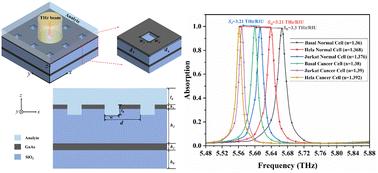
We propose a tri-band metamaterial sensor operating in the terahertz range, structured with a semiconductor–dielectric–semiconductor configuration. Tri-band resonance is produced by this structure at 4.216 THz, 5.210 THz, and 5.770 THz. The physical mechanism underlying these absorption peaks is elucidated through impedance matching theory. The dependence of geometric parameters on the resonant frequency is analyzed based on an LC model. Furthermore, to obtain the best sensitivity, an analysis is conducted on the influence of the analyte thickness change on the sensor performance. Additionally, we analyze the sensing performance parameters within the analyte refractive index range of 1.33 to 1.4. Our findings highlight that, for the third resonant frequency, the sensor achieves maximum sensitivity, Q factor, and figure of merit of 3.3512 THz RIU−1, 432.5, and 261.81 RIU−1, respectively. Notably, given that most biosensing applications are in the refractive index range of 1.33 to 1.4, our sensor offers promising potential for biomedical diagnostics due to its high sensitivity.
期刊介绍:
The Journal of Materials Chemistry is divided into three distinct sections, A, B, and C, each catering to specific applications of the materials under study:
Journal of Materials Chemistry A focuses primarily on materials intended for applications in energy and sustainability.
Journal of Materials Chemistry B specializes in materials designed for applications in biology and medicine.
Journal of Materials Chemistry C is dedicated to materials suitable for applications in optical, magnetic, and electronic devices.
Example topic areas within the scope of Journal of Materials Chemistry C are listed below. This list is neither exhaustive nor exclusive.
Bioelectronics
Conductors
Detectors
Dielectrics
Displays
Ferroelectrics
Lasers
LEDs
Lighting
Liquid crystals
Memory
Metamaterials
Multiferroics
Photonics
Photovoltaics
Semiconductors
Sensors
Single molecule conductors
Spintronics
Superconductors
Thermoelectrics
Topological insulators
Transistors




 京公网安备 11010802042870号
京ICP备2023020795号-1
京公网安备 11010802042870号
京ICP备2023020795号-1

 分享
分享
 求助内容:
求助内容: 应助结果提醒方式:
 扫码关注我们
