Artem Nedoluzhko, Ekaterina Vergasova, Fedor Sharko, Natalia Agapitova, Dmitry Kharitonov, Xenia Sukhanova, Olga Pushkina, Svetlana Pankova, Natalia Slobodova, Eugenia Boulygina, Nikolay Plotnikov, Anna Kim, Evgeniia Uchaneva, Nadezhda Pogodina, Anna Ilinskaya, Alexander Rakitko, Konstantin Chugunov, Valery Ilinsky
{"title":"图瓦“帝王之谷”秦泰一世丧葬纪念建筑群中优秀游牧战士的古代DNA分析。","authors":"Artem Nedoluzhko, Ekaterina Vergasova, Fedor Sharko, Natalia Agapitova, Dmitry Kharitonov, Xenia Sukhanova, Olga Pushkina, Svetlana Pankova, Natalia Slobodova, Eugenia Boulygina, Nikolay Plotnikov, Anna Kim, Evgeniia Uchaneva, Nadezhda Pogodina, Anna Ilinskaya, Alexander Rakitko, Konstantin Chugunov, Valery Ilinsky","doi":"10.1186/s12864-025-11361-y","DOIUrl":null,"url":null,"abstract":"<p><strong>Background: </strong>In the I<sup>st</sup> millennium BC bearers of the Scythian-type nomadic cultures inhabited the steppes of Eurasia, from Northern China to the Carpathians. According to archaeological data, the origin of nomadic life style and economy can be traced to the eastern part of this steppe \"corridor\", primarily to the territory of the present-day Republic of Tuva in Russia. Here, in the Turan-Uyuk Basin, also known as the \"Valley of the Kings\", some of the earliest known Scythian-type archaeological sites called Arzhan-1, Arzhan-2, Chinge-Tey I, Tunnug 1 were studied. Each of them is a large-scale funerary commemorative complex with burials of tribal nomadic leaders, surrounded by graves of supposed members of their families or associates. All these people belonged to the societies which are associated with the earliest nomadic cultures in Asia. Representatives of similar cultures will later be known and described as the Scythians/the Saka in Assyrian, Achaemenid, and Greek sources. Arzhan 2 and Chinge-Tey I elite level sites as well as ordinary pastoralist burials of the early-Scythian period in Tuva are attributed to the Aldy-Bel archaeological culture of the Early Iron Age (8th- 6th century BC). Taking the first step to shed light on the genetic origin of Aldy-Bel elites, we carried out a comparative genome-wide analysis of an elite level person buried in grave 9 at Chinge-Tey I (7th- 6th centuries BC) and two published earlier genomes of individuals, whose burials (graves 14 and 22) accompanied the 'royal couple' (grave 5) at Arzhan-2. This study aims also at checking a hypothesis of genetic kinship between human individuals buried in the large-scale burial complexes of the \"Valley of the Kings\" and brings up the issue of possible dynastic connections of local elites, buried under different kurgans of the valley.</p><p><strong>Results: </strong>First, ancient DNA analysis of an elite nomadic warrior from Chinge-Tey I has been carried out, thus a third wide-genome dataset for Aldy-Bel culture- one of the earliest nomadic cultures in Asia, is presented in this study. Second, we undertook a comparative analysis of genome-wide data of three mentioned Aldy-Bel culture representatives and individuals of the other Bronze and Early Iron Age population groups of Asia to estimate their possible genetic connections. Then, kinship analysis was undertaken for these three Aldy-Bel culture individuals. Finally, mitochondrial and Y-chromosome haplogroups of Chinge-Tey princely person were compared to those of other Aldy-Bel culture representatives and to individuals of subsequent Scythian-type Uyuk-Sagly culture in Tuva.</p><p><strong>Conclusion: </strong>(1) Generating the third wide-genome of the enabled us to undertake its comparison with two other genomes of Aldy-Bel culture representatives (Arzhan-2, graves 14 and 22) and with other Bronze and Early Iron Age population groups in Asia to trace the origin and genetic connection of Aldy-Bel population, representing one of the earliest Scythian-type nomadic group. (2) The results obtained show that the princely individual from Chinge-Tey I and two 'king's associates' from Arzhan-2 were genetically close to nomads of simultaneous Tasmola culture in Eastern and Central Kazakhstan and pastoralists buried in the Early Iron Age cemeteries of present-day Xinjiang (first of all, Abusanteer archaeological site). Aldy-Bel culture representatives appeared also close to individuals of the Middle Bronze Age Okunevo culture in the Minusinsk Basin. Besides, Aldy-Bel pastoralists turned out genetically close to nomads of the subsequent Uyuk-Sagly culture in Mongolia (5th - 3rd centuries BC). (3) Ancient DNA kinship analyses, undertaken for three Aldy-Bel culture individuals pointed out to the absence of their tribe kinship. (4) On the other hand, Chinge-Tey warrior's mitochondrial haplogroup G was previously described in two (graves 14 and 5) individuals from Arzhan-2, including a female individual from the \"royal\" tomb 5. This result provided a possibility of maternal kinship among this so called 'queen' from Arzhan-2 and the princely person from Chinge-Tey I. This possibility supported a hypothesis of their family ties suggested on archaeological materials. Y-chromosome haplogroup Q1b1, revealed for the princely person, was widely distributed among local people of Aldy-Bel and subsequent Uyuk-Sagly cultures.</p>","PeriodicalId":9030,"journal":{"name":"BMC Genomics","volume":"26 1","pages":"220"},"PeriodicalIF":3.9000,"publicationDate":"2025-03-05","publicationTypes":"Journal Article","fieldsOfStudy":null,"isOpenAccess":false,"openAccessPdf":"https://www.ncbi.nlm.nih.gov/pmc/articles/PMC11884045/pdf/","citationCount":"0","resultStr":"{\"title\":\"Ancient DNA analysis of elite nomadic warrior from Chinge-Tey I funerary commemorative complex in the \\\"Valley of the Kings\\\", Tuva.\",\"authors\":\"Artem Nedoluzhko, Ekaterina Vergasova, Fedor Sharko, Natalia Agapitova, Dmitry Kharitonov, Xenia Sukhanova, Olga Pushkina, Svetlana Pankova, Natalia Slobodova, Eugenia Boulygina, Nikolay Plotnikov, Anna Kim, Evgeniia Uchaneva, Nadezhda Pogodina, Anna Ilinskaya, Alexander Rakitko, Konstantin Chugunov, Valery Ilinsky\",\"doi\":\"10.1186/s12864-025-11361-y\",\"DOIUrl\":null,\"url\":null,\"abstract\":\"<p><strong>Background: </strong>In the I<sup>st</sup> millennium BC bearers of the Scythian-type nomadic cultures inhabited the steppes of Eurasia, from Northern China to the Carpathians. According to archaeological data, the origin of nomadic life style and economy can be traced to the eastern part of this steppe \\\"corridor\\\", primarily to the territory of the present-day Republic of Tuva in Russia. Here, in the Turan-Uyuk Basin, also known as the \\\"Valley of the Kings\\\", some of the earliest known Scythian-type archaeological sites called Arzhan-1, Arzhan-2, Chinge-Tey I, Tunnug 1 were studied. Each of them is a large-scale funerary commemorative complex with burials of tribal nomadic leaders, surrounded by graves of supposed members of their families or associates. All these people belonged to the societies which are associated with the earliest nomadic cultures in Asia. Representatives of similar cultures will later be known and described as the Scythians/the Saka in Assyrian, Achaemenid, and Greek sources. Arzhan 2 and Chinge-Tey I elite level sites as well as ordinary pastoralist burials of the early-Scythian period in Tuva are attributed to the Aldy-Bel archaeological culture of the Early Iron Age (8th- 6th century BC). Taking the first step to shed light on the genetic origin of Aldy-Bel elites, we carried out a comparative genome-wide analysis of an elite level person buried in grave 9 at Chinge-Tey I (7th- 6th centuries BC) and two published earlier genomes of individuals, whose burials (graves 14 and 22) accompanied the 'royal couple' (grave 5) at Arzhan-2. This study aims also at checking a hypothesis of genetic kinship between human individuals buried in the large-scale burial complexes of the \\\"Valley of the Kings\\\" and brings up the issue of possible dynastic connections of local elites, buried under different kurgans of the valley.</p><p><strong>Results: </strong>First, ancient DNA analysis of an elite nomadic warrior from Chinge-Tey I has been carried out, thus a third wide-genome dataset for Aldy-Bel culture- one of the earliest nomadic cultures in Asia, is presented in this study. Second, we undertook a comparative analysis of genome-wide data of three mentioned Aldy-Bel culture representatives and individuals of the other Bronze and Early Iron Age population groups of Asia to estimate their possible genetic connections. Then, kinship analysis was undertaken for these three Aldy-Bel culture individuals. Finally, mitochondrial and Y-chromosome haplogroups of Chinge-Tey princely person were compared to those of other Aldy-Bel culture representatives and to individuals of subsequent Scythian-type Uyuk-Sagly culture in Tuva.</p><p><strong>Conclusion: </strong>(1) Generating the third wide-genome of the enabled us to undertake its comparison with two other genomes of Aldy-Bel culture representatives (Arzhan-2, graves 14 and 22) and with other Bronze and Early Iron Age population groups in Asia to trace the origin and genetic connection of Aldy-Bel population, representing one of the earliest Scythian-type nomadic group. (2) The results obtained show that the princely individual from Chinge-Tey I and two 'king's associates' from Arzhan-2 were genetically close to nomads of simultaneous Tasmola culture in Eastern and Central Kazakhstan and pastoralists buried in the Early Iron Age cemeteries of present-day Xinjiang (first of all, Abusanteer archaeological site). Aldy-Bel culture representatives appeared also close to individuals of the Middle Bronze Age Okunevo culture in the Minusinsk Basin. Besides, Aldy-Bel pastoralists turned out genetically close to nomads of the subsequent Uyuk-Sagly culture in Mongolia (5th - 3rd centuries BC). (3) Ancient DNA kinship analyses, undertaken for three Aldy-Bel culture individuals pointed out to the absence of their tribe kinship. (4) On the other hand, Chinge-Tey warrior's mitochondrial haplogroup G was previously described in two (graves 14 and 5) individuals from Arzhan-2, including a female individual from the \\\"royal\\\" tomb 5. This result provided a possibility of maternal kinship among this so called 'queen' from Arzhan-2 and the princely person from Chinge-Tey I. This possibility supported a hypothesis of their family ties suggested on archaeological materials. Y-chromosome haplogroup Q1b1, revealed for the princely person, was widely distributed among local people of Aldy-Bel and subsequent Uyuk-Sagly cultures.</p>\",\"PeriodicalId\":9030,\"journal\":{\"name\":\"BMC Genomics\",\"volume\":\"26 1\",\"pages\":\"220\"},\"PeriodicalIF\":3.9000,\"publicationDate\":\"2025-03-05\",\"publicationTypes\":\"Journal Article\",\"fieldsOfStudy\":null,\"isOpenAccess\":false,\"openAccessPdf\":\"https://www.ncbi.nlm.nih.gov/pmc/articles/PMC11884045/pdf/\",\"citationCount\":\"0\",\"resultStr\":null,\"platform\":\"Semanticscholar\",\"paperid\":null,\"PeriodicalName\":\"BMC Genomics\",\"FirstCategoryId\":\"99\",\"ListUrlMain\":\"https://doi.org/10.1186/s12864-025-11361-y\",\"RegionNum\":2,\"RegionCategory\":\"生物学\",\"ArticlePicture\":[],\"TitleCN\":null,\"AbstractTextCN\":null,\"PMCID\":null,\"EPubDate\":\"\",\"PubModel\":\"\",\"JCR\":\"Q2\",\"JCRName\":\"BIOTECHNOLOGY & APPLIED MICROBIOLOGY\",\"Score\":null,\"Total\":0}","platform":"Semanticscholar","paperid":null,"PeriodicalName":"BMC Genomics","FirstCategoryId":"99","ListUrlMain":"https://doi.org/10.1186/s12864-025-11361-y","RegionNum":2,"RegionCategory":"生物学","ArticlePicture":[],"TitleCN":null,"AbstractTextCN":null,"PMCID":null,"EPubDate":"","PubModel":"","JCR":"Q2","JCRName":"BIOTECHNOLOGY & APPLIED MICROBIOLOGY","Score":null,"Total":0}
Ancient DNA analysis of elite nomadic warrior from Chinge-Tey I funerary commemorative complex in the "Valley of the Kings", Tuva.
Background: In the Ist millennium BC bearers of the Scythian-type nomadic cultures inhabited the steppes of Eurasia, from Northern China to the Carpathians. According to archaeological data, the origin of nomadic life style and economy can be traced to the eastern part of this steppe "corridor", primarily to the territory of the present-day Republic of Tuva in Russia. Here, in the Turan-Uyuk Basin, also known as the "Valley of the Kings", some of the earliest known Scythian-type archaeological sites called Arzhan-1, Arzhan-2, Chinge-Tey I, Tunnug 1 were studied. Each of them is a large-scale funerary commemorative complex with burials of tribal nomadic leaders, surrounded by graves of supposed members of their families or associates. All these people belonged to the societies which are associated with the earliest nomadic cultures in Asia. Representatives of similar cultures will later be known and described as the Scythians/the Saka in Assyrian, Achaemenid, and Greek sources. Arzhan 2 and Chinge-Tey I elite level sites as well as ordinary pastoralist burials of the early-Scythian period in Tuva are attributed to the Aldy-Bel archaeological culture of the Early Iron Age (8th- 6th century BC). Taking the first step to shed light on the genetic origin of Aldy-Bel elites, we carried out a comparative genome-wide analysis of an elite level person buried in grave 9 at Chinge-Tey I (7th- 6th centuries BC) and two published earlier genomes of individuals, whose burials (graves 14 and 22) accompanied the 'royal couple' (grave 5) at Arzhan-2. This study aims also at checking a hypothesis of genetic kinship between human individuals buried in the large-scale burial complexes of the "Valley of the Kings" and brings up the issue of possible dynastic connections of local elites, buried under different kurgans of the valley.
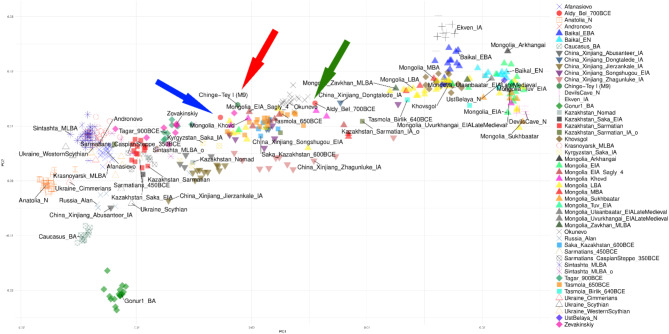
Results: First, ancient DNA analysis of an elite nomadic warrior from Chinge-Tey I has been carried out, thus a third wide-genome dataset for Aldy-Bel culture- one of the earliest nomadic cultures in Asia, is presented in this study. Second, we undertook a comparative analysis of genome-wide data of three mentioned Aldy-Bel culture representatives and individuals of the other Bronze and Early Iron Age population groups of Asia to estimate their possible genetic connections. Then, kinship analysis was undertaken for these three Aldy-Bel culture individuals. Finally, mitochondrial and Y-chromosome haplogroups of Chinge-Tey princely person were compared to those of other Aldy-Bel culture representatives and to individuals of subsequent Scythian-type Uyuk-Sagly culture in Tuva.
Conclusion: (1) Generating the third wide-genome of the enabled us to undertake its comparison with two other genomes of Aldy-Bel culture representatives (Arzhan-2, graves 14 and 22) and with other Bronze and Early Iron Age population groups in Asia to trace the origin and genetic connection of Aldy-Bel population, representing one of the earliest Scythian-type nomadic group. (2) The results obtained show that the princely individual from Chinge-Tey I and two 'king's associates' from Arzhan-2 were genetically close to nomads of simultaneous Tasmola culture in Eastern and Central Kazakhstan and pastoralists buried in the Early Iron Age cemeteries of present-day Xinjiang (first of all, Abusanteer archaeological site). Aldy-Bel culture representatives appeared also close to individuals of the Middle Bronze Age Okunevo culture in the Minusinsk Basin. Besides, Aldy-Bel pastoralists turned out genetically close to nomads of the subsequent Uyuk-Sagly culture in Mongolia (5th - 3rd centuries BC). (3) Ancient DNA kinship analyses, undertaken for three Aldy-Bel culture individuals pointed out to the absence of their tribe kinship. (4) On the other hand, Chinge-Tey warrior's mitochondrial haplogroup G was previously described in two (graves 14 and 5) individuals from Arzhan-2, including a female individual from the "royal" tomb 5. This result provided a possibility of maternal kinship among this so called 'queen' from Arzhan-2 and the princely person from Chinge-Tey I. This possibility supported a hypothesis of their family ties suggested on archaeological materials. Y-chromosome haplogroup Q1b1, revealed for the princely person, was widely distributed among local people of Aldy-Bel and subsequent Uyuk-Sagly cultures.
期刊介绍:
BMC Genomics is an open access, peer-reviewed journal that considers articles on all aspects of genome-scale analysis, functional genomics, and proteomics.
BMC Genomics is part of the BMC series which publishes subject-specific journals focused on the needs of individual research communities across all areas of biology and medicine. We offer an efficient, fair and friendly peer review service, and are committed to publishing all sound science, provided that there is some advance in knowledge presented by the work.






 京公网安备 11010802042870号
京ICP备2023020795号-1
京公网安备 11010802042870号
京ICP备2023020795号-1

 分享
分享
 求助内容:
求助内容: 应助结果提醒方式:
 扫码关注我们
