Ilona Malikova, Anastassiya Worth, Diana Aliyeva, Madina Khassenova, Marina V Kriajevska, Eugene Tulchinsky
{"title":"自身免疫性疾病和癌症中TAM受体的蛋白水解:它告诉我们什么?","authors":"Ilona Malikova, Anastassiya Worth, Diana Aliyeva, Madina Khassenova, Marina V Kriajevska, Eugene Tulchinsky","doi":"10.1038/s41419-025-07480-9","DOIUrl":null,"url":null,"abstract":"<p><p>Proteolytic processing of Receptor Tyrosine Kinases (RTKs) leads to the release of ectodomains in the extracellular space. These soluble ectodomains often retain the ligand binding activity and dampen canonical pathways by acting as decoy receptors. On the other hand, shedding the ectodomains may initiate new molecular events and diversification of signalling. Members of the TAM (TYRO3, AXL, MER) family of RTKs undergo proteolytic cleavage, and their soluble forms are present in the extracellular space and biological fluids. TAM receptors are expressed in professional phagocytes, mediating apoptotic cell clearance, and suppressing innate immunity. Enhanced shedding of TAM ectodomains is documented in autoimmune and some inflammatory conditions. Also, soluble TAM receptors are present at high levels in the biological fluids of cancer patients and are associated with poor survival. We outline the biology of TAM receptors and discuss how their proteolytic processing impacts autoimmunity and tumorigenesis. In autoimmune diseases, proteolysis of TAM receptors likely reflects reduced canonical signalling in professional phagocytes. In cancer, TAM receptors are expressed in the immune cells of the tumour microenvironment, where they control pathways facilitating immune evasion. In tumour cells, ectodomain shedding activates non-canonical TAM pathways, leading to epithelial-mesenchymal transition, metastasis, and drug resistance.</p>","PeriodicalId":9734,"journal":{"name":"Cell Death & Disease","volume":"16 1","pages":"155"},"PeriodicalIF":9.6000,"publicationDate":"2025-03-05","publicationTypes":"Journal Article","fieldsOfStudy":null,"isOpenAccess":false,"openAccessPdf":"https://www.ncbi.nlm.nih.gov/pmc/articles/PMC11883011/pdf/","citationCount":"0","resultStr":"{\"title\":\"Proteolysis of TAM receptors in autoimmune diseases and cancer: what does it say to us?\",\"authors\":\"Ilona Malikova, Anastassiya Worth, Diana Aliyeva, Madina Khassenova, Marina V Kriajevska, Eugene Tulchinsky\",\"doi\":\"10.1038/s41419-025-07480-9\",\"DOIUrl\":null,\"url\":null,\"abstract\":\"<p><p>Proteolytic processing of Receptor Tyrosine Kinases (RTKs) leads to the release of ectodomains in the extracellular space. These soluble ectodomains often retain the ligand binding activity and dampen canonical pathways by acting as decoy receptors. On the other hand, shedding the ectodomains may initiate new molecular events and diversification of signalling. Members of the TAM (TYRO3, AXL, MER) family of RTKs undergo proteolytic cleavage, and their soluble forms are present in the extracellular space and biological fluids. TAM receptors are expressed in professional phagocytes, mediating apoptotic cell clearance, and suppressing innate immunity. Enhanced shedding of TAM ectodomains is documented in autoimmune and some inflammatory conditions. Also, soluble TAM receptors are present at high levels in the biological fluids of cancer patients and are associated with poor survival. We outline the biology of TAM receptors and discuss how their proteolytic processing impacts autoimmunity and tumorigenesis. In autoimmune diseases, proteolysis of TAM receptors likely reflects reduced canonical signalling in professional phagocytes. In cancer, TAM receptors are expressed in the immune cells of the tumour microenvironment, where they control pathways facilitating immune evasion. In tumour cells, ectodomain shedding activates non-canonical TAM pathways, leading to epithelial-mesenchymal transition, metastasis, and drug resistance.</p>\",\"PeriodicalId\":9734,\"journal\":{\"name\":\"Cell Death & Disease\",\"volume\":\"16 1\",\"pages\":\"155\"},\"PeriodicalIF\":9.6000,\"publicationDate\":\"2025-03-05\",\"publicationTypes\":\"Journal Article\",\"fieldsOfStudy\":null,\"isOpenAccess\":false,\"openAccessPdf\":\"https://www.ncbi.nlm.nih.gov/pmc/articles/PMC11883011/pdf/\",\"citationCount\":\"0\",\"resultStr\":null,\"platform\":\"Semanticscholar\",\"paperid\":null,\"PeriodicalName\":\"Cell Death & Disease\",\"FirstCategoryId\":\"99\",\"ListUrlMain\":\"https://doi.org/10.1038/s41419-025-07480-9\",\"RegionNum\":1,\"RegionCategory\":\"生物学\",\"ArticlePicture\":[],\"TitleCN\":null,\"AbstractTextCN\":null,\"PMCID\":null,\"EPubDate\":\"\",\"PubModel\":\"\",\"JCR\":\"Q1\",\"JCRName\":\"CELL BIOLOGY\",\"Score\":null,\"Total\":0}","platform":"Semanticscholar","paperid":null,"PeriodicalName":"Cell Death & Disease","FirstCategoryId":"99","ListUrlMain":"https://doi.org/10.1038/s41419-025-07480-9","RegionNum":1,"RegionCategory":"生物学","ArticlePicture":[],"TitleCN":null,"AbstractTextCN":null,"PMCID":null,"EPubDate":"","PubModel":"","JCR":"Q1","JCRName":"CELL BIOLOGY","Score":null,"Total":0}
Proteolysis of TAM receptors in autoimmune diseases and cancer: what does it say to us?
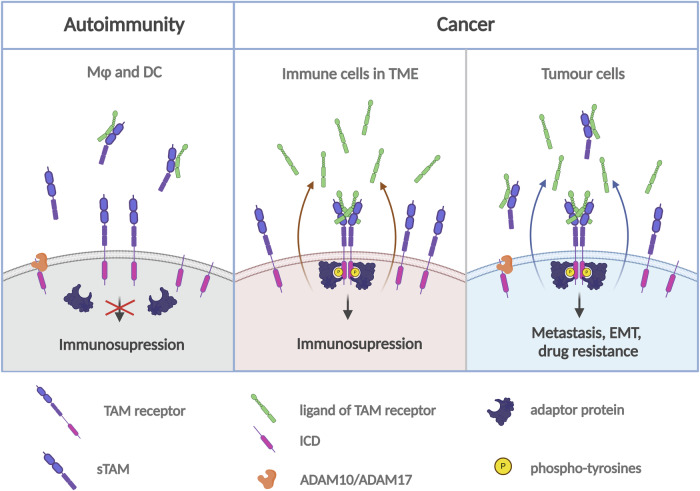
Proteolytic processing of Receptor Tyrosine Kinases (RTKs) leads to the release of ectodomains in the extracellular space. These soluble ectodomains often retain the ligand binding activity and dampen canonical pathways by acting as decoy receptors. On the other hand, shedding the ectodomains may initiate new molecular events and diversification of signalling. Members of the TAM (TYRO3, AXL, MER) family of RTKs undergo proteolytic cleavage, and their soluble forms are present in the extracellular space and biological fluids. TAM receptors are expressed in professional phagocytes, mediating apoptotic cell clearance, and suppressing innate immunity. Enhanced shedding of TAM ectodomains is documented in autoimmune and some inflammatory conditions. Also, soluble TAM receptors are present at high levels in the biological fluids of cancer patients and are associated with poor survival. We outline the biology of TAM receptors and discuss how their proteolytic processing impacts autoimmunity and tumorigenesis. In autoimmune diseases, proteolysis of TAM receptors likely reflects reduced canonical signalling in professional phagocytes. In cancer, TAM receptors are expressed in the immune cells of the tumour microenvironment, where they control pathways facilitating immune evasion. In tumour cells, ectodomain shedding activates non-canonical TAM pathways, leading to epithelial-mesenchymal transition, metastasis, and drug resistance.
期刊介绍:
Brought to readers by the editorial team of Cell Death & Differentiation, Cell Death & Disease is an online peer-reviewed journal specializing in translational cell death research. It covers a wide range of topics in experimental and internal medicine, including cancer, immunity, neuroscience, and now cancer metabolism.
Cell Death & Disease seeks to encompass the breadth of translational implications of cell death, and topics of particular concentration will include, but are not limited to, the following:
Experimental medicine
Cancer
Immunity
Internal medicine
Neuroscience
Cancer metabolism






 京公网安备 11010802042870号
京ICP备2023020795号-1
京公网安备 11010802042870号
京ICP备2023020795号-1

 分享
分享
 求助内容:
求助内容: 应助结果提醒方式:
 扫码关注我们
