Björn Sake, Kira Butenholz, Katrin Kempf, Nicole Kemper, Jochen Schulz
{"title":"混合谷仓:从自然通风到机械通风的火鸡谷仓的转换,以防止有害的生物气溶胶。","authors":"Björn Sake, Kira Butenholz, Katrin Kempf, Nicole Kemper, Jochen Schulz","doi":"10.3389/fvets.2025.1443139","DOIUrl":null,"url":null,"abstract":"<p><strong>Introduction: </strong>Animal health is essential to ensure the highest level of animal welfare and to conserve resources. Especially in naturally ventilated barns, the airborne entry of pathogens is difficult to avoid. For instance, birds in naturally ventilated turkey barns are frequently infected by highly pathogenic avian influenza and the airborne route may play a role. In this study, a naturally ventilated turkey barn was equipped with filter modules that allow a conversion to a mechanically ventilated barn.</p><p><strong>Methods: </strong>Four filter modules with two filter stages were adapted to a turkey barn and the curtains were closed to induce a slight overpressure in the barn. Air samples were taken over the course of 16 months in front of and behind the filter units to assess the filter efficiencies. Filter efficiencies were evaluated by the reduction of particle classes (PM1, PM10, nanoparticles), microorganisms (total bacteria, molds, yeasts), and the detection of potentially pathogenic bacteria and viruses by PCR tests.</p><p><strong>Results: </strong>Particle reduction rates were 94.17% for PM1, 94.27% for PM10, and 95.80% for nanoparticles, respectively. Total bacteria counts were reduced by 95.88%, molds by 94.64%, and yeasts by 66.03%. <i>Ornithobacterium rhinotracheale</i> was significantly retained in the filter units. The results for influenza A also indicated that the entry of potentially infectious particles could be prevented.</p><p><strong>Discussion: </strong>The flexible switch from a naturally to a mechanically ventilated barn with filtered supply air can be an innovative solution to avoid airborne pathogen entry in risky situations and may represent a component in the strategy to control epidemic diseases.</p>","PeriodicalId":12772,"journal":{"name":"Frontiers in Veterinary Science","volume":"12 ","pages":"1443139"},"PeriodicalIF":3.1000,"publicationDate":"2025-02-19","publicationTypes":"Journal Article","fieldsOfStudy":null,"isOpenAccess":false,"openAccessPdf":"https://www.ncbi.nlm.nih.gov/pmc/articles/PMC11881083/pdf/","citationCount":"0","resultStr":"{\"title\":\"Hybrid barn: the switch from a naturally to a mechanically ventilated turkey barn to protect from harmful bioaerosols.\",\"authors\":\"Björn Sake, Kira Butenholz, Katrin Kempf, Nicole Kemper, Jochen Schulz\",\"doi\":\"10.3389/fvets.2025.1443139\",\"DOIUrl\":null,\"url\":null,\"abstract\":\"<p><strong>Introduction: </strong>Animal health is essential to ensure the highest level of animal welfare and to conserve resources. Especially in naturally ventilated barns, the airborne entry of pathogens is difficult to avoid. For instance, birds in naturally ventilated turkey barns are frequently infected by highly pathogenic avian influenza and the airborne route may play a role. In this study, a naturally ventilated turkey barn was equipped with filter modules that allow a conversion to a mechanically ventilated barn.</p><p><strong>Methods: </strong>Four filter modules with two filter stages were adapted to a turkey barn and the curtains were closed to induce a slight overpressure in the barn. Air samples were taken over the course of 16 months in front of and behind the filter units to assess the filter efficiencies. Filter efficiencies were evaluated by the reduction of particle classes (PM1, PM10, nanoparticles), microorganisms (total bacteria, molds, yeasts), and the detection of potentially pathogenic bacteria and viruses by PCR tests.</p><p><strong>Results: </strong>Particle reduction rates were 94.17% for PM1, 94.27% for PM10, and 95.80% for nanoparticles, respectively. Total bacteria counts were reduced by 95.88%, molds by 94.64%, and yeasts by 66.03%. <i>Ornithobacterium rhinotracheale</i> was significantly retained in the filter units. The results for influenza A also indicated that the entry of potentially infectious particles could be prevented.</p><p><strong>Discussion: </strong>The flexible switch from a naturally to a mechanically ventilated barn with filtered supply air can be an innovative solution to avoid airborne pathogen entry in risky situations and may represent a component in the strategy to control epidemic diseases.</p>\",\"PeriodicalId\":12772,\"journal\":{\"name\":\"Frontiers in Veterinary Science\",\"volume\":\"12 \",\"pages\":\"1443139\"},\"PeriodicalIF\":3.1000,\"publicationDate\":\"2025-02-19\",\"publicationTypes\":\"Journal Article\",\"fieldsOfStudy\":null,\"isOpenAccess\":false,\"openAccessPdf\":\"https://www.ncbi.nlm.nih.gov/pmc/articles/PMC11881083/pdf/\",\"citationCount\":\"0\",\"resultStr\":null,\"platform\":\"Semanticscholar\",\"paperid\":null,\"PeriodicalName\":\"Frontiers in Veterinary Science\",\"FirstCategoryId\":\"97\",\"ListUrlMain\":\"https://doi.org/10.3389/fvets.2025.1443139\",\"RegionNum\":2,\"RegionCategory\":\"农林科学\",\"ArticlePicture\":[],\"TitleCN\":null,\"AbstractTextCN\":null,\"PMCID\":null,\"EPubDate\":\"2025/1/1 0:00:00\",\"PubModel\":\"eCollection\",\"JCR\":\"Q1\",\"JCRName\":\"VETERINARY SCIENCES\",\"Score\":null,\"Total\":0}","platform":"Semanticscholar","paperid":null,"PeriodicalName":"Frontiers in Veterinary Science","FirstCategoryId":"97","ListUrlMain":"https://doi.org/10.3389/fvets.2025.1443139","RegionNum":2,"RegionCategory":"农林科学","ArticlePicture":[],"TitleCN":null,"AbstractTextCN":null,"PMCID":null,"EPubDate":"2025/1/1 0:00:00","PubModel":"eCollection","JCR":"Q1","JCRName":"VETERINARY SCIENCES","Score":null,"Total":0}
Hybrid barn: the switch from a naturally to a mechanically ventilated turkey barn to protect from harmful bioaerosols.
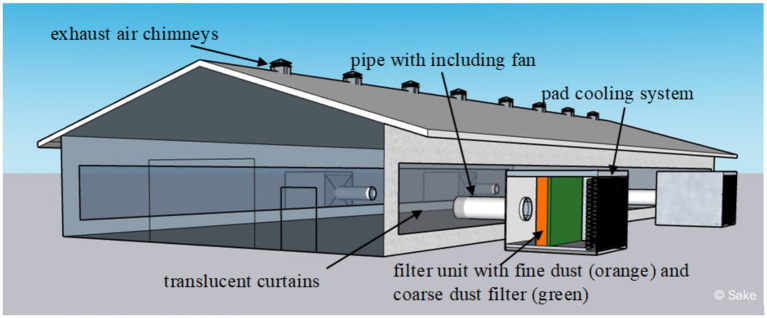
Introduction: Animal health is essential to ensure the highest level of animal welfare and to conserve resources. Especially in naturally ventilated barns, the airborne entry of pathogens is difficult to avoid. For instance, birds in naturally ventilated turkey barns are frequently infected by highly pathogenic avian influenza and the airborne route may play a role. In this study, a naturally ventilated turkey barn was equipped with filter modules that allow a conversion to a mechanically ventilated barn.
Methods: Four filter modules with two filter stages were adapted to a turkey barn and the curtains were closed to induce a slight overpressure in the barn. Air samples were taken over the course of 16 months in front of and behind the filter units to assess the filter efficiencies. Filter efficiencies were evaluated by the reduction of particle classes (PM1, PM10, nanoparticles), microorganisms (total bacteria, molds, yeasts), and the detection of potentially pathogenic bacteria and viruses by PCR tests.
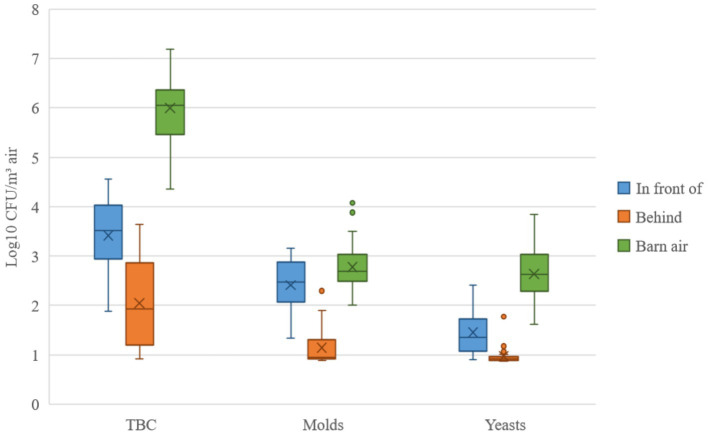
Results: Particle reduction rates were 94.17% for PM1, 94.27% for PM10, and 95.80% for nanoparticles, respectively. Total bacteria counts were reduced by 95.88%, molds by 94.64%, and yeasts by 66.03%. Ornithobacterium rhinotracheale was significantly retained in the filter units. The results for influenza A also indicated that the entry of potentially infectious particles could be prevented.
Discussion: The flexible switch from a naturally to a mechanically ventilated barn with filtered supply air can be an innovative solution to avoid airborne pathogen entry in risky situations and may represent a component in the strategy to control epidemic diseases.
期刊介绍:
Frontiers in Veterinary Science is a global, peer-reviewed, Open Access journal that bridges animal and human health, brings a comparative approach to medical and surgical challenges, and advances innovative biotechnology and therapy.
Veterinary research today is interdisciplinary, collaborative, and socially relevant, transforming how we understand and investigate animal health and disease. Fundamental research in emerging infectious diseases, predictive genomics, stem cell therapy, and translational modelling is grounded within the integrative social context of public and environmental health, wildlife conservation, novel biomarkers, societal well-being, and cutting-edge clinical practice and specialization. Frontiers in Veterinary Science brings a 21st-century approach—networked, collaborative, and Open Access—to communicate this progress and innovation to both the specialist and to the wider audience of readers in the field.
Frontiers in Veterinary Science publishes articles on outstanding discoveries across a wide spectrum of translational, foundational, and clinical research. The journal''s mission is to bring all relevant veterinary sciences together on a single platform with the goal of improving animal and human health.





 京公网安备 11010802042870号
京ICP备2023020795号-1
京公网安备 11010802042870号
京ICP备2023020795号-1

 分享
分享
 求助内容:
求助内容: 应助结果提醒方式:
 扫码关注我们
