{"title":"可解释的机器学习模型预测非小细胞肺癌切除后复发风险强调术前最大标准化摄取值。","authors":"Takafumi Iguchi, Kensuke Kojima, Daiki Hayashi, Toshiteru Tokunaga, Kyoichi Okishio, Hyungeun Yoon","doi":"10.1200/CCI-24-00194","DOIUrl":null,"url":null,"abstract":"<p><strong>Purpose: </strong>To comprehensively analyze the association between preoperative maximum standardized uptake value (SUV<sub>max</sub>) on 18F-fluorodeoxyglucose positron emission tomography-computed tomography and postoperative recurrence in resected non-small cell lung cancer (NSCLC) using machine learning (ML) and statistical approaches.</p><p><strong>Patients and methods: </strong>This retrospective study included 643 patients who had undergone NSCLC resection. ML models (random forest, gradient boosting, extreme gradient boosting, and AdaBoost) and a random survival forest model were developed to predict postoperative recurrence. Model performance was evaluated using the receiver operating characteristic (ROC) AUC and concordance index (C-index). Shapley additive explanations (SHAP) and partial dependence plots (PDPs) were used to interpret model predictions and quantify feature importance. The relationship between SUV<sub>max</sub> and recurrence risk was evaluated by using a multivariable Cox proportional hazards model.</p><p><strong>Results: </strong>The random forest model showed the highest predictive performance (ROC AUC, 0.90; 95% CI, 0.86 to 0.97). The SHAP analysis identified SUV<sub>max</sub> as an important predictor. The PDP analysis showed a nonlinear relationship between SUV<sub>max</sub> and recurrence risk, with a sharp increase at SUV<sub>max</sub> 2-5. The random survival forest model achieved a C-index of 0.82. A permutation importance analysis identified SUV<sub>max</sub> as the most important feature. In the Cox model, increased SUV<sub>max</sub> was associated with a higher risk of recurrence (adjusted hazard ratio, 1.03 [95% CI, 1.00 to 1.06]).</p><p><strong>Conclusion: </strong>Preoperative SUV<sub>max</sub> showed significant predictive value for postoperative recurrence after NSCLC resection. The nonlinear relationship between SUV<sub>max</sub> and recurrence risk, with a sharp increase at relatively low SUV<sub>max</sub> values, suggests its potential as a sensitive biomarker for early identification of high-risk patients. This may contribute to more precise assessments of the risk of recurrence and personalized treatment strategies for NSCLC.</p>","PeriodicalId":51626,"journal":{"name":"JCO Clinical Cancer Informatics","volume":"9 ","pages":"e2400194"},"PeriodicalIF":2.8000,"publicationDate":"2025-03-01","publicationTypes":"Journal Article","fieldsOfStudy":null,"isOpenAccess":false,"openAccessPdf":"https://www.ncbi.nlm.nih.gov/pmc/articles/PMC11902606/pdf/","citationCount":"0","resultStr":"{\"title\":\"Preoperative Maximum Standardized Uptake Value Emphasized in Explainable Machine Learning Model for Predicting the Risk of Recurrence in Resected Non-Small Cell Lung Cancer.\",\"authors\":\"Takafumi Iguchi, Kensuke Kojima, Daiki Hayashi, Toshiteru Tokunaga, Kyoichi Okishio, Hyungeun Yoon\",\"doi\":\"10.1200/CCI-24-00194\",\"DOIUrl\":null,\"url\":null,\"abstract\":\"<p><strong>Purpose: </strong>To comprehensively analyze the association between preoperative maximum standardized uptake value (SUV<sub>max</sub>) on 18F-fluorodeoxyglucose positron emission tomography-computed tomography and postoperative recurrence in resected non-small cell lung cancer (NSCLC) using machine learning (ML) and statistical approaches.</p><p><strong>Patients and methods: </strong>This retrospective study included 643 patients who had undergone NSCLC resection. ML models (random forest, gradient boosting, extreme gradient boosting, and AdaBoost) and a random survival forest model were developed to predict postoperative recurrence. Model performance was evaluated using the receiver operating characteristic (ROC) AUC and concordance index (C-index). Shapley additive explanations (SHAP) and partial dependence plots (PDPs) were used to interpret model predictions and quantify feature importance. The relationship between SUV<sub>max</sub> and recurrence risk was evaluated by using a multivariable Cox proportional hazards model.</p><p><strong>Results: </strong>The random forest model showed the highest predictive performance (ROC AUC, 0.90; 95% CI, 0.86 to 0.97). The SHAP analysis identified SUV<sub>max</sub> as an important predictor. The PDP analysis showed a nonlinear relationship between SUV<sub>max</sub> and recurrence risk, with a sharp increase at SUV<sub>max</sub> 2-5. The random survival forest model achieved a C-index of 0.82. A permutation importance analysis identified SUV<sub>max</sub> as the most important feature. In the Cox model, increased SUV<sub>max</sub> was associated with a higher risk of recurrence (adjusted hazard ratio, 1.03 [95% CI, 1.00 to 1.06]).</p><p><strong>Conclusion: </strong>Preoperative SUV<sub>max</sub> showed significant predictive value for postoperative recurrence after NSCLC resection. The nonlinear relationship between SUV<sub>max</sub> and recurrence risk, with a sharp increase at relatively low SUV<sub>max</sub> values, suggests its potential as a sensitive biomarker for early identification of high-risk patients. This may contribute to more precise assessments of the risk of recurrence and personalized treatment strategies for NSCLC.</p>\",\"PeriodicalId\":51626,\"journal\":{\"name\":\"JCO Clinical Cancer Informatics\",\"volume\":\"9 \",\"pages\":\"e2400194\"},\"PeriodicalIF\":2.8000,\"publicationDate\":\"2025-03-01\",\"publicationTypes\":\"Journal Article\",\"fieldsOfStudy\":null,\"isOpenAccess\":false,\"openAccessPdf\":\"https://www.ncbi.nlm.nih.gov/pmc/articles/PMC11902606/pdf/\",\"citationCount\":\"0\",\"resultStr\":null,\"platform\":\"Semanticscholar\",\"paperid\":null,\"PeriodicalName\":\"JCO Clinical Cancer Informatics\",\"FirstCategoryId\":\"1085\",\"ListUrlMain\":\"https://doi.org/10.1200/CCI-24-00194\",\"RegionNum\":0,\"RegionCategory\":null,\"ArticlePicture\":[],\"TitleCN\":null,\"AbstractTextCN\":null,\"PMCID\":null,\"EPubDate\":\"2025/3/5 0:00:00\",\"PubModel\":\"Epub\",\"JCR\":\"Q2\",\"JCRName\":\"ONCOLOGY\",\"Score\":null,\"Total\":0}","platform":"Semanticscholar","paperid":null,"PeriodicalName":"JCO Clinical Cancer Informatics","FirstCategoryId":"1085","ListUrlMain":"https://doi.org/10.1200/CCI-24-00194","RegionNum":0,"RegionCategory":null,"ArticlePicture":[],"TitleCN":null,"AbstractTextCN":null,"PMCID":null,"EPubDate":"2025/3/5 0:00:00","PubModel":"Epub","JCR":"Q2","JCRName":"ONCOLOGY","Score":null,"Total":0}
Preoperative Maximum Standardized Uptake Value Emphasized in Explainable Machine Learning Model for Predicting the Risk of Recurrence in Resected Non-Small Cell Lung Cancer.
Purpose: To comprehensively analyze the association between preoperative maximum standardized uptake value (SUVmax) on 18F-fluorodeoxyglucose positron emission tomography-computed tomography and postoperative recurrence in resected non-small cell lung cancer (NSCLC) using machine learning (ML) and statistical approaches.
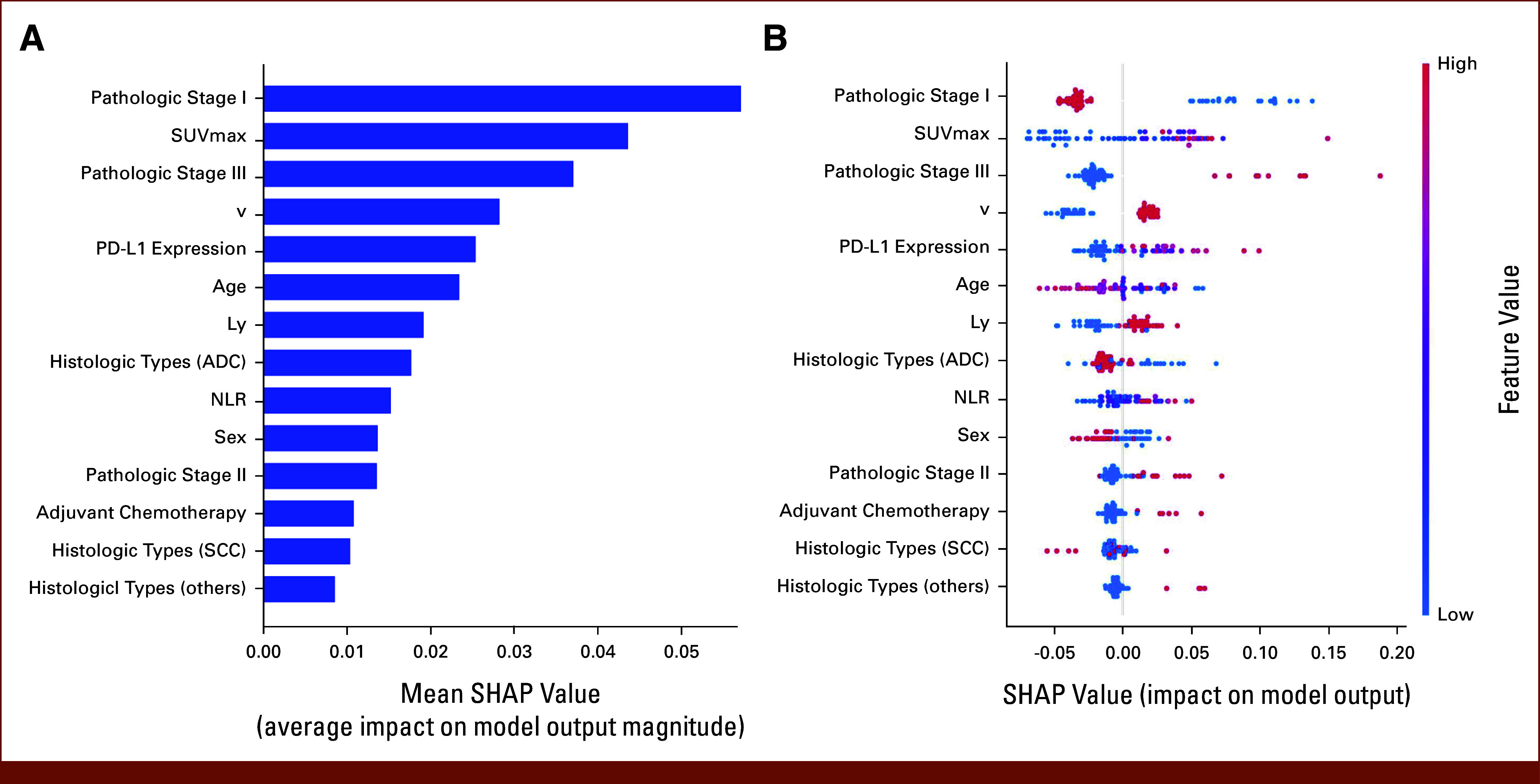
Patients and methods: This retrospective study included 643 patients who had undergone NSCLC resection. ML models (random forest, gradient boosting, extreme gradient boosting, and AdaBoost) and a random survival forest model were developed to predict postoperative recurrence. Model performance was evaluated using the receiver operating characteristic (ROC) AUC and concordance index (C-index). Shapley additive explanations (SHAP) and partial dependence plots (PDPs) were used to interpret model predictions and quantify feature importance. The relationship between SUVmax and recurrence risk was evaluated by using a multivariable Cox proportional hazards model.
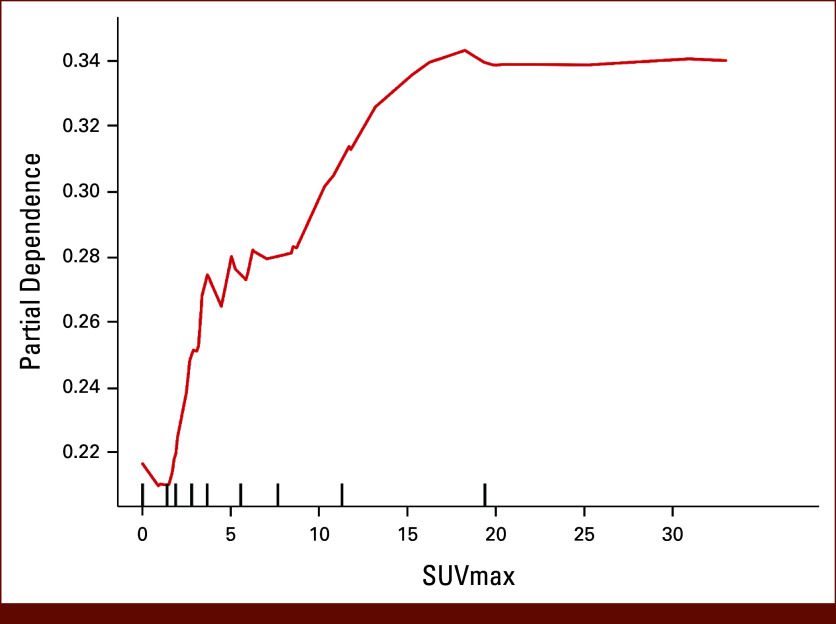
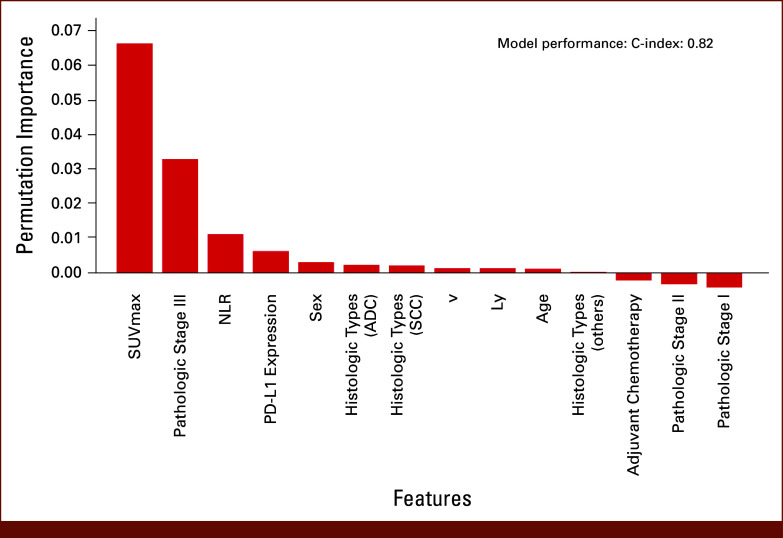
Results: The random forest model showed the highest predictive performance (ROC AUC, 0.90; 95% CI, 0.86 to 0.97). The SHAP analysis identified SUVmax as an important predictor. The PDP analysis showed a nonlinear relationship between SUVmax and recurrence risk, with a sharp increase at SUVmax 2-5. The random survival forest model achieved a C-index of 0.82. A permutation importance analysis identified SUVmax as the most important feature. In the Cox model, increased SUVmax was associated with a higher risk of recurrence (adjusted hazard ratio, 1.03 [95% CI, 1.00 to 1.06]).
Conclusion: Preoperative SUVmax showed significant predictive value for postoperative recurrence after NSCLC resection. The nonlinear relationship between SUVmax and recurrence risk, with a sharp increase at relatively low SUVmax values, suggests its potential as a sensitive biomarker for early identification of high-risk patients. This may contribute to more precise assessments of the risk of recurrence and personalized treatment strategies for NSCLC.





 京公网安备 11010802042870号
京ICP备2023020795号-1
京公网安备 11010802042870号
京ICP备2023020795号-1

 分享
分享
 求助内容:
求助内容: 应助结果提醒方式:
 扫码关注我们
