{"title":"镉纳米粒子和分子钴催化剂在金属有机框架中的集成用于高效光催化胺氧化","authors":"Lianfen Chen, Zijian Liu, Derui Kong, Qing Tang, Li-Lin Tan, Zhi-Min Liang, Yifan Chen, Cheng-Xia Chen, Shengqian Ma","doi":"10.1021/acscatal.4c07398","DOIUrl":null,"url":null,"abstract":"The rational design and construction of metal–organic framework (MOF)-based photocatalytic composites with outstanding visible-light responsiveness, rapid photogenerated charge carrier separation and migration ability, and suitable band gaps for photocatalytic organic transformation have gained enormous attention, yet they are highly challenging. Herein, a series of hybrid materials, CdS-<i>x</i>/UiO-66-IPy(Co) (<i>x</i> represents the theoretical loading amount of CdS into the synthetic system), featuring CdS nanoparticles and molecular cobalt centers, have been constructed by a step-by-step assembly (SSA) strategy. Significantly, the resultant CdS-<i>x</i>/UiO-66-IPy(Co) composites present dramatically improved catalytic activity in the oxidative coupling of amines under ambient air and visible-light irradiation (λ > 400 nm) as compared with the parent UiO-66 and CdS. Specifically, CdS-20/UiO-66-IPy(Co) can efficiently convert benzylamine derivatives into the target imine products with conversion and selectivity both exceeding 95%, attributed to the formation of a heterostructure between the well-dispersed CdS nanoparticles, molecular Co catalyst, and UiO-66-NH<sub>2</sub>, which facilitated an extended range of light absorption, efficient separation and migration of photogenerated charge carriers, and abundant exposed reaction active sites. The recycling experiments confirm the good recyclability and durability of CdS-20/UiO-66-IPy(Co). Furthermore, the underlying catalytic mechanism has been well established by comprehensive experiments involving photocurrent, electrochemical impedance, photoluminescence, transient absorption, and electron paramagnetic resonance spectroscopy measurements.","PeriodicalId":9,"journal":{"name":"ACS Catalysis ","volume":"30 1","pages":""},"PeriodicalIF":13.1000,"publicationDate":"2025-03-07","publicationTypes":"Journal Article","fieldsOfStudy":null,"isOpenAccess":false,"openAccessPdf":"","citationCount":"0","resultStr":"{\"title\":\"Integration of CdS Nanoparticles and Molecular Cobalt Catalysts into Metal–Organic Frameworks for Highly Efficient Photocatalytic Amine Oxidation\",\"authors\":\"Lianfen Chen, Zijian Liu, Derui Kong, Qing Tang, Li-Lin Tan, Zhi-Min Liang, Yifan Chen, Cheng-Xia Chen, Shengqian Ma\",\"doi\":\"10.1021/acscatal.4c07398\",\"DOIUrl\":null,\"url\":null,\"abstract\":\"The rational design and construction of metal–organic framework (MOF)-based photocatalytic composites with outstanding visible-light responsiveness, rapid photogenerated charge carrier separation and migration ability, and suitable band gaps for photocatalytic organic transformation have gained enormous attention, yet they are highly challenging. Herein, a series of hybrid materials, CdS-<i>x</i>/UiO-66-IPy(Co) (<i>x</i> represents the theoretical loading amount of CdS into the synthetic system), featuring CdS nanoparticles and molecular cobalt centers, have been constructed by a step-by-step assembly (SSA) strategy. Significantly, the resultant CdS-<i>x</i>/UiO-66-IPy(Co) composites present dramatically improved catalytic activity in the oxidative coupling of amines under ambient air and visible-light irradiation (λ > 400 nm) as compared with the parent UiO-66 and CdS. Specifically, CdS-20/UiO-66-IPy(Co) can efficiently convert benzylamine derivatives into the target imine products with conversion and selectivity both exceeding 95%, attributed to the formation of a heterostructure between the well-dispersed CdS nanoparticles, molecular Co catalyst, and UiO-66-NH<sub>2</sub>, which facilitated an extended range of light absorption, efficient separation and migration of photogenerated charge carriers, and abundant exposed reaction active sites. The recycling experiments confirm the good recyclability and durability of CdS-20/UiO-66-IPy(Co). Furthermore, the underlying catalytic mechanism has been well established by comprehensive experiments involving photocurrent, electrochemical impedance, photoluminescence, transient absorption, and electron paramagnetic resonance spectroscopy measurements.\",\"PeriodicalId\":9,\"journal\":{\"name\":\"ACS Catalysis \",\"volume\":\"30 1\",\"pages\":\"\"},\"PeriodicalIF\":13.1000,\"publicationDate\":\"2025-03-07\",\"publicationTypes\":\"Journal Article\",\"fieldsOfStudy\":null,\"isOpenAccess\":false,\"openAccessPdf\":\"\",\"citationCount\":\"0\",\"resultStr\":null,\"platform\":\"Semanticscholar\",\"paperid\":null,\"PeriodicalName\":\"ACS Catalysis \",\"FirstCategoryId\":\"92\",\"ListUrlMain\":\"https://doi.org/10.1021/acscatal.4c07398\",\"RegionNum\":1,\"RegionCategory\":\"化学\",\"ArticlePicture\":[],\"TitleCN\":null,\"AbstractTextCN\":null,\"PMCID\":null,\"EPubDate\":\"\",\"PubModel\":\"\",\"JCR\":\"Q1\",\"JCRName\":\"CHEMISTRY, PHYSICAL\",\"Score\":null,\"Total\":0}","platform":"Semanticscholar","paperid":null,"PeriodicalName":"ACS Catalysis ","FirstCategoryId":"92","ListUrlMain":"https://doi.org/10.1021/acscatal.4c07398","RegionNum":1,"RegionCategory":"化学","ArticlePicture":[],"TitleCN":null,"AbstractTextCN":null,"PMCID":null,"EPubDate":"","PubModel":"","JCR":"Q1","JCRName":"CHEMISTRY, PHYSICAL","Score":null,"Total":0}
Integration of CdS Nanoparticles and Molecular Cobalt Catalysts into Metal–Organic Frameworks for Highly Efficient Photocatalytic Amine Oxidation
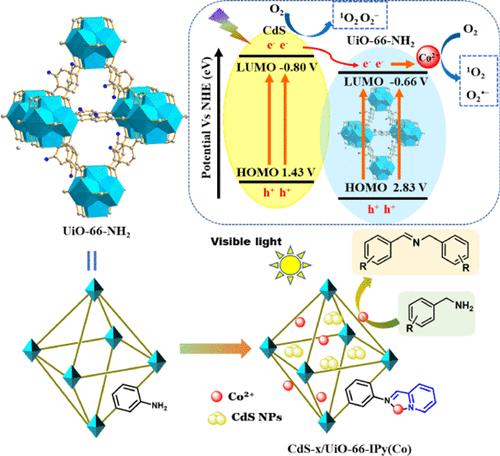
The rational design and construction of metal–organic framework (MOF)-based photocatalytic composites with outstanding visible-light responsiveness, rapid photogenerated charge carrier separation and migration ability, and suitable band gaps for photocatalytic organic transformation have gained enormous attention, yet they are highly challenging. Herein, a series of hybrid materials, CdS-x/UiO-66-IPy(Co) (x represents the theoretical loading amount of CdS into the synthetic system), featuring CdS nanoparticles and molecular cobalt centers, have been constructed by a step-by-step assembly (SSA) strategy. Significantly, the resultant CdS-x/UiO-66-IPy(Co) composites present dramatically improved catalytic activity in the oxidative coupling of amines under ambient air and visible-light irradiation (λ > 400 nm) as compared with the parent UiO-66 and CdS. Specifically, CdS-20/UiO-66-IPy(Co) can efficiently convert benzylamine derivatives into the target imine products with conversion and selectivity both exceeding 95%, attributed to the formation of a heterostructure between the well-dispersed CdS nanoparticles, molecular Co catalyst, and UiO-66-NH2, which facilitated an extended range of light absorption, efficient separation and migration of photogenerated charge carriers, and abundant exposed reaction active sites. The recycling experiments confirm the good recyclability and durability of CdS-20/UiO-66-IPy(Co). Furthermore, the underlying catalytic mechanism has been well established by comprehensive experiments involving photocurrent, electrochemical impedance, photoluminescence, transient absorption, and electron paramagnetic resonance spectroscopy measurements.
期刊介绍:
ACS Catalysis is an esteemed journal that publishes original research in the fields of heterogeneous catalysis, molecular catalysis, and biocatalysis. It offers broad coverage across diverse areas such as life sciences, organometallics and synthesis, photochemistry and electrochemistry, drug discovery and synthesis, materials science, environmental protection, polymer discovery and synthesis, and energy and fuels.
The scope of the journal is to showcase innovative work in various aspects of catalysis. This includes new reactions and novel synthetic approaches utilizing known catalysts, the discovery or modification of new catalysts, elucidation of catalytic mechanisms through cutting-edge investigations, practical enhancements of existing processes, as well as conceptual advances in the field. Contributions to ACS Catalysis can encompass both experimental and theoretical research focused on catalytic molecules, macromolecules, and materials that exhibit catalytic turnover.



 京公网安备 11010802042870号
京ICP备2023020795号-1
京公网安备 11010802042870号
京ICP备2023020795号-1

 分享
分享
 求助内容:
求助内容: 应助结果提醒方式:
 扫码关注我们
