{"title":"[CrO4]团簇作为甲烷光催化氧化脱氢终止剂实现近100%氧化产物选择性","authors":"Zhengfeng Shen, Jianxin Liu, Lijun Guo, Yawen Wang, Yunfang Wang, Xiao Zhang, Xuan Jian, Xiaoming Gao, Zhongde Wang, Caimei Fan, Rui Li, Jiancheng Wang","doi":"10.1021/acscatal.4c06790","DOIUrl":null,"url":null,"abstract":"The direct conversion of methane to high-value liquid oxygenates under mild conditions holds considerable appeal. However, a significant dilemma is that target oxygenates are highly susceptible to overoxidation due to the uncontrollable chain dehydrogenation process. This study reveals that various MCrO<sub>4</sub> (M = Bi, Pb, Ag<sub>2</sub>, Ba, Cu) compounds exhibit 100% selectivity for methane oxidation to oxygenates, with Bi<sub>8</sub>(CrO<sub>4</sub>)O<sub>11</sub> showing the highest activity, producing 556.21 μmol g<sup>–1</sup> and an apparent quantum efficiency of 1.54% at 350 nm. The [CrO<sub>4</sub>] moiety functions as dehydrogenation terminators in the photocatalytic reaction, capturing methane oxidation intermediates and preventing overoxidation. In situ DRIFTS, XPS, and calculations show methane is activated to form oxidation intermediates at the [BiO<sub><i>x</i></sub>] center, which then move to [CrO<sub>4</sub>]. [CrO<sub>4</sub>] exhibits an exceptionally high energy barrier (3.40 eV) for deep dehydrogenation, thereby halting the dehydrogenation of oxygenates. This work broadens the design and development of catalysts for inhibiting excessive oxidation of target products.","PeriodicalId":9,"journal":{"name":"ACS Catalysis ","volume":"53 1","pages":""},"PeriodicalIF":13.6000,"publicationDate":"2025-03-07","publicationTypes":"Journal Article","fieldsOfStudy":null,"isOpenAccess":false,"openAccessPdf":"","citationCount":"0","resultStr":"{\"title\":\"[CrO4] Clusters as Dehydrogenation Terminators for Photocatalytic Oxidation of Methane to Achieve Nearly 100% Oxygenates Selectivity\",\"authors\":\"Zhengfeng Shen, Jianxin Liu, Lijun Guo, Yawen Wang, Yunfang Wang, Xiao Zhang, Xuan Jian, Xiaoming Gao, Zhongde Wang, Caimei Fan, Rui Li, Jiancheng Wang\",\"doi\":\"10.1021/acscatal.4c06790\",\"DOIUrl\":null,\"url\":null,\"abstract\":\"The direct conversion of methane to high-value liquid oxygenates under mild conditions holds considerable appeal. However, a significant dilemma is that target oxygenates are highly susceptible to overoxidation due to the uncontrollable chain dehydrogenation process. This study reveals that various MCrO<sub>4</sub> (M = Bi, Pb, Ag<sub>2</sub>, Ba, Cu) compounds exhibit 100% selectivity for methane oxidation to oxygenates, with Bi<sub>8</sub>(CrO<sub>4</sub>)O<sub>11</sub> showing the highest activity, producing 556.21 μmol g<sup>–1</sup> and an apparent quantum efficiency of 1.54% at 350 nm. The [CrO<sub>4</sub>] moiety functions as dehydrogenation terminators in the photocatalytic reaction, capturing methane oxidation intermediates and preventing overoxidation. In situ DRIFTS, XPS, and calculations show methane is activated to form oxidation intermediates at the [BiO<sub><i>x</i></sub>] center, which then move to [CrO<sub>4</sub>]. [CrO<sub>4</sub>] exhibits an exceptionally high energy barrier (3.40 eV) for deep dehydrogenation, thereby halting the dehydrogenation of oxygenates. This work broadens the design and development of catalysts for inhibiting excessive oxidation of target products.\",\"PeriodicalId\":9,\"journal\":{\"name\":\"ACS Catalysis \",\"volume\":\"53 1\",\"pages\":\"\"},\"PeriodicalIF\":13.6000,\"publicationDate\":\"2025-03-07\",\"publicationTypes\":\"Journal Article\",\"fieldsOfStudy\":null,\"isOpenAccess\":false,\"openAccessPdf\":\"\",\"citationCount\":\"0\",\"resultStr\":null,\"platform\":\"Semanticscholar\",\"paperid\":null,\"PeriodicalName\":\"ACS Catalysis \",\"FirstCategoryId\":\"92\",\"ListUrlMain\":\"https://doi.org/10.1021/acscatal.4c06790\",\"RegionNum\":1,\"RegionCategory\":\"化学\",\"ArticlePicture\":[],\"TitleCN\":null,\"AbstractTextCN\":null,\"PMCID\":null,\"EPubDate\":\"\",\"PubModel\":\"\",\"JCR\":\"Q1\",\"JCRName\":\"CHEMISTRY, PHYSICAL\",\"Score\":null,\"Total\":0}","platform":"Semanticscholar","paperid":null,"PeriodicalName":"ACS Catalysis ","FirstCategoryId":"92","ListUrlMain":"https://doi.org/10.1021/acscatal.4c06790","RegionNum":1,"RegionCategory":"化学","ArticlePicture":[],"TitleCN":null,"AbstractTextCN":null,"PMCID":null,"EPubDate":"","PubModel":"","JCR":"Q1","JCRName":"CHEMISTRY, PHYSICAL","Score":null,"Total":0}
[CrO4] Clusters as Dehydrogenation Terminators for Photocatalytic Oxidation of Methane to Achieve Nearly 100% Oxygenates Selectivity
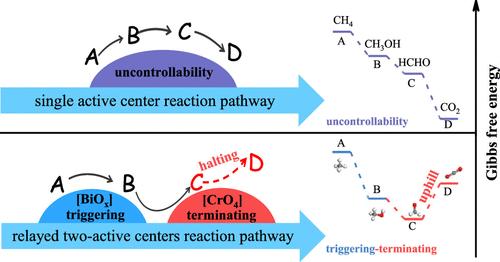
The direct conversion of methane to high-value liquid oxygenates under mild conditions holds considerable appeal. However, a significant dilemma is that target oxygenates are highly susceptible to overoxidation due to the uncontrollable chain dehydrogenation process. This study reveals that various MCrO4 (M = Bi, Pb, Ag2, Ba, Cu) compounds exhibit 100% selectivity for methane oxidation to oxygenates, with Bi8(CrO4)O11 showing the highest activity, producing 556.21 μmol g–1 and an apparent quantum efficiency of 1.54% at 350 nm. The [CrO4] moiety functions as dehydrogenation terminators in the photocatalytic reaction, capturing methane oxidation intermediates and preventing overoxidation. In situ DRIFTS, XPS, and calculations show methane is activated to form oxidation intermediates at the [BiOx] center, which then move to [CrO4]. [CrO4] exhibits an exceptionally high energy barrier (3.40 eV) for deep dehydrogenation, thereby halting the dehydrogenation of oxygenates. This work broadens the design and development of catalysts for inhibiting excessive oxidation of target products.
期刊介绍:
ACS Catalysis is an esteemed journal that publishes original research in the fields of heterogeneous catalysis, molecular catalysis, and biocatalysis. It offers broad coverage across diverse areas such as life sciences, organometallics and synthesis, photochemistry and electrochemistry, drug discovery and synthesis, materials science, environmental protection, polymer discovery and synthesis, and energy and fuels.
The scope of the journal is to showcase innovative work in various aspects of catalysis. This includes new reactions and novel synthetic approaches utilizing known catalysts, the discovery or modification of new catalysts, elucidation of catalytic mechanisms through cutting-edge investigations, practical enhancements of existing processes, as well as conceptual advances in the field. Contributions to ACS Catalysis can encompass both experimental and theoretical research focused on catalytic molecules, macromolecules, and materials that exhibit catalytic turnover.




 京公网安备 11010802042870号
京ICP备2023020795号-1
京公网安备 11010802042870号
京ICP备2023020795号-1

 分享
分享
 求助内容:
求助内容: 应助结果提醒方式:
 扫码关注我们
