{"title":"基于PET/CT的放射组学和深度学习在预测直肠癌周围神经侵犯中的价值。","authors":"Mengzhang Jiao, Zongjing Ma, Zhaisong Gao, Yu Kong, Shumao Zhang, Guangjie Yang, Zhenguang Wang","doi":"10.1007/s00261-025-04833-y","DOIUrl":null,"url":null,"abstract":"<div><h3>Objective</h3><p>The objective of this study is to investigate the value of radiomics features and deep learning features based on positron emission tomography/computed tomography (PET/CT) in predicting perineural invasion (PNI) in rectal cancer.</p><h3>Methods</h3><p>We retrospectively collected 120 rectal cancer (56 PNI-positive patients 64 PNI-negative patients) patients with preoperative <sup>18</sup>F-FDG PET/CT examination and randomly divided them into training and validation sets at a 7:3 ratio. We also collected 31 rectal cancer patients from two other hospitals as an independent external validation set. χ2 test and binary logistic regression were used to analyze PET metabolic parameters. PET/CT images were utilized to extract radiomics features and deep learning features. The Mann-Whitney U test and LASSO were employed to select valuable features. Metabolic parameter, radiomics, deep learning and combined models were constructed. ROC curves were generated to evaluate the performance of models.</p><h3>Results</h3><p>The results indicate that metabolic tumor volume (MTV) is correlated with PNI (<i>P</i> = 0.001). In the training set and validation set, the AUC values of the metabolic parameter model were 0.673 (95%CI: 0.572–0.773), 0.748 (95%CI: 0.599–0.896). We selected 16 radiomics features and 17 deep learning features as valuable factors for predicting PNI. The AUC values of radiomics model and deep learning model were 0.768 (95%CI: 0.667–0.868) and 0.860 (95%CI: 0.780–0.940) in the training set. And the AUC values in the validation set were 0.803 (95%CI: 0.656–0.950) and 0.854 (95% CI 0.721–0.987). Finally, the combined model exhibited AUCs of 0.893 (95%CI: 0.825–0.961) in the training set and 0.883 (95%CI: 0.775–0.990) in the validation set. In the external validation set, the combined model achieved an AUC of 0.829 (95% CI: 0.674–0.984), outperforming each individual model. The decision curve analysis of these models indicated that using the combined model to guide treatment provided a substantial net benefit.</p><h3>Conclusions</h3><p>This combined model established by integrating PET metabolic parameters, radiomics features, and deep learning features can accurately predict the PNI in rectal cancer.</p></div>","PeriodicalId":7126,"journal":{"name":"Abdominal Radiology","volume":"50 9","pages":"4403 - 4412"},"PeriodicalIF":2.2000,"publicationDate":"2025-03-07","publicationTypes":"Journal Article","fieldsOfStudy":null,"isOpenAccess":false,"openAccessPdf":"","citationCount":"0","resultStr":"{\"title\":\"The value of radiomics and deep learning based on PET/CT in predicting perineural nerve invasion in rectal cancer\",\"authors\":\"Mengzhang Jiao, Zongjing Ma, Zhaisong Gao, Yu Kong, Shumao Zhang, Guangjie Yang, Zhenguang Wang\",\"doi\":\"10.1007/s00261-025-04833-y\",\"DOIUrl\":null,\"url\":null,\"abstract\":\"<div><h3>Objective</h3><p>The objective of this study is to investigate the value of radiomics features and deep learning features based on positron emission tomography/computed tomography (PET/CT) in predicting perineural invasion (PNI) in rectal cancer.</p><h3>Methods</h3><p>We retrospectively collected 120 rectal cancer (56 PNI-positive patients 64 PNI-negative patients) patients with preoperative <sup>18</sup>F-FDG PET/CT examination and randomly divided them into training and validation sets at a 7:3 ratio. We also collected 31 rectal cancer patients from two other hospitals as an independent external validation set. χ2 test and binary logistic regression were used to analyze PET metabolic parameters. PET/CT images were utilized to extract radiomics features and deep learning features. The Mann-Whitney U test and LASSO were employed to select valuable features. Metabolic parameter, radiomics, deep learning and combined models were constructed. ROC curves were generated to evaluate the performance of models.</p><h3>Results</h3><p>The results indicate that metabolic tumor volume (MTV) is correlated with PNI (<i>P</i> = 0.001). In the training set and validation set, the AUC values of the metabolic parameter model were 0.673 (95%CI: 0.572–0.773), 0.748 (95%CI: 0.599–0.896). We selected 16 radiomics features and 17 deep learning features as valuable factors for predicting PNI. The AUC values of radiomics model and deep learning model were 0.768 (95%CI: 0.667–0.868) and 0.860 (95%CI: 0.780–0.940) in the training set. And the AUC values in the validation set were 0.803 (95%CI: 0.656–0.950) and 0.854 (95% CI 0.721–0.987). Finally, the combined model exhibited AUCs of 0.893 (95%CI: 0.825–0.961) in the training set and 0.883 (95%CI: 0.775–0.990) in the validation set. In the external validation set, the combined model achieved an AUC of 0.829 (95% CI: 0.674–0.984), outperforming each individual model. The decision curve analysis of these models indicated that using the combined model to guide treatment provided a substantial net benefit.</p><h3>Conclusions</h3><p>This combined model established by integrating PET metabolic parameters, radiomics features, and deep learning features can accurately predict the PNI in rectal cancer.</p></div>\",\"PeriodicalId\":7126,\"journal\":{\"name\":\"Abdominal Radiology\",\"volume\":\"50 9\",\"pages\":\"4403 - 4412\"},\"PeriodicalIF\":2.2000,\"publicationDate\":\"2025-03-07\",\"publicationTypes\":\"Journal Article\",\"fieldsOfStudy\":null,\"isOpenAccess\":false,\"openAccessPdf\":\"\",\"citationCount\":\"0\",\"resultStr\":null,\"platform\":\"Semanticscholar\",\"paperid\":null,\"PeriodicalName\":\"Abdominal Radiology\",\"FirstCategoryId\":\"3\",\"ListUrlMain\":\"https://link.springer.com/article/10.1007/s00261-025-04833-y\",\"RegionNum\":3,\"RegionCategory\":\"医学\",\"ArticlePicture\":[],\"TitleCN\":null,\"AbstractTextCN\":null,\"PMCID\":null,\"EPubDate\":\"\",\"PubModel\":\"\",\"JCR\":\"Q2\",\"JCRName\":\"RADIOLOGY, NUCLEAR MEDICINE & MEDICAL IMAGING\",\"Score\":null,\"Total\":0}","platform":"Semanticscholar","paperid":null,"PeriodicalName":"Abdominal Radiology","FirstCategoryId":"3","ListUrlMain":"https://link.springer.com/article/10.1007/s00261-025-04833-y","RegionNum":3,"RegionCategory":"医学","ArticlePicture":[],"TitleCN":null,"AbstractTextCN":null,"PMCID":null,"EPubDate":"","PubModel":"","JCR":"Q2","JCRName":"RADIOLOGY, NUCLEAR MEDICINE & MEDICAL IMAGING","Score":null,"Total":0}
The value of radiomics and deep learning based on PET/CT in predicting perineural nerve invasion in rectal cancer
Objective
The objective of this study is to investigate the value of radiomics features and deep learning features based on positron emission tomography/computed tomography (PET/CT) in predicting perineural invasion (PNI) in rectal cancer.
Methods
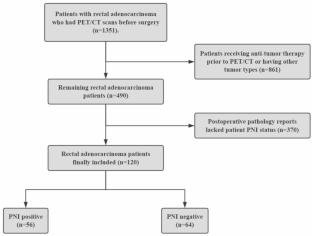
We retrospectively collected 120 rectal cancer (56 PNI-positive patients 64 PNI-negative patients) patients with preoperative 18F-FDG PET/CT examination and randomly divided them into training and validation sets at a 7:3 ratio. We also collected 31 rectal cancer patients from two other hospitals as an independent external validation set. χ2 test and binary logistic regression were used to analyze PET metabolic parameters. PET/CT images were utilized to extract radiomics features and deep learning features. The Mann-Whitney U test and LASSO were employed to select valuable features. Metabolic parameter, radiomics, deep learning and combined models were constructed. ROC curves were generated to evaluate the performance of models.
Results
The results indicate that metabolic tumor volume (MTV) is correlated with PNI (P = 0.001). In the training set and validation set, the AUC values of the metabolic parameter model were 0.673 (95%CI: 0.572–0.773), 0.748 (95%CI: 0.599–0.896). We selected 16 radiomics features and 17 deep learning features as valuable factors for predicting PNI. The AUC values of radiomics model and deep learning model were 0.768 (95%CI: 0.667–0.868) and 0.860 (95%CI: 0.780–0.940) in the training set. And the AUC values in the validation set were 0.803 (95%CI: 0.656–0.950) and 0.854 (95% CI 0.721–0.987). Finally, the combined model exhibited AUCs of 0.893 (95%CI: 0.825–0.961) in the training set and 0.883 (95%CI: 0.775–0.990) in the validation set. In the external validation set, the combined model achieved an AUC of 0.829 (95% CI: 0.674–0.984), outperforming each individual model. The decision curve analysis of these models indicated that using the combined model to guide treatment provided a substantial net benefit.
Conclusions
This combined model established by integrating PET metabolic parameters, radiomics features, and deep learning features can accurately predict the PNI in rectal cancer.
期刊介绍:
Abdominal Radiology seeks to meet the professional needs of the abdominal radiologist by publishing clinically pertinent original, review and practice related articles on the gastrointestinal and genitourinary tracts and abdominal interventional and radiologic procedures. Case reports are generally not accepted unless they are the first report of a new disease or condition, or part of a special solicited section.
Reasons to Publish Your Article in Abdominal Radiology:
· Official journal of the Society of Abdominal Radiology (SAR)
· Published in Cooperation with:
European Society of Gastrointestinal and Abdominal Radiology (ESGAR)
European Society of Urogenital Radiology (ESUR)
Asian Society of Abdominal Radiology (ASAR)
· Efficient handling and Expeditious review
· Author feedback is provided in a mentoring style
· Global readership
· Readers can earn CME credits




 京公网安备 11010802042870号
京ICP备2023020795号-1
京公网安备 11010802042870号
京ICP备2023020795号-1

 分享
分享
 求助内容:
求助内容: 应助结果提醒方式:
 扫码关注我们
