{"title":"利用组装聚离子液体和CdS量子点提高苯甲醇制氢和选择性偶联的双光催化活性","authors":"Sanhawat Rumporee, Wissuta Boonta, Athis Watwiangkham, Taweesak Sudyoadsuk, Khetpakorn Chakarawet, Nawaporn Vinayavekhin, Syuji Fujii, Teera Butburee, Suwit Suthirakun, Junjuda Unruangsri","doi":"10.1002/cssc.202402328","DOIUrl":null,"url":null,"abstract":"<p>Dual photocatalysis converts renewable solar energy into clean fuel and concomitantly value-added chemical synthesis through hydrogen generation and selective organic transformation, using semiconductor catalysts. The catalytic activity of solitary component semiconductor photocatalysts is impeded by their inefficient charge separation and transfer. We, herein, present a facile method, electrostatic assembly, to create hybrid photocatalysts that consist of CdS quantum dots and non-conjugated poly(ionic liquid)s including poly(diallyl dimethyl ammonium bromide) (P(DADMA)) and poly(1-ethyl-3-vinylimidazolium bromide) (P(VEIM)). Poly(ionic liquid)s acted as electron donors to CdS, resulting in an increase in charge separation and transportation in CdS/P(DADMA) and CdS/P(VEIM) hybrids, as demonstrated by experimental and computational results. The optimal photocatalysis of benzyl alcohol (BA) in water was achieved by CdS/P(DADMA) under 12 h LED370 illumination in a nitrogen-atmosphere. This process produced 12.8 mmol g<sub>cat</sub><sup>−1</sup> h<sup>−1</sup> of H<sub>2</sub> and 12.5 mmol g<sub>cat</sub><sup>−1</sup> h<sup>−1</sup> of racemic hydrobenzoin (HB) with 99 % selectivity. In photocatalysis, CdS/P(DADMA) outperformed CdS/P(VEIM) and CdS by a significant margin. Our photocatalytic system enabled the BA-to-HB conversion in water, of which the reaction is commonly sluggish due to a mass transfer constraint. The insightful DFT calculation confirmed that poly(ionic liquid)s may stabilize active intermediate species in the process, significantly enhancing photogenerated charge expedition and photocatalytic performance.</p>","PeriodicalId":149,"journal":{"name":"ChemSusChem","volume":"18 10","pages":""},"PeriodicalIF":5.9000,"publicationDate":"2025-03-07","publicationTypes":"Journal Article","fieldsOfStudy":null,"isOpenAccess":false,"openAccessPdf":"","citationCount":"0","resultStr":"{\"title\":\"Boosting Dual Photocatalytic Activity of Hydrogen Production and Selective Coupling of Benzyl Alcohol Using Assembled Poly(ionic liquid)s and CdS Quantum Dots\",\"authors\":\"Sanhawat Rumporee, Wissuta Boonta, Athis Watwiangkham, Taweesak Sudyoadsuk, Khetpakorn Chakarawet, Nawaporn Vinayavekhin, Syuji Fujii, Teera Butburee, Suwit Suthirakun, Junjuda Unruangsri\",\"doi\":\"10.1002/cssc.202402328\",\"DOIUrl\":null,\"url\":null,\"abstract\":\"<p>Dual photocatalysis converts renewable solar energy into clean fuel and concomitantly value-added chemical synthesis through hydrogen generation and selective organic transformation, using semiconductor catalysts. The catalytic activity of solitary component semiconductor photocatalysts is impeded by their inefficient charge separation and transfer. We, herein, present a facile method, electrostatic assembly, to create hybrid photocatalysts that consist of CdS quantum dots and non-conjugated poly(ionic liquid)s including poly(diallyl dimethyl ammonium bromide) (P(DADMA)) and poly(1-ethyl-3-vinylimidazolium bromide) (P(VEIM)). Poly(ionic liquid)s acted as electron donors to CdS, resulting in an increase in charge separation and transportation in CdS/P(DADMA) and CdS/P(VEIM) hybrids, as demonstrated by experimental and computational results. The optimal photocatalysis of benzyl alcohol (BA) in water was achieved by CdS/P(DADMA) under 12 h LED370 illumination in a nitrogen-atmosphere. This process produced 12.8 mmol g<sub>cat</sub><sup>−1</sup> h<sup>−1</sup> of H<sub>2</sub> and 12.5 mmol g<sub>cat</sub><sup>−1</sup> h<sup>−1</sup> of racemic hydrobenzoin (HB) with 99 % selectivity. In photocatalysis, CdS/P(DADMA) outperformed CdS/P(VEIM) and CdS by a significant margin. Our photocatalytic system enabled the BA-to-HB conversion in water, of which the reaction is commonly sluggish due to a mass transfer constraint. The insightful DFT calculation confirmed that poly(ionic liquid)s may stabilize active intermediate species in the process, significantly enhancing photogenerated charge expedition and photocatalytic performance.</p>\",\"PeriodicalId\":149,\"journal\":{\"name\":\"ChemSusChem\",\"volume\":\"18 10\",\"pages\":\"\"},\"PeriodicalIF\":5.9000,\"publicationDate\":\"2025-03-07\",\"publicationTypes\":\"Journal Article\",\"fieldsOfStudy\":null,\"isOpenAccess\":false,\"openAccessPdf\":\"\",\"citationCount\":\"0\",\"resultStr\":null,\"platform\":\"Semanticscholar\",\"paperid\":null,\"PeriodicalName\":\"ChemSusChem\",\"FirstCategoryId\":\"92\",\"ListUrlMain\":\"https://chemistry-europe.onlinelibrary.wiley.com/doi/10.1002/cssc.202402328\",\"RegionNum\":2,\"RegionCategory\":\"化学\",\"ArticlePicture\":[],\"TitleCN\":null,\"AbstractTextCN\":null,\"PMCID\":null,\"EPubDate\":\"\",\"PubModel\":\"\",\"JCR\":\"Q1\",\"JCRName\":\"CHEMISTRY, MULTIDISCIPLINARY\",\"Score\":null,\"Total\":0}","platform":"Semanticscholar","paperid":null,"PeriodicalName":"ChemSusChem","FirstCategoryId":"92","ListUrlMain":"https://chemistry-europe.onlinelibrary.wiley.com/doi/10.1002/cssc.202402328","RegionNum":2,"RegionCategory":"化学","ArticlePicture":[],"TitleCN":null,"AbstractTextCN":null,"PMCID":null,"EPubDate":"","PubModel":"","JCR":"Q1","JCRName":"CHEMISTRY, MULTIDISCIPLINARY","Score":null,"Total":0}
Boosting Dual Photocatalytic Activity of Hydrogen Production and Selective Coupling of Benzyl Alcohol Using Assembled Poly(ionic liquid)s and CdS Quantum Dots
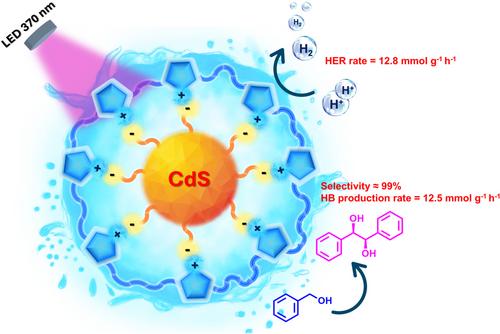
Dual photocatalysis converts renewable solar energy into clean fuel and concomitantly value-added chemical synthesis through hydrogen generation and selective organic transformation, using semiconductor catalysts. The catalytic activity of solitary component semiconductor photocatalysts is impeded by their inefficient charge separation and transfer. We, herein, present a facile method, electrostatic assembly, to create hybrid photocatalysts that consist of CdS quantum dots and non-conjugated poly(ionic liquid)s including poly(diallyl dimethyl ammonium bromide) (P(DADMA)) and poly(1-ethyl-3-vinylimidazolium bromide) (P(VEIM)). Poly(ionic liquid)s acted as electron donors to CdS, resulting in an increase in charge separation and transportation in CdS/P(DADMA) and CdS/P(VEIM) hybrids, as demonstrated by experimental and computational results. The optimal photocatalysis of benzyl alcohol (BA) in water was achieved by CdS/P(DADMA) under 12 h LED370 illumination in a nitrogen-atmosphere. This process produced 12.8 mmol gcat−1 h−1 of H2 and 12.5 mmol gcat−1 h−1 of racemic hydrobenzoin (HB) with 99 % selectivity. In photocatalysis, CdS/P(DADMA) outperformed CdS/P(VEIM) and CdS by a significant margin. Our photocatalytic system enabled the BA-to-HB conversion in water, of which the reaction is commonly sluggish due to a mass transfer constraint. The insightful DFT calculation confirmed that poly(ionic liquid)s may stabilize active intermediate species in the process, significantly enhancing photogenerated charge expedition and photocatalytic performance.
期刊介绍:
ChemSusChem
Impact Factor (2016): 7.226
Scope:
Interdisciplinary journal
Focuses on research at the interface of chemistry and sustainability
Features the best research on sustainability and energy
Areas Covered:
Chemistry
Materials Science
Chemical Engineering
Biotechnology






 京公网安备 11010802042870号
京ICP备2023020795号-1
京公网安备 11010802042870号
京ICP备2023020795号-1

 分享
分享
 求助内容:
求助内容: 应助结果提醒方式:
 扫码关注我们
