Odd-Einar Svinøy, Jakob Vangen Nordbø, Are Hugo Pripp, May Arna Risberg, Astrid Bergland, Pål Oliver Borgen, Gunvor Hilde
{"title":"预适应对等待全髋关节置换术的老年患者的影响。随机对照试验,长期随访。","authors":"Odd-Einar Svinøy, Jakob Vangen Nordbø, Are Hugo Pripp, May Arna Risberg, Astrid Bergland, Pål Oliver Borgen, Gunvor Hilde","doi":"10.1186/s12891-025-08468-4","DOIUrl":null,"url":null,"abstract":"<p><strong>Background: </strong>Prehabilitation involving a planned exercise program before surgery is proposed to improve rehabilitation and postoperative outcomes. However, the current evidence on the efficacy of prehabilitation for patients awaiting total hip replacement is conflicting. The aim of this study was to evaluate efficacy of preoperative exercises and education (AktivA®) for adults 70 years or older awaiting total hip replacement.</p><p><strong>Methods: </strong>In a two-armed randomized controlled trial we recruited 98 participants aged 70 years or older with a Harris Hip Score less than 60 awaiting elective primary total hip replacement. Participants were recruited at three hospitals in Norway between 2019 and 2022. Participants were randomly assigned to prehabilitation or usual care. The prehabilitation group received a tailored exercise program for 6-12 weeks in addition to patient education. Gait speed, the primary outcome, was measured by the 40 m Fast-Paced Walk Test. Secondary outcomes included performance-based tests (Chair Stand Test, Timed Up & Go Test, 6-Minute Walk Test, Stair Climb Test) and patient-reported outcomes (Hip Disability and Osteoarthritis Outcome Score (HOOS) and EQ-5D). Outcomes were assessed at baseline, post intervention, and further 6 weeks, 3-, 6-, and 12 months post-surgery.</p><p><strong>Results: </strong>For the primary outcome gait speed at the primary endpoint (3 months post-surgery), no significant between-group differences were observed. However, post-intervention (before surgery), we found a significant improvement in favor of prehabilitation for both gait speed (0.15 m/s, 95% CI 0.02-0.28) and the HOOS quality of life subscale (11.93, 95% CI 3.38-20.48). No other significant differences were found at any post-surgery follow-up for these outcomes. For other secondary outcomes, there were no between-group differences at any point of assessment. Both groups showed improvement across all outcomes 3-12 months after surgery.</p><p><strong>Conclusions: </strong>The AktivA<sup>®</sup>program, used as a prehabilitation intervention during a period of 6-12 weeks before total hip replacement did not improve gait speed or any other post-operative outcomes compared to usual care. Both groups demonstrated significant improvement in gait speed and performed well relative to Western reference values 12 months post-surgery. Thus, replacing painful hip joints through total joint replacement seems to outweigh the efficacy of prehabilitation.</p><p><strong>Trial registration: </strong>ClinicalTrials.gov Identifier: NCT03602105-initial release: 06/06/2018.</p>","PeriodicalId":9189,"journal":{"name":"BMC Musculoskeletal Disorders","volume":"26 1","pages":"227"},"PeriodicalIF":2.4000,"publicationDate":"2025-03-06","publicationTypes":"Journal Article","fieldsOfStudy":null,"isOpenAccess":false,"openAccessPdf":"https://www.ncbi.nlm.nih.gov/pmc/articles/PMC11884013/pdf/","citationCount":"0","resultStr":"{\"title\":\"The effect of prehabilitation for older patients awaiting total hip replacement. A randomized controlled trial with long-term follow up.\",\"authors\":\"Odd-Einar Svinøy, Jakob Vangen Nordbø, Are Hugo Pripp, May Arna Risberg, Astrid Bergland, Pål Oliver Borgen, Gunvor Hilde\",\"doi\":\"10.1186/s12891-025-08468-4\",\"DOIUrl\":null,\"url\":null,\"abstract\":\"<p><strong>Background: </strong>Prehabilitation involving a planned exercise program before surgery is proposed to improve rehabilitation and postoperative outcomes. However, the current evidence on the efficacy of prehabilitation for patients awaiting total hip replacement is conflicting. The aim of this study was to evaluate efficacy of preoperative exercises and education (AktivA®) for adults 70 years or older awaiting total hip replacement.</p><p><strong>Methods: </strong>In a two-armed randomized controlled trial we recruited 98 participants aged 70 years or older with a Harris Hip Score less than 60 awaiting elective primary total hip replacement. Participants were recruited at three hospitals in Norway between 2019 and 2022. Participants were randomly assigned to prehabilitation or usual care. The prehabilitation group received a tailored exercise program for 6-12 weeks in addition to patient education. Gait speed, the primary outcome, was measured by the 40 m Fast-Paced Walk Test. Secondary outcomes included performance-based tests (Chair Stand Test, Timed Up & Go Test, 6-Minute Walk Test, Stair Climb Test) and patient-reported outcomes (Hip Disability and Osteoarthritis Outcome Score (HOOS) and EQ-5D). Outcomes were assessed at baseline, post intervention, and further 6 weeks, 3-, 6-, and 12 months post-surgery.</p><p><strong>Results: </strong>For the primary outcome gait speed at the primary endpoint (3 months post-surgery), no significant between-group differences were observed. However, post-intervention (before surgery), we found a significant improvement in favor of prehabilitation for both gait speed (0.15 m/s, 95% CI 0.02-0.28) and the HOOS quality of life subscale (11.93, 95% CI 3.38-20.48). No other significant differences were found at any post-surgery follow-up for these outcomes. For other secondary outcomes, there were no between-group differences at any point of assessment. Both groups showed improvement across all outcomes 3-12 months after surgery.</p><p><strong>Conclusions: </strong>The AktivA<sup>®</sup>program, used as a prehabilitation intervention during a period of 6-12 weeks before total hip replacement did not improve gait speed or any other post-operative outcomes compared to usual care. Both groups demonstrated significant improvement in gait speed and performed well relative to Western reference values 12 months post-surgery. Thus, replacing painful hip joints through total joint replacement seems to outweigh the efficacy of prehabilitation.</p><p><strong>Trial registration: </strong>ClinicalTrials.gov Identifier: NCT03602105-initial release: 06/06/2018.</p>\",\"PeriodicalId\":9189,\"journal\":{\"name\":\"BMC Musculoskeletal Disorders\",\"volume\":\"26 1\",\"pages\":\"227\"},\"PeriodicalIF\":2.4000,\"publicationDate\":\"2025-03-06\",\"publicationTypes\":\"Journal Article\",\"fieldsOfStudy\":null,\"isOpenAccess\":false,\"openAccessPdf\":\"https://www.ncbi.nlm.nih.gov/pmc/articles/PMC11884013/pdf/\",\"citationCount\":\"0\",\"resultStr\":null,\"platform\":\"Semanticscholar\",\"paperid\":null,\"PeriodicalName\":\"BMC Musculoskeletal Disorders\",\"FirstCategoryId\":\"3\",\"ListUrlMain\":\"https://doi.org/10.1186/s12891-025-08468-4\",\"RegionNum\":3,\"RegionCategory\":\"医学\",\"ArticlePicture\":[],\"TitleCN\":null,\"AbstractTextCN\":null,\"PMCID\":null,\"EPubDate\":\"\",\"PubModel\":\"\",\"JCR\":\"Q2\",\"JCRName\":\"ORTHOPEDICS\",\"Score\":null,\"Total\":0}","platform":"Semanticscholar","paperid":null,"PeriodicalName":"BMC Musculoskeletal Disorders","FirstCategoryId":"3","ListUrlMain":"https://doi.org/10.1186/s12891-025-08468-4","RegionNum":3,"RegionCategory":"医学","ArticlePicture":[],"TitleCN":null,"AbstractTextCN":null,"PMCID":null,"EPubDate":"","PubModel":"","JCR":"Q2","JCRName":"ORTHOPEDICS","Score":null,"Total":0}
引用次数: 0
摘要
背景:术前康复包括有计划的运动计划,以改善康复和术后预后。然而,目前关于等待全髋关节置换术的患者康复效果的证据是相互矛盾的。本研究的目的是评估术前锻炼和教育(AktivA®)对70岁或以上等待全髋关节置换术的成年人的疗效。方法:在一项双臂随机对照试验中,我们招募了98名年龄在70岁或以上、Harris髋关节评分小于60、等待择期原发性全髋关节置换术的患者。参与者于2019年至2022年在挪威的三家医院招募。参与者被随机分配到康复治疗组或常规护理组。除患者教育外,康复组还接受了为期6-12周的量身定制的锻炼计划。步态速度是主要的结果,通过40米快节奏步行测试来测量。次要结果包括基于性能的测试(椅子站立测试、定时起身和行走测试、6分钟步行测试、爬楼梯测试)和患者报告的结果(髋关节残疾和骨关节炎结局评分(HOOS)和EQ-5D)。在基线、干预后以及术后6周、3个月、6个月和12个月评估结果。结果:对于主要终点(术后3个月)的主要结局步态速度,组间无显著差异。然而,在干预后(手术前),我们发现步态速度(0.15 m/s, 95% CI 0.02-0.28)和HOOS生活质量量表(11.93,95% CI 3.38-20.48)的预适应能力都有显著改善。在任何术后随访中,这些结果均未发现其他显著差异。对于其他次要结果,在任何评估点上都没有组间差异。两组术后3-12个月的所有结果均有改善。结论:与常规护理相比,在全髋关节置换术前6-12周使用AktivA®程序作为康复干预并没有改善步态速度或任何其他术后结果。术后12个月,两组患者的步态速度均有显著改善,与西方参考值相比表现良好。因此,通过全关节置换术来替代疼痛的髋关节似乎超过了康复的效果。试验注册:ClinicalTrials.gov标识符:nct03602105 -首次发布:06/06/2018。
The effect of prehabilitation for older patients awaiting total hip replacement. A randomized controlled trial with long-term follow up.
Background: Prehabilitation involving a planned exercise program before surgery is proposed to improve rehabilitation and postoperative outcomes. However, the current evidence on the efficacy of prehabilitation for patients awaiting total hip replacement is conflicting. The aim of this study was to evaluate efficacy of preoperative exercises and education (AktivA®) for adults 70 years or older awaiting total hip replacement.
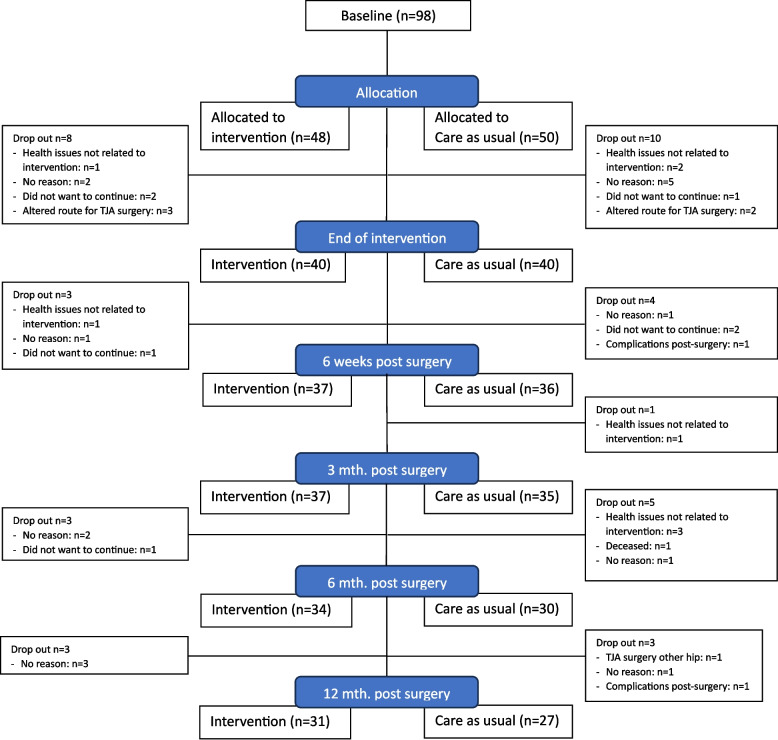
Methods: In a two-armed randomized controlled trial we recruited 98 participants aged 70 years or older with a Harris Hip Score less than 60 awaiting elective primary total hip replacement. Participants were recruited at three hospitals in Norway between 2019 and 2022. Participants were randomly assigned to prehabilitation or usual care. The prehabilitation group received a tailored exercise program for 6-12 weeks in addition to patient education. Gait speed, the primary outcome, was measured by the 40 m Fast-Paced Walk Test. Secondary outcomes included performance-based tests (Chair Stand Test, Timed Up & Go Test, 6-Minute Walk Test, Stair Climb Test) and patient-reported outcomes (Hip Disability and Osteoarthritis Outcome Score (HOOS) and EQ-5D). Outcomes were assessed at baseline, post intervention, and further 6 weeks, 3-, 6-, and 12 months post-surgery.
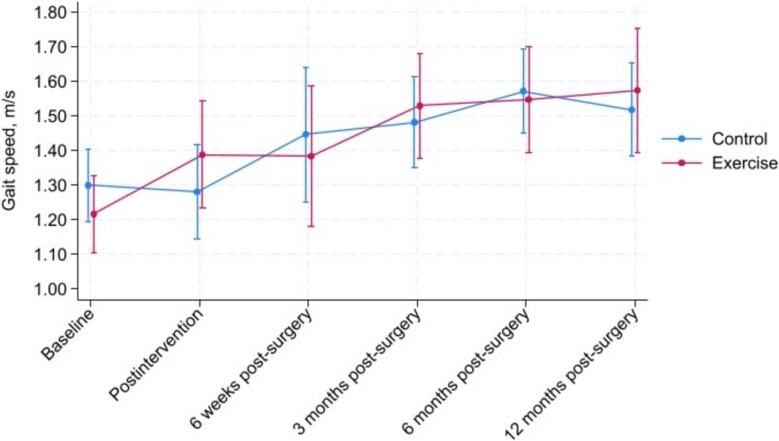
Results: For the primary outcome gait speed at the primary endpoint (3 months post-surgery), no significant between-group differences were observed. However, post-intervention (before surgery), we found a significant improvement in favor of prehabilitation for both gait speed (0.15 m/s, 95% CI 0.02-0.28) and the HOOS quality of life subscale (11.93, 95% CI 3.38-20.48). No other significant differences were found at any post-surgery follow-up for these outcomes. For other secondary outcomes, there were no between-group differences at any point of assessment. Both groups showed improvement across all outcomes 3-12 months after surgery.
Conclusions: The AktivA®program, used as a prehabilitation intervention during a period of 6-12 weeks before total hip replacement did not improve gait speed or any other post-operative outcomes compared to usual care. Both groups demonstrated significant improvement in gait speed and performed well relative to Western reference values 12 months post-surgery. Thus, replacing painful hip joints through total joint replacement seems to outweigh the efficacy of prehabilitation.
期刊介绍:
BMC Musculoskeletal Disorders is an open access, peer-reviewed journal that considers articles on all aspects of the prevention, diagnosis and management of musculoskeletal disorders, as well as related molecular genetics, pathophysiology, and epidemiology.
The scope of the Journal covers research into rheumatic diseases where the primary focus relates specifically to a component(s) of the musculoskeletal system.




 京公网安备 11010802042870号
京ICP备2023020795号-1
京公网安备 11010802042870号
京ICP备2023020795号-1

 分享
分享
 求助内容:
求助内容: 应助结果提醒方式:
 扫码关注我们
