{"title":"基于cts的光子计数检测器CT深度学习重建:肺部肿瘤评估的图像质量和诊断置信度。","authors":"Tomoaki Sasaki, Hirofumi Kuno, Keiichi Nomura, Yoshihisa Muramatsu, Keiju Aokage, Joji Samejima, Tetsuro Taki, Eisuke Goto, Masashi Wakabayashi, Hideki Furuya, Hiroki Taguchi, Tatsushi Kobayashi","doi":"10.1007/s11604-025-01759-9","DOIUrl":null,"url":null,"abstract":"<p><strong>Purpose: </strong>This is a preliminary analysis of one of the secondary endpoints in the prospective study cohort. The aim of this study is to assess the image quality and diagnostic confidence for lung cancer of CT images generated by using cadmium-zinc-telluride (CZT)-based photon-counting-detector-CT (PCD-CT) and comparing these super-high-resolution (SHR) images with conventional normal-resolution (NR) CT images.</p><p><strong>Materials and methods: </strong>Twenty-five patients (median age 75 years, interquartile range 66-78 years, 18 men and 7 women) with 29 lung nodules overall (including two patients with 4 and 2 nodules, respectively) were enrolled to undergo PCD-CT. Three types of images were reconstructed: a 512 × 512 matrix with adaptive iterative dose reduction 3D (AIDR 3D) as the NR<sub>AIDR3D</sub> image, a 1024 × 1024 matrix with AIDR 3D as the SHR<sub>AIDR3D</sub> image, and a 1024 × 1024 matrix with deep-learning reconstruction (DLR) as the SHR<sub>DLR</sub> image. For qualitative analysis, two radiologists evaluated the matched reconstructed series twice (NR<sub>AIDR3D</sub> vs. SHR<sub>AIDR3D</sub> and SHR<sub>AIDR3D</sub> vs. SHR<sub>DLR</sub>) and scored the presence of imaging findings, such as spiculation, lobulation, appearance of ground-glass opacity or air bronchiologram, image quality, and diagnostic confidence, using a 5-point Likert scale. For quantitative analysis, contrast-to-noise ratios (CNRs) of the three images were compared.</p><p><strong>Results: </strong>In the qualitative analysis, compared to NR<sub>AIDR3D</sub>, SHR<sub>AIDR3D</sub> yielded higher image quality and diagnostic confidence, except for image noise (all P < 0.01). In comparison with SHR<sub>AIDR3D</sub>, SHR<sub>DLR</sub> yielded higher image quality and diagnostic confidence (all P < 0.01). In the quantitative analysis, CNRs in the modified NR<sub>AIDR3D</sub> and SHR<sub>DLR</sub> groups were higher than those in the SHR<sub>AIDR3D</sub> group (P = 0.003, <0.001, respectively).</p><p><strong>Conclusion: </strong>In PCD-CT, SHR<sub>DLR</sub> images provided the highest image quality and diagnostic confidence for lung tumor evaluation, followed by SHR<sub>AIDR3D</sub> and NR<sub>AIDR3D</sub> images. DLR demonstrated superior noise reduction compared to other reconstruction methods.</p>","PeriodicalId":14691,"journal":{"name":"Japanese Journal of Radiology","volume":" ","pages":"1132-1144"},"PeriodicalIF":2.1000,"publicationDate":"2025-07-01","publicationTypes":"Journal Article","fieldsOfStudy":null,"isOpenAccess":false,"openAccessPdf":"https://www.ncbi.nlm.nih.gov/pmc/articles/PMC12205019/pdf/","citationCount":"0","resultStr":"{\"title\":\"CZT-based photon-counting-detector CT with deep-learning reconstruction: image quality and diagnostic confidence for lung tumor assessment.\",\"authors\":\"Tomoaki Sasaki, Hirofumi Kuno, Keiichi Nomura, Yoshihisa Muramatsu, Keiju Aokage, Joji Samejima, Tetsuro Taki, Eisuke Goto, Masashi Wakabayashi, Hideki Furuya, Hiroki Taguchi, Tatsushi Kobayashi\",\"doi\":\"10.1007/s11604-025-01759-9\",\"DOIUrl\":null,\"url\":null,\"abstract\":\"<p><strong>Purpose: </strong>This is a preliminary analysis of one of the secondary endpoints in the prospective study cohort. The aim of this study is to assess the image quality and diagnostic confidence for lung cancer of CT images generated by using cadmium-zinc-telluride (CZT)-based photon-counting-detector-CT (PCD-CT) and comparing these super-high-resolution (SHR) images with conventional normal-resolution (NR) CT images.</p><p><strong>Materials and methods: </strong>Twenty-five patients (median age 75 years, interquartile range 66-78 years, 18 men and 7 women) with 29 lung nodules overall (including two patients with 4 and 2 nodules, respectively) were enrolled to undergo PCD-CT. Three types of images were reconstructed: a 512 × 512 matrix with adaptive iterative dose reduction 3D (AIDR 3D) as the NR<sub>AIDR3D</sub> image, a 1024 × 1024 matrix with AIDR 3D as the SHR<sub>AIDR3D</sub> image, and a 1024 × 1024 matrix with deep-learning reconstruction (DLR) as the SHR<sub>DLR</sub> image. For qualitative analysis, two radiologists evaluated the matched reconstructed series twice (NR<sub>AIDR3D</sub> vs. SHR<sub>AIDR3D</sub> and SHR<sub>AIDR3D</sub> vs. SHR<sub>DLR</sub>) and scored the presence of imaging findings, such as spiculation, lobulation, appearance of ground-glass opacity or air bronchiologram, image quality, and diagnostic confidence, using a 5-point Likert scale. For quantitative analysis, contrast-to-noise ratios (CNRs) of the three images were compared.</p><p><strong>Results: </strong>In the qualitative analysis, compared to NR<sub>AIDR3D</sub>, SHR<sub>AIDR3D</sub> yielded higher image quality and diagnostic confidence, except for image noise (all P < 0.01). In comparison with SHR<sub>AIDR3D</sub>, SHR<sub>DLR</sub> yielded higher image quality and diagnostic confidence (all P < 0.01). In the quantitative analysis, CNRs in the modified NR<sub>AIDR3D</sub> and SHR<sub>DLR</sub> groups were higher than those in the SHR<sub>AIDR3D</sub> group (P = 0.003, <0.001, respectively).</p><p><strong>Conclusion: </strong>In PCD-CT, SHR<sub>DLR</sub> images provided the highest image quality and diagnostic confidence for lung tumor evaluation, followed by SHR<sub>AIDR3D</sub> and NR<sub>AIDR3D</sub> images. DLR demonstrated superior noise reduction compared to other reconstruction methods.</p>\",\"PeriodicalId\":14691,\"journal\":{\"name\":\"Japanese Journal of Radiology\",\"volume\":\" \",\"pages\":\"1132-1144\"},\"PeriodicalIF\":2.1000,\"publicationDate\":\"2025-07-01\",\"publicationTypes\":\"Journal Article\",\"fieldsOfStudy\":null,\"isOpenAccess\":false,\"openAccessPdf\":\"https://www.ncbi.nlm.nih.gov/pmc/articles/PMC12205019/pdf/\",\"citationCount\":\"0\",\"resultStr\":null,\"platform\":\"Semanticscholar\",\"paperid\":null,\"PeriodicalName\":\"Japanese Journal of Radiology\",\"FirstCategoryId\":\"3\",\"ListUrlMain\":\"https://doi.org/10.1007/s11604-025-01759-9\",\"RegionNum\":4,\"RegionCategory\":\"医学\",\"ArticlePicture\":[],\"TitleCN\":null,\"AbstractTextCN\":null,\"PMCID\":null,\"EPubDate\":\"2025/3/7 0:00:00\",\"PubModel\":\"Epub\",\"JCR\":\"\",\"JCRName\":\"\",\"Score\":null,\"Total\":0}","platform":"Semanticscholar","paperid":null,"PeriodicalName":"Japanese Journal of Radiology","FirstCategoryId":"3","ListUrlMain":"https://doi.org/10.1007/s11604-025-01759-9","RegionNum":4,"RegionCategory":"医学","ArticlePicture":[],"TitleCN":null,"AbstractTextCN":null,"PMCID":null,"EPubDate":"2025/3/7 0:00:00","PubModel":"Epub","JCR":"","JCRName":"","Score":null,"Total":0}
引用次数: 0
摘要
目的:这是对前瞻性研究队列中一个次要终点的初步分析。本研究的目的是评估使用碲化镉锌(CZT)为基础的光子计数检测器CT (PCD-CT)生成的CT图像的图像质量和诊断肺癌的可信度,并将这些超高分辨率(SHR)图像与传统的正常分辨率(NR) CT图像进行比较。材料和方法:25例患者(中位年龄75岁,四分位数范围66-78岁,男性18例,女性7例)共29个肺结节(其中2例分别为4个和2个结节)接受PCD-CT检查。重建三种类型的图像:自适应迭代剂量减少3D (AIDR 3D)的512 × 512矩阵作为NRAIDR3D图像,AIDR3D作为SHRAIDR3D图像的1024 × 1024矩阵,以及深度学习重建(DLR)的1024 × 1024矩阵作为SHRDLR图像。为了进行定性分析,两位放射科医生对匹配的重建序列进行了两次评估(NRAIDR3D vs. SHRAIDR3D和SHRAIDR3D vs. SHRDLR),并使用5分制李克特量表对影像学发现的存在进行评分,如毛泡、分叶、毛玻璃混浊或空气细支气管造影的外观、图像质量和诊断置信度。为了定量分析,我们比较了三幅图像的噪比(CNRs)。结果:在定性分析中,SHRAIDR3D与NRAIDR3D相比具有更高的图像质量和诊断置信度,除了图像噪声(P AIDR3D均存在)外,SHRAIDR3D具有更高的图像质量和诊断置信度(P AIDR3D和SHRDLR组均高于SHRAIDR3D组(P = 0.003)。结论:在PCD-CT中,SHRDLR影像对肺肿瘤评价的图像质量和诊断置信度最高,其次为SHRAIDR3D和NRAIDR3D影像。与其他重建方法相比,DLR显示出更好的降噪效果。
CZT-based photon-counting-detector CT with deep-learning reconstruction: image quality and diagnostic confidence for lung tumor assessment.
Purpose: This is a preliminary analysis of one of the secondary endpoints in the prospective study cohort. The aim of this study is to assess the image quality and diagnostic confidence for lung cancer of CT images generated by using cadmium-zinc-telluride (CZT)-based photon-counting-detector-CT (PCD-CT) and comparing these super-high-resolution (SHR) images with conventional normal-resolution (NR) CT images.
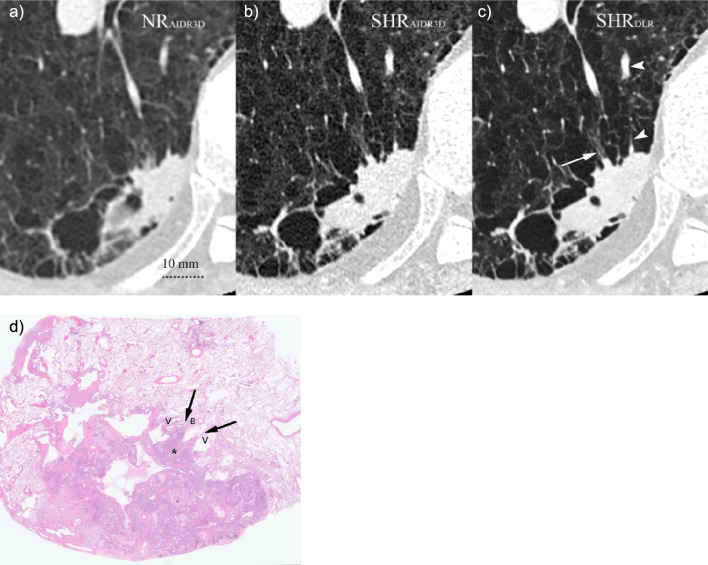
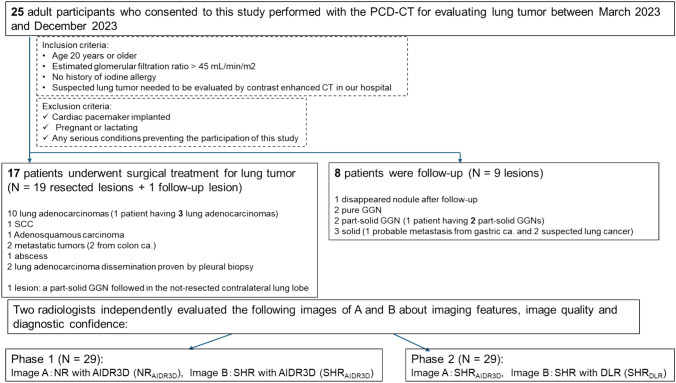
Materials and methods: Twenty-five patients (median age 75 years, interquartile range 66-78 years, 18 men and 7 women) with 29 lung nodules overall (including two patients with 4 and 2 nodules, respectively) were enrolled to undergo PCD-CT. Three types of images were reconstructed: a 512 × 512 matrix with adaptive iterative dose reduction 3D (AIDR 3D) as the NRAIDR3D image, a 1024 × 1024 matrix with AIDR 3D as the SHRAIDR3D image, and a 1024 × 1024 matrix with deep-learning reconstruction (DLR) as the SHRDLR image. For qualitative analysis, two radiologists evaluated the matched reconstructed series twice (NRAIDR3D vs. SHRAIDR3D and SHRAIDR3D vs. SHRDLR) and scored the presence of imaging findings, such as spiculation, lobulation, appearance of ground-glass opacity or air bronchiologram, image quality, and diagnostic confidence, using a 5-point Likert scale. For quantitative analysis, contrast-to-noise ratios (CNRs) of the three images were compared.
Results: In the qualitative analysis, compared to NRAIDR3D, SHRAIDR3D yielded higher image quality and diagnostic confidence, except for image noise (all P < 0.01). In comparison with SHRAIDR3D, SHRDLR yielded higher image quality and diagnostic confidence (all P < 0.01). In the quantitative analysis, CNRs in the modified NRAIDR3D and SHRDLR groups were higher than those in the SHRAIDR3D group (P = 0.003, <0.001, respectively).
Conclusion: In PCD-CT, SHRDLR images provided the highest image quality and diagnostic confidence for lung tumor evaluation, followed by SHRAIDR3D and NRAIDR3D images. DLR demonstrated superior noise reduction compared to other reconstruction methods.
期刊介绍:
Japanese Journal of Radiology is a peer-reviewed journal, officially published by the Japan Radiological Society. The main purpose of the journal is to provide a forum for the publication of papers documenting recent advances and new developments in the field of radiology in medicine and biology. The scope of Japanese Journal of Radiology encompasses but is not restricted to diagnostic radiology, interventional radiology, radiation oncology, nuclear medicine, radiation physics, and radiation biology. Additionally, the journal covers technical and industrial innovations. The journal welcomes original articles, technical notes, review articles, pictorial essays and letters to the editor. The journal also provides announcements from the boards and the committees of the society. Membership in the Japan Radiological Society is not a prerequisite for submission. Contributions are welcomed from all parts of the world.





 京公网安备 11010802042870号
京ICP备2023020795号-1
京公网安备 11010802042870号
京ICP备2023020795号-1

 分享
分享
 求助内容:
求助内容: 应助结果提醒方式:
 扫码关注我们
