Xiaoyu Quan , Zhiwei Miao , Runxi Han , Rui Deng , Yaqi Cao , Jingshan Tian , Yaping Lu , Guoxiang Wang , Xingjian Yu , Yi Wu , Chen Dai
{"title":"蛋白质组学分析显示,南方猕猴桃通过调节FABP4/PPARγ/NF-κB信号通路减轻慢性结肠炎。","authors":"Xiaoyu Quan , Zhiwei Miao , Runxi Han , Rui Deng , Yaqi Cao , Jingshan Tian , Yaping Lu , Guoxiang Wang , Xingjian Yu , Yi Wu , Chen Dai","doi":"10.1016/j.jep.2025.119585","DOIUrl":null,"url":null,"abstract":"<div><h3>Ethnopharmacological relevance</h3><div><em>Acalypha australis</em> L. (AAL), a traditional medicinal herb from the Euphorbiaceae family, has been widely used in Chinese medicine for its heat-clearing, detoxifying, and diuretic properties, as well as for treating gastrointestinal disorders such as diarrhea and dysentery. Its reported anti-inflammatory and hemostatic effects are closely linked to inflammatory pathways. While previous studies have demonstrated AAL's efficacy in acute colitis, its therapeutic potential in chronic colitis and the underlying mechanisms remain largely unexplored.</div></div><div><h3>Aim of the study</h3><div>This study aims to investigate the therapeutic efficacy of AAL in dextran sulfate sodium (DSS)-induced chronic colitis and elucidate its anti-inflammatory and barrier-protective mechanisms, with a specific focus on the FABP4/PPARγ/NF-κB signaling pathway.</div></div><div><h3>Materials and methods</h3><div>The chemical composition of AAL was characterized using ultra-high-performance liquid chromatography coupled with quadrupole time-of-flight mass spectrometry (UPLC-QTOF-MS). Chronic colitis was induced in mice through three cycles of DSS administration, and the therapeutic effects of AAL were evaluated by assessing body weight, Disease Activity Index (DAI), colon length, and pathological alterations. Enzyme-linked immunosorbent assay (ELISA) was used to quantify inflammatory cytokine levels. Immunohistochemistry and Western blotting were performed to assess mucosal barrier proteins, including Mucin 2 (MUC2), zonula occludens-1 (ZO-1), and Occludin, as well as key signaling proteins such as fatty acid-binding protein 4 (FABP4), peroxisome proliferator-activated receptor gamma (PPARγ), and phosphorylated P65 (p-P65). Proteomic analysis combined with Gene Set Enrichment Analysis (GSEA) was conducted to identify differentially expressed proteins and enriched pathways. The role of the FABP4/PPARγ/NF-κB axis was further validated using the PPARγ antagonist GW9662. Additionally, molecular docking and molecular dynamics simulations were employed to identify bioactive components in AAL and their interactions with FABP4 and PPARγ.</div></div><div><h3>Results</h3><div>UPLC-QTOF-MS analysis identified 47 compounds in AAL, including flavonoids, terpenoids, and polyphenols. Bergaptol and corilagin were identified as major constituents with potential anti-inflammatory properties. AAL treatment significantly alleviated chronic colitis symptoms, as evidenced by reduced DAI scores, restoration of body weight, and improved colon length. Pathological and immunohistochemical analyses demonstrated that AAL preserved intestinal mucosal integrity by upregulating MUC2, ZO-1, and Occludin expression. Proteomic and GSEA analyses identified the FABP4/PPARγ/NF-κB pathway as a key target of AAL. Western blotting confirmed that AAL suppressed FABP4 expression, enhanced PPARγ levels, and reduced p-P65 expression, indicating inhibition of NF-κB activation. Notably, the therapeutic effects of AAL were abolished by GW9662, further validating the involvement of PPARγ signaling. Molecular docking and molecular dynamics simulations demonstrated strong binding affinities of bergaptol and corilagin to FABP4 and PPARγ, suggesting their role as active compounds responsible for AAL's therapeutic effects.</div></div><div><h3>Conclusions</h3><div>AAL effectively mitigates chronic colitis by preserving intestinal barrier integrity, suppressing inflammatory responses, and modulating the FABP4/PPARγ/NF-κB pathway. The bioactive compounds bergaptol and corilagin may contribute to these therapeutic effects, highlighting AAL as a promising natural therapeutic agent for ulcerative colitis.</div></div>","PeriodicalId":15761,"journal":{"name":"Journal of ethnopharmacology","volume":"345 ","pages":"Article 119585"},"PeriodicalIF":5.4000,"publicationDate":"2025-04-09","publicationTypes":"Journal Article","fieldsOfStudy":null,"isOpenAccess":false,"openAccessPdf":"","citationCount":"0","resultStr":"{\"title\":\"Proteomic analysis reveals that Acalypha australis L. mitigates chronic colitis by modulating the FABP4/PPARγ/NF-κB signaling pathway\",\"authors\":\"Xiaoyu Quan , Zhiwei Miao , Runxi Han , Rui Deng , Yaqi Cao , Jingshan Tian , Yaping Lu , Guoxiang Wang , Xingjian Yu , Yi Wu , Chen Dai\",\"doi\":\"10.1016/j.jep.2025.119585\",\"DOIUrl\":null,\"url\":null,\"abstract\":\"<div><h3>Ethnopharmacological relevance</h3><div><em>Acalypha australis</em> L. (AAL), a traditional medicinal herb from the Euphorbiaceae family, has been widely used in Chinese medicine for its heat-clearing, detoxifying, and diuretic properties, as well as for treating gastrointestinal disorders such as diarrhea and dysentery. Its reported anti-inflammatory and hemostatic effects are closely linked to inflammatory pathways. While previous studies have demonstrated AAL's efficacy in acute colitis, its therapeutic potential in chronic colitis and the underlying mechanisms remain largely unexplored.</div></div><div><h3>Aim of the study</h3><div>This study aims to investigate the therapeutic efficacy of AAL in dextran sulfate sodium (DSS)-induced chronic colitis and elucidate its anti-inflammatory and barrier-protective mechanisms, with a specific focus on the FABP4/PPARγ/NF-κB signaling pathway.</div></div><div><h3>Materials and methods</h3><div>The chemical composition of AAL was characterized using ultra-high-performance liquid chromatography coupled with quadrupole time-of-flight mass spectrometry (UPLC-QTOF-MS). Chronic colitis was induced in mice through three cycles of DSS administration, and the therapeutic effects of AAL were evaluated by assessing body weight, Disease Activity Index (DAI), colon length, and pathological alterations. Enzyme-linked immunosorbent assay (ELISA) was used to quantify inflammatory cytokine levels. Immunohistochemistry and Western blotting were performed to assess mucosal barrier proteins, including Mucin 2 (MUC2), zonula occludens-1 (ZO-1), and Occludin, as well as key signaling proteins such as fatty acid-binding protein 4 (FABP4), peroxisome proliferator-activated receptor gamma (PPARγ), and phosphorylated P65 (p-P65). Proteomic analysis combined with Gene Set Enrichment Analysis (GSEA) was conducted to identify differentially expressed proteins and enriched pathways. The role of the FABP4/PPARγ/NF-κB axis was further validated using the PPARγ antagonist GW9662. Additionally, molecular docking and molecular dynamics simulations were employed to identify bioactive components in AAL and their interactions with FABP4 and PPARγ.</div></div><div><h3>Results</h3><div>UPLC-QTOF-MS analysis identified 47 compounds in AAL, including flavonoids, terpenoids, and polyphenols. Bergaptol and corilagin were identified as major constituents with potential anti-inflammatory properties. AAL treatment significantly alleviated chronic colitis symptoms, as evidenced by reduced DAI scores, restoration of body weight, and improved colon length. Pathological and immunohistochemical analyses demonstrated that AAL preserved intestinal mucosal integrity by upregulating MUC2, ZO-1, and Occludin expression. Proteomic and GSEA analyses identified the FABP4/PPARγ/NF-κB pathway as a key target of AAL. Western blotting confirmed that AAL suppressed FABP4 expression, enhanced PPARγ levels, and reduced p-P65 expression, indicating inhibition of NF-κB activation. Notably, the therapeutic effects of AAL were abolished by GW9662, further validating the involvement of PPARγ signaling. Molecular docking and molecular dynamics simulations demonstrated strong binding affinities of bergaptol and corilagin to FABP4 and PPARγ, suggesting their role as active compounds responsible for AAL's therapeutic effects.</div></div><div><h3>Conclusions</h3><div>AAL effectively mitigates chronic colitis by preserving intestinal barrier integrity, suppressing inflammatory responses, and modulating the FABP4/PPARγ/NF-κB pathway. The bioactive compounds bergaptol and corilagin may contribute to these therapeutic effects, highlighting AAL as a promising natural therapeutic agent for ulcerative colitis.</div></div>\",\"PeriodicalId\":15761,\"journal\":{\"name\":\"Journal of ethnopharmacology\",\"volume\":\"345 \",\"pages\":\"Article 119585\"},\"PeriodicalIF\":5.4000,\"publicationDate\":\"2025-04-09\",\"publicationTypes\":\"Journal Article\",\"fieldsOfStudy\":null,\"isOpenAccess\":false,\"openAccessPdf\":\"\",\"citationCount\":\"0\",\"resultStr\":null,\"platform\":\"Semanticscholar\",\"paperid\":null,\"PeriodicalName\":\"Journal of ethnopharmacology\",\"FirstCategoryId\":\"3\",\"ListUrlMain\":\"https://www.sciencedirect.com/science/article/pii/S0378874125002697\",\"RegionNum\":2,\"RegionCategory\":\"医学\",\"ArticlePicture\":[],\"TitleCN\":null,\"AbstractTextCN\":null,\"PMCID\":null,\"EPubDate\":\"2025/3/4 0:00:00\",\"PubModel\":\"Epub\",\"JCR\":\"Q1\",\"JCRName\":\"CHEMISTRY, MEDICINAL\",\"Score\":null,\"Total\":0}","platform":"Semanticscholar","paperid":null,"PeriodicalName":"Journal of ethnopharmacology","FirstCategoryId":"3","ListUrlMain":"https://www.sciencedirect.com/science/article/pii/S0378874125002697","RegionNum":2,"RegionCategory":"医学","ArticlePicture":[],"TitleCN":null,"AbstractTextCN":null,"PMCID":null,"EPubDate":"2025/3/4 0:00:00","PubModel":"Epub","JCR":"Q1","JCRName":"CHEMISTRY, MEDICINAL","Score":null,"Total":0}
Proteomic analysis reveals that Acalypha australis L. mitigates chronic colitis by modulating the FABP4/PPARγ/NF-κB signaling pathway
Ethnopharmacological relevance
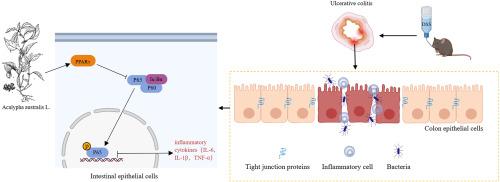
Acalypha australis L. (AAL), a traditional medicinal herb from the Euphorbiaceae family, has been widely used in Chinese medicine for its heat-clearing, detoxifying, and diuretic properties, as well as for treating gastrointestinal disorders such as diarrhea and dysentery. Its reported anti-inflammatory and hemostatic effects are closely linked to inflammatory pathways. While previous studies have demonstrated AAL's efficacy in acute colitis, its therapeutic potential in chronic colitis and the underlying mechanisms remain largely unexplored.
Aim of the study
This study aims to investigate the therapeutic efficacy of AAL in dextran sulfate sodium (DSS)-induced chronic colitis and elucidate its anti-inflammatory and barrier-protective mechanisms, with a specific focus on the FABP4/PPARγ/NF-κB signaling pathway.
Materials and methods
The chemical composition of AAL was characterized using ultra-high-performance liquid chromatography coupled with quadrupole time-of-flight mass spectrometry (UPLC-QTOF-MS). Chronic colitis was induced in mice through three cycles of DSS administration, and the therapeutic effects of AAL were evaluated by assessing body weight, Disease Activity Index (DAI), colon length, and pathological alterations. Enzyme-linked immunosorbent assay (ELISA) was used to quantify inflammatory cytokine levels. Immunohistochemistry and Western blotting were performed to assess mucosal barrier proteins, including Mucin 2 (MUC2), zonula occludens-1 (ZO-1), and Occludin, as well as key signaling proteins such as fatty acid-binding protein 4 (FABP4), peroxisome proliferator-activated receptor gamma (PPARγ), and phosphorylated P65 (p-P65). Proteomic analysis combined with Gene Set Enrichment Analysis (GSEA) was conducted to identify differentially expressed proteins and enriched pathways. The role of the FABP4/PPARγ/NF-κB axis was further validated using the PPARγ antagonist GW9662. Additionally, molecular docking and molecular dynamics simulations were employed to identify bioactive components in AAL and their interactions with FABP4 and PPARγ.
Results
UPLC-QTOF-MS analysis identified 47 compounds in AAL, including flavonoids, terpenoids, and polyphenols. Bergaptol and corilagin were identified as major constituents with potential anti-inflammatory properties. AAL treatment significantly alleviated chronic colitis symptoms, as evidenced by reduced DAI scores, restoration of body weight, and improved colon length. Pathological and immunohistochemical analyses demonstrated that AAL preserved intestinal mucosal integrity by upregulating MUC2, ZO-1, and Occludin expression. Proteomic and GSEA analyses identified the FABP4/PPARγ/NF-κB pathway as a key target of AAL. Western blotting confirmed that AAL suppressed FABP4 expression, enhanced PPARγ levels, and reduced p-P65 expression, indicating inhibition of NF-κB activation. Notably, the therapeutic effects of AAL were abolished by GW9662, further validating the involvement of PPARγ signaling. Molecular docking and molecular dynamics simulations demonstrated strong binding affinities of bergaptol and corilagin to FABP4 and PPARγ, suggesting their role as active compounds responsible for AAL's therapeutic effects.
Conclusions
AAL effectively mitigates chronic colitis by preserving intestinal barrier integrity, suppressing inflammatory responses, and modulating the FABP4/PPARγ/NF-κB pathway. The bioactive compounds bergaptol and corilagin may contribute to these therapeutic effects, highlighting AAL as a promising natural therapeutic agent for ulcerative colitis.
期刊介绍:
The Journal of Ethnopharmacology is dedicated to the exchange of information and understandings about people''s use of plants, fungi, animals, microorganisms and minerals and their biological and pharmacological effects based on the principles established through international conventions. Early people confronted with illness and disease, discovered a wealth of useful therapeutic agents in the plant and animal kingdoms. The empirical knowledge of these medicinal substances and their toxic potential was passed on by oral tradition and sometimes recorded in herbals and other texts on materia medica. Many valuable drugs of today (e.g., atropine, ephedrine, tubocurarine, digoxin, reserpine) came into use through the study of indigenous remedies. Chemists continue to use plant-derived drugs (e.g., morphine, taxol, physostigmine, quinidine, emetine) as prototypes in their attempts to develop more effective and less toxic medicinals.





 京公网安备 11010802042870号
京ICP备2023020795号-1
京公网安备 11010802042870号
京ICP备2023020795号-1

 分享
分享
 求助内容:
求助内容: 应助结果提醒方式:
 扫码关注我们
