Logiraj Kumaralingam, Kenneth Le May, Van Bao Dang, Javaneh Alavi, Hien Q Huynh, Lawrence H Le
{"title":"利用肠道超声图像评估儿童炎症性肠病肠壁厚度的人工智能辅助方法","authors":"Logiraj Kumaralingam, Kenneth Le May, Van Bao Dang, Javaneh Alavi, Hien Q Huynh, Lawrence H Le","doi":"10.1093/ecco-jcc/jjaf037","DOIUrl":null,"url":null,"abstract":"<p><strong>Background and aim: </strong>Intestinal ultrasound (IUS) potentially spares patients from repeated endoscopies under sedation and eliminates the need for alternative imaging modalities like magnetic resonance enterography and computed tomography enterography scans. However, interpreting IUS images is challenging for physicians due to the time-intensive process of identifying markers indicative of inflammatory bowel disease (IBD). This study aims for fully automating the analysis of pediatric IBD to distinguish between abnormal and normal cases.</p><p><strong>Methods: </strong>We used data set of 260 pediatric patients, consisting of 4565 IUS images with 1478 abnormal and 3087 normal cases. Meticulous annotation of the region between the lumen/mucosa and the muscularis/serosa interfaces in a subset of 612 images were performed. An artificial intelligence (AI) algorithm was trained to delineate the region between these interfaces. The boundaries of these regions were extracted, and the average bowel wall thickness (BWT) was calculated and analyzed using cutoff values ranging between 1.5 and 3 mm.</p><p><strong>Results: </strong>This study showed promising segmentation performance in accurately identifying the lumen/mucosa and muscularis/serosa interfaces. In a separate test set of 3953 images, the classification performance at the 2mm BWT cutoff showed the highest sensitivity of 90.29% and a specificity of 93.70%. The AI method showed strong agreement, with an interclass correlation of 0.942 (95% CI: 0.938-0.946), compared to manual clinical measurements.</p><p><strong>Conclusions: </strong>This study demonstrates an AI approach to automate the analysis of pediatric IBD IUS images, providing a reliable tool for early detection, precise characterization, and monitoring of the disease.</p>","PeriodicalId":94074,"journal":{"name":"Journal of Crohn's & colitis","volume":" ","pages":""},"PeriodicalIF":8.7000,"publicationDate":"2025-04-04","publicationTypes":"Journal Article","fieldsOfStudy":null,"isOpenAccess":false,"openAccessPdf":"https://www.ncbi.nlm.nih.gov/pmc/articles/PMC11976712/pdf/","citationCount":"0","resultStr":"{\"title\":\"Artificial intelligence-assisted approach to assessing bowel wall thickness in pediatric inflammatory bowel disease using intestinal ultrasound images.\",\"authors\":\"Logiraj Kumaralingam, Kenneth Le May, Van Bao Dang, Javaneh Alavi, Hien Q Huynh, Lawrence H Le\",\"doi\":\"10.1093/ecco-jcc/jjaf037\",\"DOIUrl\":null,\"url\":null,\"abstract\":\"<p><strong>Background and aim: </strong>Intestinal ultrasound (IUS) potentially spares patients from repeated endoscopies under sedation and eliminates the need for alternative imaging modalities like magnetic resonance enterography and computed tomography enterography scans. However, interpreting IUS images is challenging for physicians due to the time-intensive process of identifying markers indicative of inflammatory bowel disease (IBD). This study aims for fully automating the analysis of pediatric IBD to distinguish between abnormal and normal cases.</p><p><strong>Methods: </strong>We used data set of 260 pediatric patients, consisting of 4565 IUS images with 1478 abnormal and 3087 normal cases. Meticulous annotation of the region between the lumen/mucosa and the muscularis/serosa interfaces in a subset of 612 images were performed. An artificial intelligence (AI) algorithm was trained to delineate the region between these interfaces. The boundaries of these regions were extracted, and the average bowel wall thickness (BWT) was calculated and analyzed using cutoff values ranging between 1.5 and 3 mm.</p><p><strong>Results: </strong>This study showed promising segmentation performance in accurately identifying the lumen/mucosa and muscularis/serosa interfaces. In a separate test set of 3953 images, the classification performance at the 2mm BWT cutoff showed the highest sensitivity of 90.29% and a specificity of 93.70%. The AI method showed strong agreement, with an interclass correlation of 0.942 (95% CI: 0.938-0.946), compared to manual clinical measurements.</p><p><strong>Conclusions: </strong>This study demonstrates an AI approach to automate the analysis of pediatric IBD IUS images, providing a reliable tool for early detection, precise characterization, and monitoring of the disease.</p>\",\"PeriodicalId\":94074,\"journal\":{\"name\":\"Journal of Crohn's & colitis\",\"volume\":\" \",\"pages\":\"\"},\"PeriodicalIF\":8.7000,\"publicationDate\":\"2025-04-04\",\"publicationTypes\":\"Journal Article\",\"fieldsOfStudy\":null,\"isOpenAccess\":false,\"openAccessPdf\":\"https://www.ncbi.nlm.nih.gov/pmc/articles/PMC11976712/pdf/\",\"citationCount\":\"0\",\"resultStr\":null,\"platform\":\"Semanticscholar\",\"paperid\":null,\"PeriodicalName\":\"Journal of Crohn's & colitis\",\"FirstCategoryId\":\"1085\",\"ListUrlMain\":\"https://doi.org/10.1093/ecco-jcc/jjaf037\",\"RegionNum\":0,\"RegionCategory\":null,\"ArticlePicture\":[],\"TitleCN\":null,\"AbstractTextCN\":null,\"PMCID\":null,\"EPubDate\":\"\",\"PubModel\":\"\",\"JCR\":\"\",\"JCRName\":\"\",\"Score\":null,\"Total\":0}","platform":"Semanticscholar","paperid":null,"PeriodicalName":"Journal of Crohn's & colitis","FirstCategoryId":"1085","ListUrlMain":"https://doi.org/10.1093/ecco-jcc/jjaf037","RegionNum":0,"RegionCategory":null,"ArticlePicture":[],"TitleCN":null,"AbstractTextCN":null,"PMCID":null,"EPubDate":"","PubModel":"","JCR":"","JCRName":"","Score":null,"Total":0}
引用次数: 0
摘要
背景和目的:肠道超声(IUS)有可能使患者在镇静状态下免于重复内窥镜检查,并消除了磁共振肠造影和计算机断层肠造影扫描等替代成像方式的需要。然而,由于识别炎症性肠病(IBD)标志物的耗时过程,解释IUS图像对医生来说是具有挑战性的。本研究旨在使小儿IBD的分析完全自动化,以区分异常病例和正常病例。方法:使用260例儿童患者的数据集,包括4565张IUS图像,其中异常1478例,正常3087例。在612张图像的子集中,对管腔/粘膜和肌层/浆膜界面之间的区域进行了细致的注释。训练人工智能(AI)算法来描绘这些界面之间的区域。提取这些区域的边界,并计算平均肠壁厚度(BWT),并使用截断值在1.5 mm和3 mm之间进行分析。结果:该研究在准确识别管腔/粘膜和肌层/浆膜界面方面表现出良好的分割性能。在3,953张图像的单独测试集中,在2 mm BWT截止点的分类性能显示灵敏度最高,为90.29%,特异性为93.70%。与人工临床测量相比,人工智能方法显示出很强的一致性,类间相关性为0.942 (95% CI: 0.938-0.946)。结论:本研究展示了一种人工智能方法来自动分析儿童IBD IUS图像,为疾病的早期发现、精确表征和监测提供了可靠的工具。
Artificial intelligence-assisted approach to assessing bowel wall thickness in pediatric inflammatory bowel disease using intestinal ultrasound images.
Background and aim: Intestinal ultrasound (IUS) potentially spares patients from repeated endoscopies under sedation and eliminates the need for alternative imaging modalities like magnetic resonance enterography and computed tomography enterography scans. However, interpreting IUS images is challenging for physicians due to the time-intensive process of identifying markers indicative of inflammatory bowel disease (IBD). This study aims for fully automating the analysis of pediatric IBD to distinguish between abnormal and normal cases.
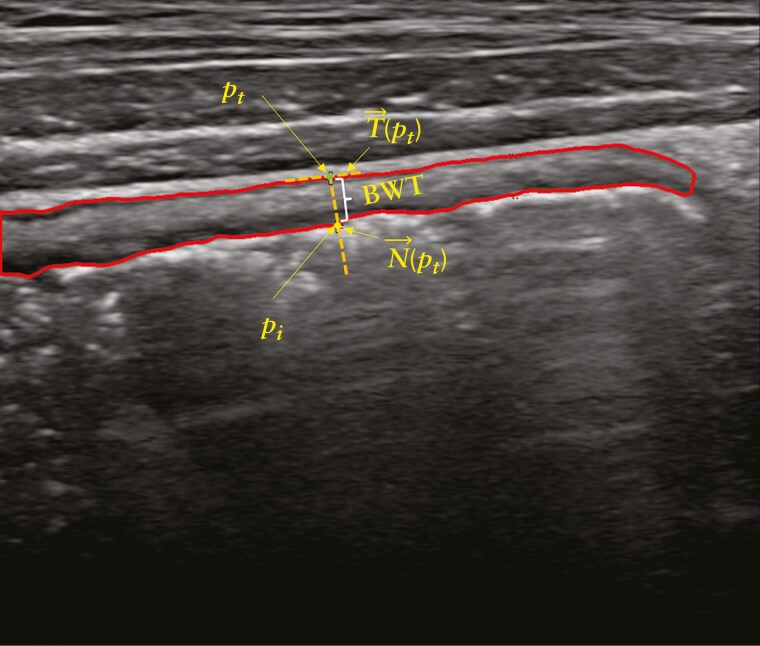
Methods: We used data set of 260 pediatric patients, consisting of 4565 IUS images with 1478 abnormal and 3087 normal cases. Meticulous annotation of the region between the lumen/mucosa and the muscularis/serosa interfaces in a subset of 612 images were performed. An artificial intelligence (AI) algorithm was trained to delineate the region between these interfaces. The boundaries of these regions were extracted, and the average bowel wall thickness (BWT) was calculated and analyzed using cutoff values ranging between 1.5 and 3 mm.
Results: This study showed promising segmentation performance in accurately identifying the lumen/mucosa and muscularis/serosa interfaces. In a separate test set of 3953 images, the classification performance at the 2mm BWT cutoff showed the highest sensitivity of 90.29% and a specificity of 93.70%. The AI method showed strong agreement, with an interclass correlation of 0.942 (95% CI: 0.938-0.946), compared to manual clinical measurements.
Conclusions: This study demonstrates an AI approach to automate the analysis of pediatric IBD IUS images, providing a reliable tool for early detection, precise characterization, and monitoring of the disease.






 京公网安备 11010802042870号
京ICP备2023020795号-1
京公网安备 11010802042870号
京ICP备2023020795号-1

 分享
分享

 求助内容:
求助内容: 应助结果提醒方式:
 扫码关注我们
