{"title":"氟化环糊精超分子纳米组装实现富氧和靶向光动力治疗","authors":"Ya-Hui Song, Yi-Jun Gu, Zhuo Lei, Nan-Kun Li, Ying-Ming Zhang, Qilin Yu, Yu Liu","doi":"10.1021/acs.nanolett.5c00090","DOIUrl":null,"url":null,"abstract":"Photodynamic therapy has become a promising treatment modality against many diseases, but its dilemma―the intrinsic hypoxia of solid tumors and the high oxygen dependence for generation of cytotoxic species―has seriously hampered its practical translation. Herein a binary supramolecular nanocarrier, which is composed of fluorocarbon chain-appended β-cyclodextrin as an oxygen carrier and adamantane-grafted hyaluronic acid as a cell-targeting agent, can deliver different types of photosensitizers by multiple noncovalent interactions. Superior to the alkylated counterpart, the fluorinated amphiphilic β-cyclodextrin can spontaneously form a nanoparticulate assembly and exhibit high oxygen-enrichment performance. The obtained nanoassembly can alleviate hypoxia in the tumor microenvironment and enhance the efficacy of photodynamic therapy. Remarkable phototoxicity and minimal dark toxicity are observed in the cancer cells, and meanwhile, preferential accumulation and significant cancer ablation are realized in the tumor-bearing mice. To be envisioned, this supramolecular assembly capable of efficiently carrying oxygen can be explored as a universal platform for precise phototherapeutics.","PeriodicalId":53,"journal":{"name":"Nano Letters","volume":"20 1","pages":""},"PeriodicalIF":9.1000,"publicationDate":"2025-03-08","publicationTypes":"Journal Article","fieldsOfStudy":null,"isOpenAccess":false,"openAccessPdf":"","citationCount":"0","resultStr":"{\"title\":\"Fluorinated Cyclodextrin Supramolecular Nanoassembly Enables Oxygen-Enriched and Targeted Photodynamic Therapy\",\"authors\":\"Ya-Hui Song, Yi-Jun Gu, Zhuo Lei, Nan-Kun Li, Ying-Ming Zhang, Qilin Yu, Yu Liu\",\"doi\":\"10.1021/acs.nanolett.5c00090\",\"DOIUrl\":null,\"url\":null,\"abstract\":\"Photodynamic therapy has become a promising treatment modality against many diseases, but its dilemma―the intrinsic hypoxia of solid tumors and the high oxygen dependence for generation of cytotoxic species―has seriously hampered its practical translation. Herein a binary supramolecular nanocarrier, which is composed of fluorocarbon chain-appended β-cyclodextrin as an oxygen carrier and adamantane-grafted hyaluronic acid as a cell-targeting agent, can deliver different types of photosensitizers by multiple noncovalent interactions. Superior to the alkylated counterpart, the fluorinated amphiphilic β-cyclodextrin can spontaneously form a nanoparticulate assembly and exhibit high oxygen-enrichment performance. The obtained nanoassembly can alleviate hypoxia in the tumor microenvironment and enhance the efficacy of photodynamic therapy. Remarkable phototoxicity and minimal dark toxicity are observed in the cancer cells, and meanwhile, preferential accumulation and significant cancer ablation are realized in the tumor-bearing mice. To be envisioned, this supramolecular assembly capable of efficiently carrying oxygen can be explored as a universal platform for precise phototherapeutics.\",\"PeriodicalId\":53,\"journal\":{\"name\":\"Nano Letters\",\"volume\":\"20 1\",\"pages\":\"\"},\"PeriodicalIF\":9.1000,\"publicationDate\":\"2025-03-08\",\"publicationTypes\":\"Journal Article\",\"fieldsOfStudy\":null,\"isOpenAccess\":false,\"openAccessPdf\":\"\",\"citationCount\":\"0\",\"resultStr\":null,\"platform\":\"Semanticscholar\",\"paperid\":null,\"PeriodicalName\":\"Nano Letters\",\"FirstCategoryId\":\"88\",\"ListUrlMain\":\"https://doi.org/10.1021/acs.nanolett.5c00090\",\"RegionNum\":1,\"RegionCategory\":\"材料科学\",\"ArticlePicture\":[],\"TitleCN\":null,\"AbstractTextCN\":null,\"PMCID\":null,\"EPubDate\":\"\",\"PubModel\":\"\",\"JCR\":\"Q1\",\"JCRName\":\"CHEMISTRY, MULTIDISCIPLINARY\",\"Score\":null,\"Total\":0}","platform":"Semanticscholar","paperid":null,"PeriodicalName":"Nano Letters","FirstCategoryId":"88","ListUrlMain":"https://doi.org/10.1021/acs.nanolett.5c00090","RegionNum":1,"RegionCategory":"材料科学","ArticlePicture":[],"TitleCN":null,"AbstractTextCN":null,"PMCID":null,"EPubDate":"","PubModel":"","JCR":"Q1","JCRName":"CHEMISTRY, MULTIDISCIPLINARY","Score":null,"Total":0}
Fluorinated Cyclodextrin Supramolecular Nanoassembly Enables Oxygen-Enriched and Targeted Photodynamic Therapy
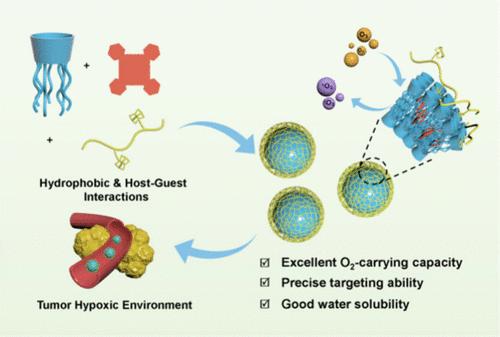
Photodynamic therapy has become a promising treatment modality against many diseases, but its dilemma―the intrinsic hypoxia of solid tumors and the high oxygen dependence for generation of cytotoxic species―has seriously hampered its practical translation. Herein a binary supramolecular nanocarrier, which is composed of fluorocarbon chain-appended β-cyclodextrin as an oxygen carrier and adamantane-grafted hyaluronic acid as a cell-targeting agent, can deliver different types of photosensitizers by multiple noncovalent interactions. Superior to the alkylated counterpart, the fluorinated amphiphilic β-cyclodextrin can spontaneously form a nanoparticulate assembly and exhibit high oxygen-enrichment performance. The obtained nanoassembly can alleviate hypoxia in the tumor microenvironment and enhance the efficacy of photodynamic therapy. Remarkable phototoxicity and minimal dark toxicity are observed in the cancer cells, and meanwhile, preferential accumulation and significant cancer ablation are realized in the tumor-bearing mice. To be envisioned, this supramolecular assembly capable of efficiently carrying oxygen can be explored as a universal platform for precise phototherapeutics.
期刊介绍:
Nano Letters serves as a dynamic platform for promptly disseminating original results in fundamental, applied, and emerging research across all facets of nanoscience and nanotechnology. A pivotal criterion for inclusion within Nano Letters is the convergence of at least two different areas or disciplines, ensuring a rich interdisciplinary scope. The journal is dedicated to fostering exploration in diverse areas, including:
- Experimental and theoretical findings on physical, chemical, and biological phenomena at the nanoscale
- Synthesis, characterization, and processing of organic, inorganic, polymer, and hybrid nanomaterials through physical, chemical, and biological methodologies
- Modeling and simulation of synthetic, assembly, and interaction processes
- Realization of integrated nanostructures and nano-engineered devices exhibiting advanced performance
- Applications of nanoscale materials in living and environmental systems
Nano Letters is committed to advancing and showcasing groundbreaking research that intersects various domains, fostering innovation and collaboration in the ever-evolving field of nanoscience and nanotechnology.




 京公网安备 11010802042870号
京ICP备2023020795号-1
京公网安备 11010802042870号
京ICP备2023020795号-1

 分享
分享
 求助内容:
求助内容: 应助结果提醒方式:
 扫码关注我们
