Chen-Chi Duan, Chen Zhang, Hua-Lin Xu, Jing Tao, Jia-Le Yu, Dan Zhang, Shan Wu, Xiu Zeng, Wan-Ting Zeng, Zhi-Yin Zhang, Cindy-Lee Dennis, Han Liu, Jia-Ying Wu, Ben Willem J Mol, He-Feng Huang, Yan-Ting Wu
{"title":"基于互联网的认知行为疗法预防怀孕抑郁症患者产后抑郁症状:中国多中心随机对照试验","authors":"Chen-Chi Duan, Chen Zhang, Hua-Lin Xu, Jing Tao, Jia-Le Yu, Dan Zhang, Shan Wu, Xiu Zeng, Wan-Ting Zeng, Zhi-Yin Zhang, Cindy-Lee Dennis, Han Liu, Jia-Ying Wu, Ben Willem J Mol, He-Feng Huang, Yan-Ting Wu","doi":"10.2196/67386","DOIUrl":null,"url":null,"abstract":"<p><strong>Background: </strong>Women are particularly vulnerable to depression during pregnancy, which is one of the strongest risk factors for developing postpartum depression (PPD). Addressing antenatal depressive symptoms in these women is crucial for preventing PPD. However, little is known about the effectiveness of internet-based cognitive behavioral therapy (ICBT) in preventing PPD in this high-risk group.</p><p><strong>Objective: </strong>This study aims to evaluate the short- and long-term effects of ICBT in preventing PPD among women with antenatal depressive symptoms.</p><p><strong>Methods: </strong>Participants were screened for antenatal depressive symptoms using the Edinburgh Postnatal Depression Scale (EPDS) and randomly allocated (1:1) to either the ICBT group (receiving weekly online modules starting antenatally and continuing into early postpartum) or the control group (observed without treatment). Follow-up assessments were conducted up to 12 months postpartum, and data were analyzed using generalized estimating equations. The primary outcome was the prevalence of depressive symptoms at 6 weeks postpartum. A subgroup analysis based on the severity of antenatal depressive symptoms was also performed. The secondary outcomes included the long-term effects of ICBT on maternal depression, as well as its impact on anxiety, sleep quality, social support, parenting stress, co-parenting relationships, and infant development.</p><p><strong>Results: </strong>Between August 2020 and September 2021, 300 pregnant individuals were recruited from 5 centers across China. No significant differences were observed in depressive symptoms at 6 weeks postpartum (P=.18) or at any longer-term follow-up time points (P=.18). However, a post hoc subgroup analysis showed that participants with antenatal EPDS scores of 10-12 in the ICBT group had a lower risk of developing depression during the first year postpartum (odds ratio 0.534, 95% CI 0.313-0.912; P=.02), but this was not observed for participants with more severe depression. Additionally, this subgroup demonstrated higher levels of co-parenting relationships (P=.02).</p><p><strong>Conclusions: </strong>Among individuals with antenatal depression, ICBT did not prevent the development of PPD. However, ICBT may be a preferable option for those with mild to moderate antenatal depressive symptoms. Future research is needed to explore modifications to ICBT to address more severe depressive symptoms.</p><p><strong>Trial registration: </strong>Chinese Clinical Trial Registry ChiCTR2000033433; https://www.chictr.org.cn/showproj.html?proj=54482.</p><p><strong>International registered report identifier (irrid): </strong>RR2-10.1186/s13063-022-06728-5.</p>","PeriodicalId":16337,"journal":{"name":"Journal of Medical Internet Research","volume":"27 ","pages":"e67386"},"PeriodicalIF":6.0000,"publicationDate":"2025-03-04","publicationTypes":"Journal Article","fieldsOfStudy":null,"isOpenAccess":false,"openAccessPdf":"https://www.ncbi.nlm.nih.gov/pmc/articles/PMC11920666/pdf/","citationCount":"0","resultStr":"{\"title\":\"Internet-Based Cognitive Behavioral Therapy for Preventing Postpartum Depressive Symptoms Among Pregnant Individuals With Depression: Multicenter Randomized Controlled Trial in China.\",\"authors\":\"Chen-Chi Duan, Chen Zhang, Hua-Lin Xu, Jing Tao, Jia-Le Yu, Dan Zhang, Shan Wu, Xiu Zeng, Wan-Ting Zeng, Zhi-Yin Zhang, Cindy-Lee Dennis, Han Liu, Jia-Ying Wu, Ben Willem J Mol, He-Feng Huang, Yan-Ting Wu\",\"doi\":\"10.2196/67386\",\"DOIUrl\":null,\"url\":null,\"abstract\":\"<p><strong>Background: </strong>Women are particularly vulnerable to depression during pregnancy, which is one of the strongest risk factors for developing postpartum depression (PPD). Addressing antenatal depressive symptoms in these women is crucial for preventing PPD. However, little is known about the effectiveness of internet-based cognitive behavioral therapy (ICBT) in preventing PPD in this high-risk group.</p><p><strong>Objective: </strong>This study aims to evaluate the short- and long-term effects of ICBT in preventing PPD among women with antenatal depressive symptoms.</p><p><strong>Methods: </strong>Participants were screened for antenatal depressive symptoms using the Edinburgh Postnatal Depression Scale (EPDS) and randomly allocated (1:1) to either the ICBT group (receiving weekly online modules starting antenatally and continuing into early postpartum) or the control group (observed without treatment). Follow-up assessments were conducted up to 12 months postpartum, and data were analyzed using generalized estimating equations. The primary outcome was the prevalence of depressive symptoms at 6 weeks postpartum. A subgroup analysis based on the severity of antenatal depressive symptoms was also performed. The secondary outcomes included the long-term effects of ICBT on maternal depression, as well as its impact on anxiety, sleep quality, social support, parenting stress, co-parenting relationships, and infant development.</p><p><strong>Results: </strong>Between August 2020 and September 2021, 300 pregnant individuals were recruited from 5 centers across China. No significant differences were observed in depressive symptoms at 6 weeks postpartum (P=.18) or at any longer-term follow-up time points (P=.18). However, a post hoc subgroup analysis showed that participants with antenatal EPDS scores of 10-12 in the ICBT group had a lower risk of developing depression during the first year postpartum (odds ratio 0.534, 95% CI 0.313-0.912; P=.02), but this was not observed for participants with more severe depression. Additionally, this subgroup demonstrated higher levels of co-parenting relationships (P=.02).</p><p><strong>Conclusions: </strong>Among individuals with antenatal depression, ICBT did not prevent the development of PPD. However, ICBT may be a preferable option for those with mild to moderate antenatal depressive symptoms. Future research is needed to explore modifications to ICBT to address more severe depressive symptoms.</p><p><strong>Trial registration: </strong>Chinese Clinical Trial Registry ChiCTR2000033433; https://www.chictr.org.cn/showproj.html?proj=54482.</p><p><strong>International registered report identifier (irrid): </strong>RR2-10.1186/s13063-022-06728-5.</p>\",\"PeriodicalId\":16337,\"journal\":{\"name\":\"Journal of Medical Internet Research\",\"volume\":\"27 \",\"pages\":\"e67386\"},\"PeriodicalIF\":6.0000,\"publicationDate\":\"2025-03-04\",\"publicationTypes\":\"Journal Article\",\"fieldsOfStudy\":null,\"isOpenAccess\":false,\"openAccessPdf\":\"https://www.ncbi.nlm.nih.gov/pmc/articles/PMC11920666/pdf/\",\"citationCount\":\"0\",\"resultStr\":null,\"platform\":\"Semanticscholar\",\"paperid\":null,\"PeriodicalName\":\"Journal of Medical Internet Research\",\"FirstCategoryId\":\"3\",\"ListUrlMain\":\"https://doi.org/10.2196/67386\",\"RegionNum\":2,\"RegionCategory\":\"医学\",\"ArticlePicture\":[],\"TitleCN\":null,\"AbstractTextCN\":null,\"PMCID\":null,\"EPubDate\":\"\",\"PubModel\":\"\",\"JCR\":\"Q1\",\"JCRName\":\"HEALTH CARE SCIENCES & SERVICES\",\"Score\":null,\"Total\":0}","platform":"Semanticscholar","paperid":null,"PeriodicalName":"Journal of Medical Internet Research","FirstCategoryId":"3","ListUrlMain":"https://doi.org/10.2196/67386","RegionNum":2,"RegionCategory":"医学","ArticlePicture":[],"TitleCN":null,"AbstractTextCN":null,"PMCID":null,"EPubDate":"","PubModel":"","JCR":"Q1","JCRName":"HEALTH CARE SCIENCES & SERVICES","Score":null,"Total":0}
引用次数: 0
摘要
背景:女性在怀孕期间特别容易抑郁,这是发生产后抑郁症(PPD)的最强危险因素之一。解决这些妇女的产前抑郁症状对于预防产后抑郁症至关重要。然而,基于互联网的认知行为疗法(ICBT)在预防这一高危人群PPD方面的有效性知之甚少。目的:本研究旨在评估ICBT在预防产前抑郁症状妇女PPD中的短期和长期效果。方法:使用爱丁堡产后抑郁量表(EPDS)筛选参与者的产前抑郁症状,并随机分配(1:1)到ICBT组(从产前开始每周接受在线模块并持续到产后早期)或对照组(未治疗观察)。随访评估至产后12个月,并使用广义估计方程分析数据。主要结局是产后6周抑郁症状的患病率。还进行了基于产前抑郁症状严重程度的亚组分析。次要结果包括ICBT对母亲抑郁的长期影响,以及对焦虑、睡眠质量、社会支持、父母压力、共同父母关系和婴儿发育的影响。结果:在2020年8月至2021年9月期间,从中国5个中心招募了300名孕妇。在产后6周(P= 0.18)或任何较长期随访时间点(P= 0.18),观察到抑郁症状无显著差异。然而,事后亚组分析显示,ICBT组中产前EPDS评分为10-12的参与者在产后第一年患抑郁症的风险较低(优势比0.534,95% CI 0.313-0.912;P=.02),但在抑郁症更严重的参与者中没有观察到这一点。此外,该亚组表现出更高水平的共同抚养关系(P= 0.02)。结论:在产前抑郁个体中,ICBT并不能预防PPD的发展。然而,ICBT对于那些有轻度到中度产前抑郁症状的人来说可能是一个更好的选择。未来的研究需要探索对ICBT的修改,以解决更严重的抑郁症状。试验注册:中国临床试验注册中心ChiCTR2000033433;https://www.chictr.org.cn/showproj.html?proj=54482.International注册报告标识符(irrid): RR2-10.1186/s13063-022-06728-5。
Internet-Based Cognitive Behavioral Therapy for Preventing Postpartum Depressive Symptoms Among Pregnant Individuals With Depression: Multicenter Randomized Controlled Trial in China.
Background: Women are particularly vulnerable to depression during pregnancy, which is one of the strongest risk factors for developing postpartum depression (PPD). Addressing antenatal depressive symptoms in these women is crucial for preventing PPD. However, little is known about the effectiveness of internet-based cognitive behavioral therapy (ICBT) in preventing PPD in this high-risk group.
Objective: This study aims to evaluate the short- and long-term effects of ICBT in preventing PPD among women with antenatal depressive symptoms.
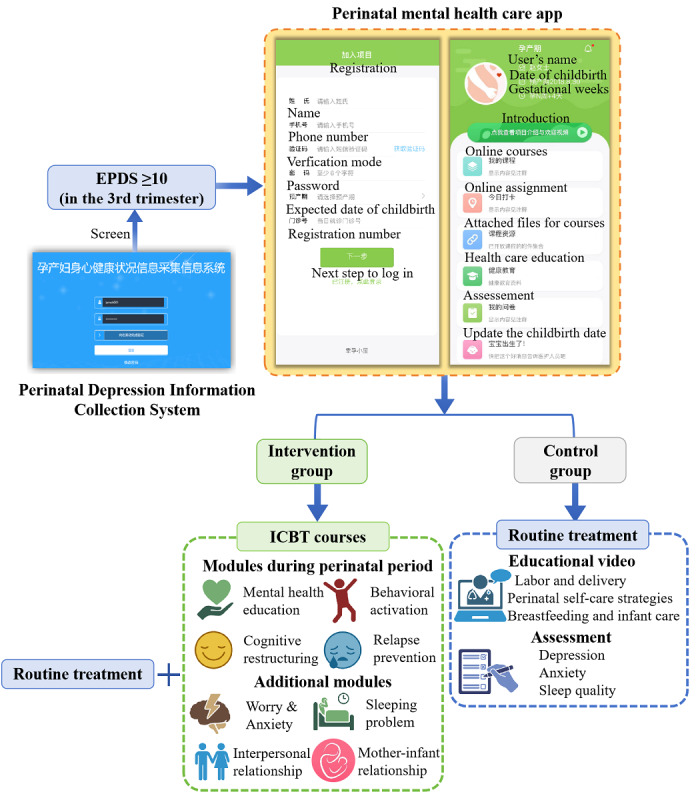
Methods: Participants were screened for antenatal depressive symptoms using the Edinburgh Postnatal Depression Scale (EPDS) and randomly allocated (1:1) to either the ICBT group (receiving weekly online modules starting antenatally and continuing into early postpartum) or the control group (observed without treatment). Follow-up assessments were conducted up to 12 months postpartum, and data were analyzed using generalized estimating equations. The primary outcome was the prevalence of depressive symptoms at 6 weeks postpartum. A subgroup analysis based on the severity of antenatal depressive symptoms was also performed. The secondary outcomes included the long-term effects of ICBT on maternal depression, as well as its impact on anxiety, sleep quality, social support, parenting stress, co-parenting relationships, and infant development.
Results: Between August 2020 and September 2021, 300 pregnant individuals were recruited from 5 centers across China. No significant differences were observed in depressive symptoms at 6 weeks postpartum (P=.18) or at any longer-term follow-up time points (P=.18). However, a post hoc subgroup analysis showed that participants with antenatal EPDS scores of 10-12 in the ICBT group had a lower risk of developing depression during the first year postpartum (odds ratio 0.534, 95% CI 0.313-0.912; P=.02), but this was not observed for participants with more severe depression. Additionally, this subgroup demonstrated higher levels of co-parenting relationships (P=.02).
Conclusions: Among individuals with antenatal depression, ICBT did not prevent the development of PPD. However, ICBT may be a preferable option for those with mild to moderate antenatal depressive symptoms. Future research is needed to explore modifications to ICBT to address more severe depressive symptoms.
Trial registration: Chinese Clinical Trial Registry ChiCTR2000033433; https://www.chictr.org.cn/showproj.html?proj=54482.
International registered report identifier (irrid): RR2-10.1186/s13063-022-06728-5.
期刊介绍:
The Journal of Medical Internet Research (JMIR) is a highly respected publication in the field of health informatics and health services. With a founding date in 1999, JMIR has been a pioneer in the field for over two decades.
As a leader in the industry, the journal focuses on digital health, data science, health informatics, and emerging technologies for health, medicine, and biomedical research. It is recognized as a top publication in these disciplines, ranking in the first quartile (Q1) by Impact Factor.
Notably, JMIR holds the prestigious position of being ranked #1 on Google Scholar within the "Medical Informatics" discipline.






 京公网安备 11010802042870号
京ICP备2023020795号-1
京公网安备 11010802042870号
京ICP备2023020795号-1

 分享
分享
 求助内容:
求助内容: 应助结果提醒方式:
 扫码关注我们
