{"title":"调查人工智能是否会取代人类医生,并了解咨询来源、健康相关污名和诊断解释对患者医疗咨询评估的相互作用:随机析因实验。","authors":"Weiqi Guo, Yang Chen","doi":"10.2196/66760","DOIUrl":null,"url":null,"abstract":"<p><strong>Background: </strong>The increasing use of artificial intelligence (AI) in medical diagnosis and consultation promises benefits such as greater accuracy and efficiency. However, there is little evidence to systematically test whether the ideal technological promises translate into an improved evaluation of the medical consultation from the patient's perspective. This perspective is significant because AI as a technological solution does not necessarily improve patient confidence in diagnosis and adherence to treatment at the functional level, create meaningful interactions between the medical agent and the patient at the relational level, evoke positive emotions, or reduce the patient's pessimism at the emotional level.</p><p><strong>Objective: </strong>This study aims to investigate, from a patient-centered perspective, whether AI or human-involved AI can replace the role of human physicians in diagnosis at the functional, relational, and emotional levels as well as how some health-related differences between human-AI and human-human interactions affect patients' evaluations of the medical consultation.</p><p><strong>Methods: </strong>A 3 (consultation source: AI vs human-involved AI vs human) × 2 (health-related stigma: low vs high) × 2 (diagnosis explanation: without vs with explanation) factorial experiment was conducted with 249 participants. The main effects and interaction effects of the variables were examined on individuals' functional, relational, and emotional evaluations of the medical consultation.</p><p><strong>Results: </strong>Functionally, people trusted the diagnosis of the human physician (mean 4.78-4.85, SD 0.06-0.07) more than medical AI (mean 4.34-4.55, SD 0.06-0.07) or human-involved AI (mean 4.39-4.56, SD 0.06-0.07; P<.001), but at the relational and emotional levels, there was no significant difference between human-AI and human-human interactions (P>.05). Health-related stigma had no significant effect on how people evaluated the medical consultation or contributed to preferring AI-powered systems over humans (P>.05); however, providing explanations of the diagnosis significantly improved the functional (P<.001), relational (P<.05), and emotional (P<.05) evaluations of the consultation for all 3 medical agents.</p><p><strong>Conclusions: </strong>The findings imply that at the current stage of AI development, people trust human expertise more than accurate AI, especially for decisions traditionally made by humans, such as medical diagnosis, supporting the algorithm aversion theory. Surprisingly, even for highly stigmatized diseases such as AIDS, where we assume anonymity and privacy are preferred in medical consultations, the dehumanization of AI does not contribute significantly to the preference for AI-powered medical agents over humans, suggesting that instrumental needs of diagnosis override patient privacy concerns. Furthermore, explaining the diagnosis effectively improves treatment adherence, strengthens the physician-patient relationship, and fosters positive emotions during the consultation. This provides insights for the design of AI medical agents, which have long been criticized for lacking transparency while making highly consequential decisions. This study concludes by outlining theoretical contributions to research on health communication and human-AI interaction and discusses the implications for the design and application of medical AI.</p>","PeriodicalId":16337,"journal":{"name":"Journal of Medical Internet Research","volume":"27 ","pages":"e66760"},"PeriodicalIF":8.2000,"publicationDate":"2025-03-05","publicationTypes":"Journal Article","fieldsOfStudy":null,"isOpenAccess":false,"openAccessPdf":"https://www.ncbi.nlm.nih.gov/pmc/articles/PMC11923482/pdf/","citationCount":"0","resultStr":"{\"title\":\"Investigating Whether AI Will Replace Human Physicians and Understanding the Interplay of the Source of Consultation, Health-Related Stigma, and Explanations of Diagnoses on Patients' Evaluations of Medical Consultations: Randomized Factorial Experiment.\",\"authors\":\"Weiqi Guo, Yang Chen\",\"doi\":\"10.2196/66760\",\"DOIUrl\":null,\"url\":null,\"abstract\":\"<p><strong>Background: </strong>The increasing use of artificial intelligence (AI) in medical diagnosis and consultation promises benefits such as greater accuracy and efficiency. However, there is little evidence to systematically test whether the ideal technological promises translate into an improved evaluation of the medical consultation from the patient's perspective. This perspective is significant because AI as a technological solution does not necessarily improve patient confidence in diagnosis and adherence to treatment at the functional level, create meaningful interactions between the medical agent and the patient at the relational level, evoke positive emotions, or reduce the patient's pessimism at the emotional level.</p><p><strong>Objective: </strong>This study aims to investigate, from a patient-centered perspective, whether AI or human-involved AI can replace the role of human physicians in diagnosis at the functional, relational, and emotional levels as well as how some health-related differences between human-AI and human-human interactions affect patients' evaluations of the medical consultation.</p><p><strong>Methods: </strong>A 3 (consultation source: AI vs human-involved AI vs human) × 2 (health-related stigma: low vs high) × 2 (diagnosis explanation: without vs with explanation) factorial experiment was conducted with 249 participants. The main effects and interaction effects of the variables were examined on individuals' functional, relational, and emotional evaluations of the medical consultation.</p><p><strong>Results: </strong>Functionally, people trusted the diagnosis of the human physician (mean 4.78-4.85, SD 0.06-0.07) more than medical AI (mean 4.34-4.55, SD 0.06-0.07) or human-involved AI (mean 4.39-4.56, SD 0.06-0.07; P<.001), but at the relational and emotional levels, there was no significant difference between human-AI and human-human interactions (P>.05). Health-related stigma had no significant effect on how people evaluated the medical consultation or contributed to preferring AI-powered systems over humans (P>.05); however, providing explanations of the diagnosis significantly improved the functional (P<.001), relational (P<.05), and emotional (P<.05) evaluations of the consultation for all 3 medical agents.</p><p><strong>Conclusions: </strong>The findings imply that at the current stage of AI development, people trust human expertise more than accurate AI, especially for decisions traditionally made by humans, such as medical diagnosis, supporting the algorithm aversion theory. Surprisingly, even for highly stigmatized diseases such as AIDS, where we assume anonymity and privacy are preferred in medical consultations, the dehumanization of AI does not contribute significantly to the preference for AI-powered medical agents over humans, suggesting that instrumental needs of diagnosis override patient privacy concerns. Furthermore, explaining the diagnosis effectively improves treatment adherence, strengthens the physician-patient relationship, and fosters positive emotions during the consultation. This provides insights for the design of AI medical agents, which have long been criticized for lacking transparency while making highly consequential decisions. This study concludes by outlining theoretical contributions to research on health communication and human-AI interaction and discusses the implications for the design and application of medical AI.</p>\",\"PeriodicalId\":16337,\"journal\":{\"name\":\"Journal of Medical Internet Research\",\"volume\":\"27 \",\"pages\":\"e66760\"},\"PeriodicalIF\":8.2000,\"publicationDate\":\"2025-03-05\",\"publicationTypes\":\"Journal Article\",\"fieldsOfStudy\":null,\"isOpenAccess\":false,\"openAccessPdf\":\"https://www.ncbi.nlm.nih.gov/pmc/articles/PMC11923482/pdf/\",\"citationCount\":\"0\",\"resultStr\":null,\"platform\":\"Semanticscholar\",\"paperid\":null,\"PeriodicalName\":\"Journal of Medical Internet Research\",\"FirstCategoryId\":\"3\",\"ListUrlMain\":\"https://doi.org/10.2196/66760\",\"RegionNum\":2,\"RegionCategory\":\"医学\",\"ArticlePicture\":[],\"TitleCN\":null,\"AbstractTextCN\":null,\"PMCID\":null,\"EPubDate\":\"\",\"PubModel\":\"\",\"JCR\":\"Q1\",\"JCRName\":\"HEALTH CARE SCIENCES & SERVICES\",\"Score\":null,\"Total\":0}","platform":"Semanticscholar","paperid":null,"PeriodicalName":"Journal of Medical Internet Research","FirstCategoryId":"3","ListUrlMain":"https://doi.org/10.2196/66760","RegionNum":2,"RegionCategory":"医学","ArticlePicture":[],"TitleCN":null,"AbstractTextCN":null,"PMCID":null,"EPubDate":"","PubModel":"","JCR":"Q1","JCRName":"HEALTH CARE SCIENCES & SERVICES","Score":null,"Total":0}
Investigating Whether AI Will Replace Human Physicians and Understanding the Interplay of the Source of Consultation, Health-Related Stigma, and Explanations of Diagnoses on Patients' Evaluations of Medical Consultations: Randomized Factorial Experiment.
Background: The increasing use of artificial intelligence (AI) in medical diagnosis and consultation promises benefits such as greater accuracy and efficiency. However, there is little evidence to systematically test whether the ideal technological promises translate into an improved evaluation of the medical consultation from the patient's perspective. This perspective is significant because AI as a technological solution does not necessarily improve patient confidence in diagnosis and adherence to treatment at the functional level, create meaningful interactions between the medical agent and the patient at the relational level, evoke positive emotions, or reduce the patient's pessimism at the emotional level.
Objective: This study aims to investigate, from a patient-centered perspective, whether AI or human-involved AI can replace the role of human physicians in diagnosis at the functional, relational, and emotional levels as well as how some health-related differences between human-AI and human-human interactions affect patients' evaluations of the medical consultation.
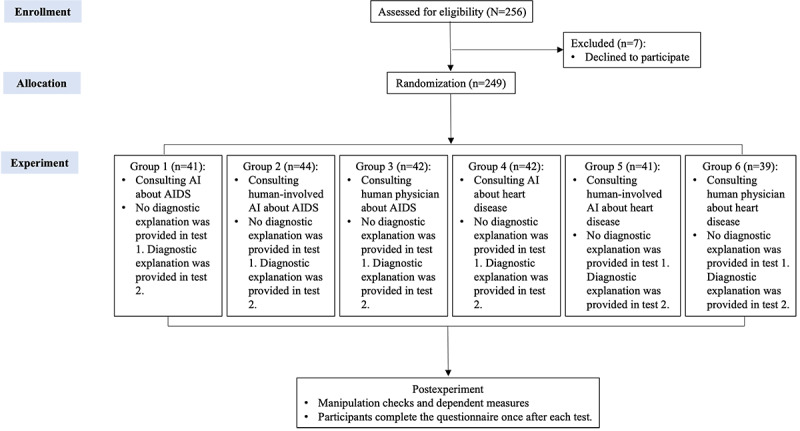
Methods: A 3 (consultation source: AI vs human-involved AI vs human) × 2 (health-related stigma: low vs high) × 2 (diagnosis explanation: without vs with explanation) factorial experiment was conducted with 249 participants. The main effects and interaction effects of the variables were examined on individuals' functional, relational, and emotional evaluations of the medical consultation.
Results: Functionally, people trusted the diagnosis of the human physician (mean 4.78-4.85, SD 0.06-0.07) more than medical AI (mean 4.34-4.55, SD 0.06-0.07) or human-involved AI (mean 4.39-4.56, SD 0.06-0.07; P<.001), but at the relational and emotional levels, there was no significant difference between human-AI and human-human interactions (P>.05). Health-related stigma had no significant effect on how people evaluated the medical consultation or contributed to preferring AI-powered systems over humans (P>.05); however, providing explanations of the diagnosis significantly improved the functional (P<.001), relational (P<.05), and emotional (P<.05) evaluations of the consultation for all 3 medical agents.
Conclusions: The findings imply that at the current stage of AI development, people trust human expertise more than accurate AI, especially for decisions traditionally made by humans, such as medical diagnosis, supporting the algorithm aversion theory. Surprisingly, even for highly stigmatized diseases such as AIDS, where we assume anonymity and privacy are preferred in medical consultations, the dehumanization of AI does not contribute significantly to the preference for AI-powered medical agents over humans, suggesting that instrumental needs of diagnosis override patient privacy concerns. Furthermore, explaining the diagnosis effectively improves treatment adherence, strengthens the physician-patient relationship, and fosters positive emotions during the consultation. This provides insights for the design of AI medical agents, which have long been criticized for lacking transparency while making highly consequential decisions. This study concludes by outlining theoretical contributions to research on health communication and human-AI interaction and discusses the implications for the design and application of medical AI.
期刊介绍:
The Journal of Medical Internet Research (JMIR) is a highly respected publication in the field of health informatics and health services. With a founding date in 1999, JMIR has been a pioneer in the field for over two decades.
As a leader in the industry, the journal focuses on digital health, data science, health informatics, and emerging technologies for health, medicine, and biomedical research. It is recognized as a top publication in these disciplines, ranking in the first quartile (Q1) by Impact Factor.
Notably, JMIR holds the prestigious position of being ranked #1 on Google Scholar within the "Medical Informatics" discipline.




 京公网安备 11010802042870号
京ICP备2023020795号-1
京公网安备 11010802042870号
京ICP备2023020795号-1

 分享
分享

 求助内容:
求助内容: 应助结果提醒方式:
 扫码关注我们
