{"title":"大型语言模型模拟人类专家对社交媒体加热烟草产品舆情评价的准确性:评价研究","authors":"Kwanho Kim, Soojong Kim","doi":"10.2196/63631","DOIUrl":null,"url":null,"abstract":"<p><strong>Background: </strong>Sentiment analysis of alternative tobacco products discussed on social media is crucial in tobacco control research. Large language models (LLMs) are artificial intelligence models that were trained on extensive text data to emulate the linguistic patterns of humans. LLMs may hold the potential to streamline the time-consuming and labor-intensive process of human sentiment analysis.</p><p><strong>Objective: </strong>This study aimed to examine the accuracy of LLMs in replicating human sentiment evaluation of social media messages relevant to heated tobacco products (HTPs).</p><p><strong>Methods: </strong>GPT-3.5 and GPT-4 Turbo (OpenAI) were used to classify 500 Facebook (Meta Platforms) and 500 Twitter (subsequently rebranded X) messages. Each set consisted of 200 human-labeled anti-HTPs, 200 pro-HTPs, and 100 neutral messages. The models evaluated each message up to 20 times to generate multiple response instances reporting its classification decisions. The majority of the labels from these responses were assigned as a model's decision for the message. The models' classification decisions were then compared with those of human evaluators.</p><p><strong>Results: </strong>GPT-3.5 accurately replicated human sentiment evaluation in 61.2% of Facebook messages and 57% of Twitter messages. GPT-4 Turbo demonstrated higher accuracies overall, with 81.7% for Facebook messages and 77% for Twitter messages. GPT-4 Turbo's accuracy with 3 response instances reached 99% of the accuracy achieved with 20 response instances. GPT-4 Turbo's accuracy was higher for human-labeled anti- and pro-HTP messages compared with neutral messages. Most of the GPT-3.5 misclassifications occurred when anti- or pro-HTP messages were incorrectly classified as neutral or irrelevant by the model, whereas GPT-4 Turbo showed improvements across all sentiment categories and reduced misclassifications, especially in incorrectly categorized messages as irrelevant.</p><p><strong>Conclusions: </strong>LLMs can be used to analyze sentiment in social media messages about HTPs. Results from GPT-4 Turbo suggest that accuracy can reach approximately 80% compared with the results of human experts, even with a small number of labeling decisions generated by the model. A potential risk of using LLMs is the misrepresentation of the overall sentiment due to the differences in accuracy across sentiment categories. Although this issue could be reduced with the newer language model, future efforts should explore the mechanisms underlying the discrepancies and how to address them systematically.</p>","PeriodicalId":16337,"journal":{"name":"Journal of Medical Internet Research","volume":"27 ","pages":"e63631"},"PeriodicalIF":6.0000,"publicationDate":"2025-03-04","publicationTypes":"Journal Article","fieldsOfStudy":null,"isOpenAccess":false,"openAccessPdf":"https://www.ncbi.nlm.nih.gov/pmc/articles/PMC11920658/pdf/","citationCount":"0","resultStr":"{\"title\":\"Large Language Models' Accuracy in Emulating Human Experts' Evaluation of Public Sentiments about Heated Tobacco Products on Social Media: Evaluation Study.\",\"authors\":\"Kwanho Kim, Soojong Kim\",\"doi\":\"10.2196/63631\",\"DOIUrl\":null,\"url\":null,\"abstract\":\"<p><strong>Background: </strong>Sentiment analysis of alternative tobacco products discussed on social media is crucial in tobacco control research. Large language models (LLMs) are artificial intelligence models that were trained on extensive text data to emulate the linguistic patterns of humans. LLMs may hold the potential to streamline the time-consuming and labor-intensive process of human sentiment analysis.</p><p><strong>Objective: </strong>This study aimed to examine the accuracy of LLMs in replicating human sentiment evaluation of social media messages relevant to heated tobacco products (HTPs).</p><p><strong>Methods: </strong>GPT-3.5 and GPT-4 Turbo (OpenAI) were used to classify 500 Facebook (Meta Platforms) and 500 Twitter (subsequently rebranded X) messages. Each set consisted of 200 human-labeled anti-HTPs, 200 pro-HTPs, and 100 neutral messages. The models evaluated each message up to 20 times to generate multiple response instances reporting its classification decisions. The majority of the labels from these responses were assigned as a model's decision for the message. The models' classification decisions were then compared with those of human evaluators.</p><p><strong>Results: </strong>GPT-3.5 accurately replicated human sentiment evaluation in 61.2% of Facebook messages and 57% of Twitter messages. GPT-4 Turbo demonstrated higher accuracies overall, with 81.7% for Facebook messages and 77% for Twitter messages. GPT-4 Turbo's accuracy with 3 response instances reached 99% of the accuracy achieved with 20 response instances. GPT-4 Turbo's accuracy was higher for human-labeled anti- and pro-HTP messages compared with neutral messages. Most of the GPT-3.5 misclassifications occurred when anti- or pro-HTP messages were incorrectly classified as neutral or irrelevant by the model, whereas GPT-4 Turbo showed improvements across all sentiment categories and reduced misclassifications, especially in incorrectly categorized messages as irrelevant.</p><p><strong>Conclusions: </strong>LLMs can be used to analyze sentiment in social media messages about HTPs. Results from GPT-4 Turbo suggest that accuracy can reach approximately 80% compared with the results of human experts, even with a small number of labeling decisions generated by the model. A potential risk of using LLMs is the misrepresentation of the overall sentiment due to the differences in accuracy across sentiment categories. Although this issue could be reduced with the newer language model, future efforts should explore the mechanisms underlying the discrepancies and how to address them systematically.</p>\",\"PeriodicalId\":16337,\"journal\":{\"name\":\"Journal of Medical Internet Research\",\"volume\":\"27 \",\"pages\":\"e63631\"},\"PeriodicalIF\":6.0000,\"publicationDate\":\"2025-03-04\",\"publicationTypes\":\"Journal Article\",\"fieldsOfStudy\":null,\"isOpenAccess\":false,\"openAccessPdf\":\"https://www.ncbi.nlm.nih.gov/pmc/articles/PMC11920658/pdf/\",\"citationCount\":\"0\",\"resultStr\":null,\"platform\":\"Semanticscholar\",\"paperid\":null,\"PeriodicalName\":\"Journal of Medical Internet Research\",\"FirstCategoryId\":\"3\",\"ListUrlMain\":\"https://doi.org/10.2196/63631\",\"RegionNum\":2,\"RegionCategory\":\"医学\",\"ArticlePicture\":[],\"TitleCN\":null,\"AbstractTextCN\":null,\"PMCID\":null,\"EPubDate\":\"\",\"PubModel\":\"\",\"JCR\":\"Q1\",\"JCRName\":\"HEALTH CARE SCIENCES & SERVICES\",\"Score\":null,\"Total\":0}","platform":"Semanticscholar","paperid":null,"PeriodicalName":"Journal of Medical Internet Research","FirstCategoryId":"3","ListUrlMain":"https://doi.org/10.2196/63631","RegionNum":2,"RegionCategory":"医学","ArticlePicture":[],"TitleCN":null,"AbstractTextCN":null,"PMCID":null,"EPubDate":"","PubModel":"","JCR":"Q1","JCRName":"HEALTH CARE SCIENCES & SERVICES","Score":null,"Total":0}
Large Language Models' Accuracy in Emulating Human Experts' Evaluation of Public Sentiments about Heated Tobacco Products on Social Media: Evaluation Study.
Background: Sentiment analysis of alternative tobacco products discussed on social media is crucial in tobacco control research. Large language models (LLMs) are artificial intelligence models that were trained on extensive text data to emulate the linguistic patterns of humans. LLMs may hold the potential to streamline the time-consuming and labor-intensive process of human sentiment analysis.
Objective: This study aimed to examine the accuracy of LLMs in replicating human sentiment evaluation of social media messages relevant to heated tobacco products (HTPs).
Methods: GPT-3.5 and GPT-4 Turbo (OpenAI) were used to classify 500 Facebook (Meta Platforms) and 500 Twitter (subsequently rebranded X) messages. Each set consisted of 200 human-labeled anti-HTPs, 200 pro-HTPs, and 100 neutral messages. The models evaluated each message up to 20 times to generate multiple response instances reporting its classification decisions. The majority of the labels from these responses were assigned as a model's decision for the message. The models' classification decisions were then compared with those of human evaluators.
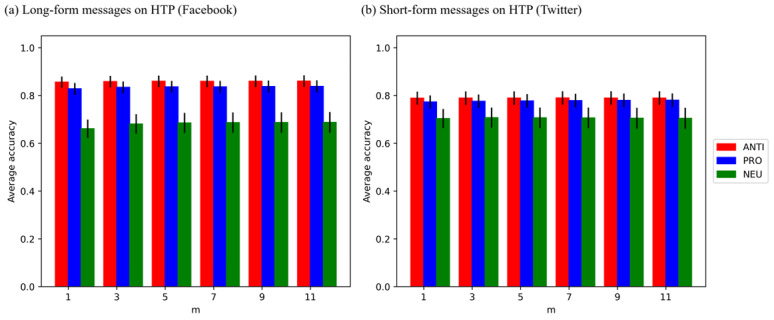
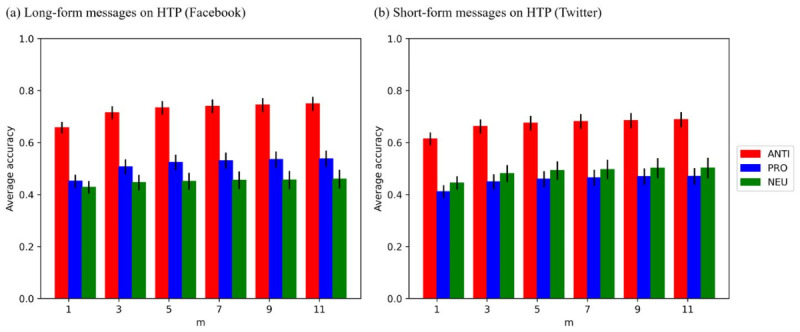
Results: GPT-3.5 accurately replicated human sentiment evaluation in 61.2% of Facebook messages and 57% of Twitter messages. GPT-4 Turbo demonstrated higher accuracies overall, with 81.7% for Facebook messages and 77% for Twitter messages. GPT-4 Turbo's accuracy with 3 response instances reached 99% of the accuracy achieved with 20 response instances. GPT-4 Turbo's accuracy was higher for human-labeled anti- and pro-HTP messages compared with neutral messages. Most of the GPT-3.5 misclassifications occurred when anti- or pro-HTP messages were incorrectly classified as neutral or irrelevant by the model, whereas GPT-4 Turbo showed improvements across all sentiment categories and reduced misclassifications, especially in incorrectly categorized messages as irrelevant.
Conclusions: LLMs can be used to analyze sentiment in social media messages about HTPs. Results from GPT-4 Turbo suggest that accuracy can reach approximately 80% compared with the results of human experts, even with a small number of labeling decisions generated by the model. A potential risk of using LLMs is the misrepresentation of the overall sentiment due to the differences in accuracy across sentiment categories. Although this issue could be reduced with the newer language model, future efforts should explore the mechanisms underlying the discrepancies and how to address them systematically.
期刊介绍:
The Journal of Medical Internet Research (JMIR) is a highly respected publication in the field of health informatics and health services. With a founding date in 1999, JMIR has been a pioneer in the field for over two decades.
As a leader in the industry, the journal focuses on digital health, data science, health informatics, and emerging technologies for health, medicine, and biomedical research. It is recognized as a top publication in these disciplines, ranking in the first quartile (Q1) by Impact Factor.
Notably, JMIR holds the prestigious position of being ranked #1 on Google Scholar within the "Medical Informatics" discipline.



 京公网安备 11010802042870号
京ICP备2023020795号-1
京公网安备 11010802042870号
京ICP备2023020795号-1

 分享
分享

 求助内容:
求助内容: 应助结果提醒方式:
 扫码关注我们
