{"title":"从系统级角度实现远程医疗:范围审查。","authors":"Xuezhu Li, Lifeng Huang, Hui Zhang, Zhanming Liang","doi":"10.2196/65932","DOIUrl":null,"url":null,"abstract":"<p><strong>Background: </strong>Telemedicine is a strategy for providing health care services remotely that improves service accessibility. Telemedicine has attracted growing research interest in the past 10 years, including systematic reviews that synthesize evidence to share experiences and enhance knowledge. However, most of the published systematic reviews have focused on synthesizing evidence from studies on telemedicine at the organizational level. A collected understanding of factors on the system level that influence the successful implementation and adoption of telemedicine needs to be developed, especially in regional and rural areas.</p><p><strong>Objective: </strong>This scoping review aims to explore key success factors and challenges that influence the implementation and adoption of telemedicine at the system level, particularly in regional and rural areas.</p><p><strong>Methods: </strong>This scoping review was conducted in accordance with the framework by Arksey and O'Malley and reported using the PRISMA-ScR (Preferred Reporting Items for Systematic Reviews and Meta-Analyses Extension for Scoping Reviews). A total of 5 databases (CINAHL, Cochrane, Medline, Ovid, and Scopus) were searched for research articles published in English between January 2010 and 2023, using the established inclusion criteria.</p><p><strong>Results: </strong>Of the 10,691 papers identified, 89 were included in this review, including 16 (17.98%) studies conducted in regional and rural areas and 13 (14.61%) in metropolitan areas. Another 13 (14.61%) studies were conducted in both metropolitan areas and regional and rural areas. Overall, 6 categories with more than 70 key success factors, including system-level requirements (n=13, 18.40%), economic considerations and funding (n=6, 8.70%), technological requirements (n=6, 8.70%), organizational requirements (n=19, 27.54%), understanding and supporting clinicians (n=12, 17.39%), and understanding and improving patients' perceptions (n=13, 18.84%), were identified. Additionally, 5 categories containing over 50 challenges, including those related to system levels (n=11, 23.91%), technological requirements (n=6, 13.04%), organizational requirements (n=13, 28.26%), clinicians (n=10, 21.74%), and patients (n=6, 13.04%), were identified. Among the identified factors, 11 (9.57%) were specific to regional and rural areas.</p><p><strong>Conclusions: </strong>This scoping review confirms that the successful implementation of telemedicine requires collective efforts at both the system and organizational levels, including coordination and collaboration across different regions and organizations. It underscores the importance of establishing a national network that enhances public awareness of telemedicine and clarity in payment and benefit distribution models and strengthens data security protection measures. The review also highlights the necessity of addressing infrastructural deficiencies, including internet connectivity in regional and rural areas, and suggests the implementation of targeted incentives and support measures. The required collective efforts are detailed in the proposed framework that promotes popularizing telemedicine, enhancing the overall quality and efficiency of health care services, and achieving broader health equity.</p>","PeriodicalId":16337,"journal":{"name":"Journal of Medical Internet Research","volume":"27 ","pages":"e65932"},"PeriodicalIF":8.2000,"publicationDate":"2025-03-05","publicationTypes":"Journal Article","fieldsOfStudy":null,"isOpenAccess":false,"openAccessPdf":"https://www.ncbi.nlm.nih.gov/pmc/articles/PMC11923472/pdf/","citationCount":"0","resultStr":"{\"title\":\"Enabling Telemedicine From the System-Level Perspective: Scoping Review.\",\"authors\":\"Xuezhu Li, Lifeng Huang, Hui Zhang, Zhanming Liang\",\"doi\":\"10.2196/65932\",\"DOIUrl\":null,\"url\":null,\"abstract\":\"<p><strong>Background: </strong>Telemedicine is a strategy for providing health care services remotely that improves service accessibility. Telemedicine has attracted growing research interest in the past 10 years, including systematic reviews that synthesize evidence to share experiences and enhance knowledge. However, most of the published systematic reviews have focused on synthesizing evidence from studies on telemedicine at the organizational level. A collected understanding of factors on the system level that influence the successful implementation and adoption of telemedicine needs to be developed, especially in regional and rural areas.</p><p><strong>Objective: </strong>This scoping review aims to explore key success factors and challenges that influence the implementation and adoption of telemedicine at the system level, particularly in regional and rural areas.</p><p><strong>Methods: </strong>This scoping review was conducted in accordance with the framework by Arksey and O'Malley and reported using the PRISMA-ScR (Preferred Reporting Items for Systematic Reviews and Meta-Analyses Extension for Scoping Reviews). A total of 5 databases (CINAHL, Cochrane, Medline, Ovid, and Scopus) were searched for research articles published in English between January 2010 and 2023, using the established inclusion criteria.</p><p><strong>Results: </strong>Of the 10,691 papers identified, 89 were included in this review, including 16 (17.98%) studies conducted in regional and rural areas and 13 (14.61%) in metropolitan areas. Another 13 (14.61%) studies were conducted in both metropolitan areas and regional and rural areas. Overall, 6 categories with more than 70 key success factors, including system-level requirements (n=13, 18.40%), economic considerations and funding (n=6, 8.70%), technological requirements (n=6, 8.70%), organizational requirements (n=19, 27.54%), understanding and supporting clinicians (n=12, 17.39%), and understanding and improving patients' perceptions (n=13, 18.84%), were identified. Additionally, 5 categories containing over 50 challenges, including those related to system levels (n=11, 23.91%), technological requirements (n=6, 13.04%), organizational requirements (n=13, 28.26%), clinicians (n=10, 21.74%), and patients (n=6, 13.04%), were identified. Among the identified factors, 11 (9.57%) were specific to regional and rural areas.</p><p><strong>Conclusions: </strong>This scoping review confirms that the successful implementation of telemedicine requires collective efforts at both the system and organizational levels, including coordination and collaboration across different regions and organizations. It underscores the importance of establishing a national network that enhances public awareness of telemedicine and clarity in payment and benefit distribution models and strengthens data security protection measures. The review also highlights the necessity of addressing infrastructural deficiencies, including internet connectivity in regional and rural areas, and suggests the implementation of targeted incentives and support measures. The required collective efforts are detailed in the proposed framework that promotes popularizing telemedicine, enhancing the overall quality and efficiency of health care services, and achieving broader health equity.</p>\",\"PeriodicalId\":16337,\"journal\":{\"name\":\"Journal of Medical Internet Research\",\"volume\":\"27 \",\"pages\":\"e65932\"},\"PeriodicalIF\":8.2000,\"publicationDate\":\"2025-03-05\",\"publicationTypes\":\"Journal Article\",\"fieldsOfStudy\":null,\"isOpenAccess\":false,\"openAccessPdf\":\"https://www.ncbi.nlm.nih.gov/pmc/articles/PMC11923472/pdf/\",\"citationCount\":\"0\",\"resultStr\":null,\"platform\":\"Semanticscholar\",\"paperid\":null,\"PeriodicalName\":\"Journal of Medical Internet Research\",\"FirstCategoryId\":\"3\",\"ListUrlMain\":\"https://doi.org/10.2196/65932\",\"RegionNum\":2,\"RegionCategory\":\"医学\",\"ArticlePicture\":[],\"TitleCN\":null,\"AbstractTextCN\":null,\"PMCID\":null,\"EPubDate\":\"\",\"PubModel\":\"\",\"JCR\":\"Q1\",\"JCRName\":\"HEALTH CARE SCIENCES & SERVICES\",\"Score\":null,\"Total\":0}","platform":"Semanticscholar","paperid":null,"PeriodicalName":"Journal of Medical Internet Research","FirstCategoryId":"3","ListUrlMain":"https://doi.org/10.2196/65932","RegionNum":2,"RegionCategory":"医学","ArticlePicture":[],"TitleCN":null,"AbstractTextCN":null,"PMCID":null,"EPubDate":"","PubModel":"","JCR":"Q1","JCRName":"HEALTH CARE SCIENCES & SERVICES","Score":null,"Total":0}
Enabling Telemedicine From the System-Level Perspective: Scoping Review.
Background: Telemedicine is a strategy for providing health care services remotely that improves service accessibility. Telemedicine has attracted growing research interest in the past 10 years, including systematic reviews that synthesize evidence to share experiences and enhance knowledge. However, most of the published systematic reviews have focused on synthesizing evidence from studies on telemedicine at the organizational level. A collected understanding of factors on the system level that influence the successful implementation and adoption of telemedicine needs to be developed, especially in regional and rural areas.
Objective: This scoping review aims to explore key success factors and challenges that influence the implementation and adoption of telemedicine at the system level, particularly in regional and rural areas.
Methods: This scoping review was conducted in accordance with the framework by Arksey and O'Malley and reported using the PRISMA-ScR (Preferred Reporting Items for Systematic Reviews and Meta-Analyses Extension for Scoping Reviews). A total of 5 databases (CINAHL, Cochrane, Medline, Ovid, and Scopus) were searched for research articles published in English between January 2010 and 2023, using the established inclusion criteria.
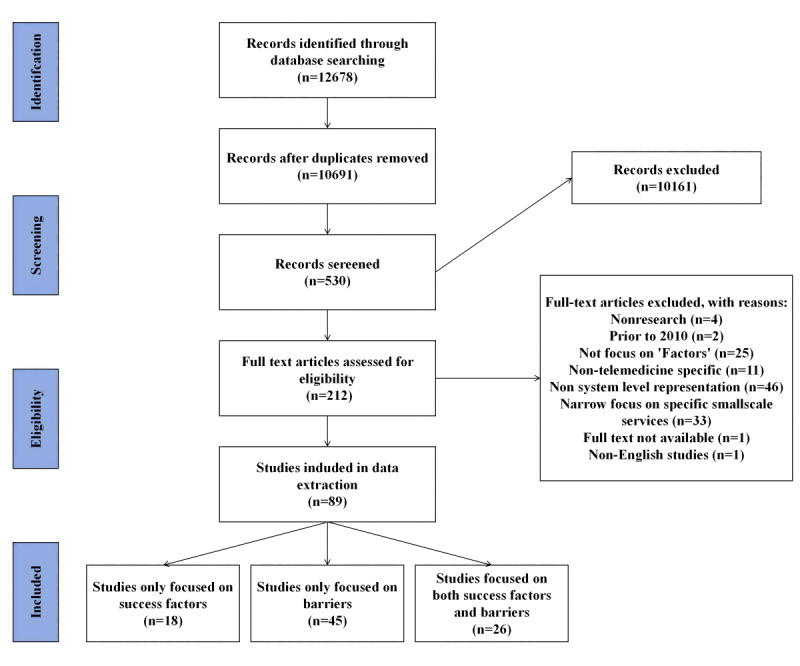
Results: Of the 10,691 papers identified, 89 were included in this review, including 16 (17.98%) studies conducted in regional and rural areas and 13 (14.61%) in metropolitan areas. Another 13 (14.61%) studies were conducted in both metropolitan areas and regional and rural areas. Overall, 6 categories with more than 70 key success factors, including system-level requirements (n=13, 18.40%), economic considerations and funding (n=6, 8.70%), technological requirements (n=6, 8.70%), organizational requirements (n=19, 27.54%), understanding and supporting clinicians (n=12, 17.39%), and understanding and improving patients' perceptions (n=13, 18.84%), were identified. Additionally, 5 categories containing over 50 challenges, including those related to system levels (n=11, 23.91%), technological requirements (n=6, 13.04%), organizational requirements (n=13, 28.26%), clinicians (n=10, 21.74%), and patients (n=6, 13.04%), were identified. Among the identified factors, 11 (9.57%) were specific to regional and rural areas.
Conclusions: This scoping review confirms that the successful implementation of telemedicine requires collective efforts at both the system and organizational levels, including coordination and collaboration across different regions and organizations. It underscores the importance of establishing a national network that enhances public awareness of telemedicine and clarity in payment and benefit distribution models and strengthens data security protection measures. The review also highlights the necessity of addressing infrastructural deficiencies, including internet connectivity in regional and rural areas, and suggests the implementation of targeted incentives and support measures. The required collective efforts are detailed in the proposed framework that promotes popularizing telemedicine, enhancing the overall quality and efficiency of health care services, and achieving broader health equity.
期刊介绍:
The Journal of Medical Internet Research (JMIR) is a highly respected publication in the field of health informatics and health services. With a founding date in 1999, JMIR has been a pioneer in the field for over two decades.
As a leader in the industry, the journal focuses on digital health, data science, health informatics, and emerging technologies for health, medicine, and biomedical research. It is recognized as a top publication in these disciplines, ranking in the first quartile (Q1) by Impact Factor.
Notably, JMIR holds the prestigious position of being ranked #1 on Google Scholar within the "Medical Informatics" discipline.





 京公网安备 11010802042870号
京ICP备2023020795号-1
京公网安备 11010802042870号
京ICP备2023020795号-1

 分享
分享

 求助内容:
求助内容: 应助结果提醒方式:
 扫码关注我们
