Eliza Berman, Holly Sundberg Malek, Michael Bitzer, Nisar Malek, Carsten Eickhoff
{"title":"分子肿瘤板检索增强治疗建议:算法开发与验证研究。","authors":"Eliza Berman, Holly Sundberg Malek, Michael Bitzer, Nisar Malek, Carsten Eickhoff","doi":"10.2196/64364","DOIUrl":null,"url":null,"abstract":"<p><strong>Background: </strong>Molecular tumor boards (MTBs) require intensive manual investigation to generate optimal treatment recommendations for patients. Large language models (LLMs) can catalyze MTB recommendations, decrease human error, improve accessibility to care, and enhance the efficiency of precision oncology.</p><p><strong>Objective: </strong>In this study, we aimed to investigate the efficacy of LLM-generated treatments for MTB patients. We specifically investigate the LLMs' ability to generate evidence-based treatment recommendations using PubMed references.</p><p><strong>Methods: </strong>We built a retrieval augmented generation pipeline using PubMed data. We prompted the resulting LLM to generate treatment recommendations with PubMed references using a test set of patients from an MTB conference at a large comprehensive cancer center at a tertiary care institution. Members of the MTB manually assessed the relevancy and correctness of the generated responses.</p><p><strong>Results: </strong>A total of 75% of the referenced articles were properly cited from PubMed, while 17% of the referenced articles were hallucinations, and the remaining were not properly cited from PubMed. Clinician-generated LLM queries achieved higher accuracy through clinician evaluation than automated queries, with clinicians labeling 25% of LLM responses as equal to their recommendations and 37.5% as alternative plausible treatments.</p><p><strong>Conclusions: </strong>This study demonstrates how retrieval augmented generation-enhanced LLMs can be a powerful tool in accelerating MTB conferences, as LLMs are sometimes capable of achieving clinician-equal treatment recommendations. However, further investigation is required to achieve stable results with zero hallucinations. LLMs signify a scalable solution to the time-intensive process of MTB investigations. However, LLM performance demonstrates that they must be used with heavy clinician supervision, and cannot yet fully automate the MTB pipeline.</p>","PeriodicalId":16337,"journal":{"name":"Journal of Medical Internet Research","volume":"27 ","pages":"e64364"},"PeriodicalIF":8.2000,"publicationDate":"2025-03-05","publicationTypes":"Journal Article","fieldsOfStudy":null,"isOpenAccess":false,"openAccessPdf":"https://www.ncbi.nlm.nih.gov/pmc/articles/PMC11923455/pdf/","citationCount":"0","resultStr":"{\"title\":\"Retrieval Augmented Therapy Suggestion for Molecular Tumor Boards: Algorithmic Development and Validation Study.\",\"authors\":\"Eliza Berman, Holly Sundberg Malek, Michael Bitzer, Nisar Malek, Carsten Eickhoff\",\"doi\":\"10.2196/64364\",\"DOIUrl\":null,\"url\":null,\"abstract\":\"<p><strong>Background: </strong>Molecular tumor boards (MTBs) require intensive manual investigation to generate optimal treatment recommendations for patients. Large language models (LLMs) can catalyze MTB recommendations, decrease human error, improve accessibility to care, and enhance the efficiency of precision oncology.</p><p><strong>Objective: </strong>In this study, we aimed to investigate the efficacy of LLM-generated treatments for MTB patients. We specifically investigate the LLMs' ability to generate evidence-based treatment recommendations using PubMed references.</p><p><strong>Methods: </strong>We built a retrieval augmented generation pipeline using PubMed data. We prompted the resulting LLM to generate treatment recommendations with PubMed references using a test set of patients from an MTB conference at a large comprehensive cancer center at a tertiary care institution. Members of the MTB manually assessed the relevancy and correctness of the generated responses.</p><p><strong>Results: </strong>A total of 75% of the referenced articles were properly cited from PubMed, while 17% of the referenced articles were hallucinations, and the remaining were not properly cited from PubMed. Clinician-generated LLM queries achieved higher accuracy through clinician evaluation than automated queries, with clinicians labeling 25% of LLM responses as equal to their recommendations and 37.5% as alternative plausible treatments.</p><p><strong>Conclusions: </strong>This study demonstrates how retrieval augmented generation-enhanced LLMs can be a powerful tool in accelerating MTB conferences, as LLMs are sometimes capable of achieving clinician-equal treatment recommendations. However, further investigation is required to achieve stable results with zero hallucinations. LLMs signify a scalable solution to the time-intensive process of MTB investigations. However, LLM performance demonstrates that they must be used with heavy clinician supervision, and cannot yet fully automate the MTB pipeline.</p>\",\"PeriodicalId\":16337,\"journal\":{\"name\":\"Journal of Medical Internet Research\",\"volume\":\"27 \",\"pages\":\"e64364\"},\"PeriodicalIF\":8.2000,\"publicationDate\":\"2025-03-05\",\"publicationTypes\":\"Journal Article\",\"fieldsOfStudy\":null,\"isOpenAccess\":false,\"openAccessPdf\":\"https://www.ncbi.nlm.nih.gov/pmc/articles/PMC11923455/pdf/\",\"citationCount\":\"0\",\"resultStr\":null,\"platform\":\"Semanticscholar\",\"paperid\":null,\"PeriodicalName\":\"Journal of Medical Internet Research\",\"FirstCategoryId\":\"3\",\"ListUrlMain\":\"https://doi.org/10.2196/64364\",\"RegionNum\":2,\"RegionCategory\":\"医学\",\"ArticlePicture\":[],\"TitleCN\":null,\"AbstractTextCN\":null,\"PMCID\":null,\"EPubDate\":\"\",\"PubModel\":\"\",\"JCR\":\"Q1\",\"JCRName\":\"HEALTH CARE SCIENCES & SERVICES\",\"Score\":null,\"Total\":0}","platform":"Semanticscholar","paperid":null,"PeriodicalName":"Journal of Medical Internet Research","FirstCategoryId":"3","ListUrlMain":"https://doi.org/10.2196/64364","RegionNum":2,"RegionCategory":"医学","ArticlePicture":[],"TitleCN":null,"AbstractTextCN":null,"PMCID":null,"EPubDate":"","PubModel":"","JCR":"Q1","JCRName":"HEALTH CARE SCIENCES & SERVICES","Score":null,"Total":0}
Retrieval Augmented Therapy Suggestion for Molecular Tumor Boards: Algorithmic Development and Validation Study.
Background: Molecular tumor boards (MTBs) require intensive manual investigation to generate optimal treatment recommendations for patients. Large language models (LLMs) can catalyze MTB recommendations, decrease human error, improve accessibility to care, and enhance the efficiency of precision oncology.
Objective: In this study, we aimed to investigate the efficacy of LLM-generated treatments for MTB patients. We specifically investigate the LLMs' ability to generate evidence-based treatment recommendations using PubMed references.
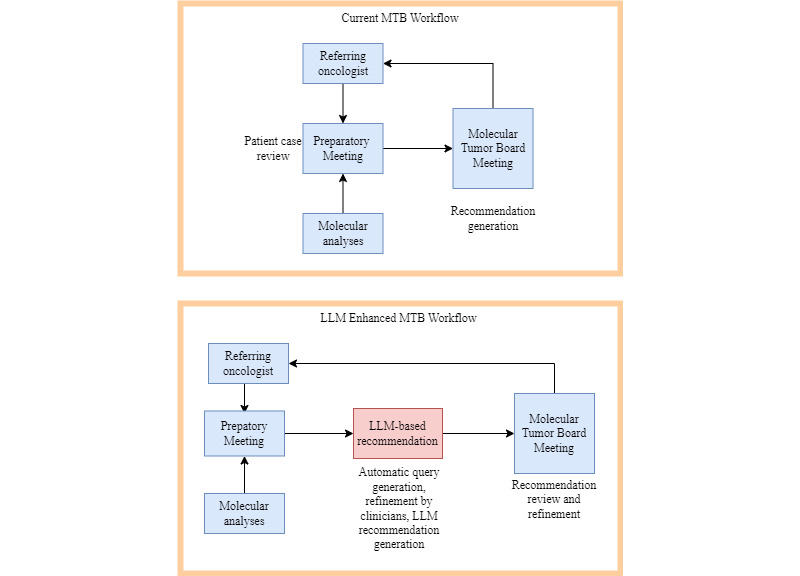
Methods: We built a retrieval augmented generation pipeline using PubMed data. We prompted the resulting LLM to generate treatment recommendations with PubMed references using a test set of patients from an MTB conference at a large comprehensive cancer center at a tertiary care institution. Members of the MTB manually assessed the relevancy and correctness of the generated responses.
Results: A total of 75% of the referenced articles were properly cited from PubMed, while 17% of the referenced articles were hallucinations, and the remaining were not properly cited from PubMed. Clinician-generated LLM queries achieved higher accuracy through clinician evaluation than automated queries, with clinicians labeling 25% of LLM responses as equal to their recommendations and 37.5% as alternative plausible treatments.
Conclusions: This study demonstrates how retrieval augmented generation-enhanced LLMs can be a powerful tool in accelerating MTB conferences, as LLMs are sometimes capable of achieving clinician-equal treatment recommendations. However, further investigation is required to achieve stable results with zero hallucinations. LLMs signify a scalable solution to the time-intensive process of MTB investigations. However, LLM performance demonstrates that they must be used with heavy clinician supervision, and cannot yet fully automate the MTB pipeline.
期刊介绍:
The Journal of Medical Internet Research (JMIR) is a highly respected publication in the field of health informatics and health services. With a founding date in 1999, JMIR has been a pioneer in the field for over two decades.
As a leader in the industry, the journal focuses on digital health, data science, health informatics, and emerging technologies for health, medicine, and biomedical research. It is recognized as a top publication in these disciplines, ranking in the first quartile (Q1) by Impact Factor.
Notably, JMIR holds the prestigious position of being ranked #1 on Google Scholar within the "Medical Informatics" discipline.





 京公网安备 11010802042870号
京ICP备2023020795号-1
京公网安备 11010802042870号
京ICP备2023020795号-1

 分享
分享

 求助内容:
求助内容: 应助结果提醒方式:
 扫码关注我们
