{"title":"探索COVID-19期间及以后慢性阻塞性肺疾病人群的心理趋势:大规模纵向推特挖掘研究","authors":"Chunyan Zhang, Ting Wang, Caixia Dong, Duwei Dai, Linyun Zhou, Zongfang Li, Songhua Xu","doi":"10.2196/54543","DOIUrl":null,"url":null,"abstract":"<p><strong>Background: </strong>Chronic obstructive pulmonary disease (COPD) ranks among the leading causes of global mortality, and COVID-19 has intensified its challenges. Beyond the evident physical effects, the long-term psychological effects of COVID-19 are not fully understood.</p><p><strong>Objective: </strong>This study aims to unveil the long-term psychological trends and patterns in populations with COPD throughout the COVID-19 pandemic and beyond via large-scale Twitter mining.</p><p><strong>Methods: </strong>A 2-stage deep learning framework was designed in this study. The first stage involved a data retrieval procedure to identify COPD and non-COPD users and to collect their daily tweets. In the second stage, a data mining procedure leveraged various deep learning algorithms to extract demographic characteristics, hashtags, topics, and sentiments from the collected tweets. Based on these data, multiple analytical methods, namely, odds ratio (OR), difference-in-difference, and emotion pattern methods, were used to examine the psychological effects.</p><p><strong>Results: </strong>A cohort of 15,347 COPD users was identified from the data that we collected in the Twitter database, comprising over 2.5 billion tweets, spanning from January 2020 to June 2023. The attentiveness toward COPD was significantly affected by gender, age, and occupation; it was lower in females (OR 0.91, 95% CI 0.87-0.94; P<.001) than in males, higher in adults aged 40 years and older (OR 7.23, 95% CI 6.95-7.52; P<.001) than in those younger than 40 years, and higher in individuals with lower socioeconomic status (OR 1.66, 95% CI 1.60-1.72; P<.001) than in those with higher socioeconomic status. Across the study duration, COPD users showed decreasing concerns for COVID-19 and increasing health-related concerns. After the middle phase of COVID-19 (July 2021), a distinct decrease in sentiments among COPD users contrasted sharply with the upward trend among non-COPD users. Notably, in the post-COVID era (June 2023), COPD users showed reduced levels of joy and trust and increased levels of fear compared to their levels of joy and trust in the middle phase of COVID-19. Moreover, males, older adults, and individuals with lower socioeconomic status showed heightened fear compared to their counterparts.</p><p><strong>Conclusions: </strong>Our data analysis results suggest that populations with COPD experienced heightened mental stress in the post-COVID era. This underscores the importance of developing tailored interventions and support systems that account for diverse population characteristics.</p>","PeriodicalId":16337,"journal":{"name":"Journal of Medical Internet Research","volume":"27 ","pages":"e54543"},"PeriodicalIF":6.0000,"publicationDate":"2025-03-05","publicationTypes":"Journal Article","fieldsOfStudy":null,"isOpenAccess":false,"openAccessPdf":"https://www.ncbi.nlm.nih.gov/pmc/articles/PMC11923484/pdf/","citationCount":"0","resultStr":"{\"title\":\"Exploring Psychological Trends in Populations With Chronic Obstructive Pulmonary Disease During COVID-19 and Beyond: Large-Scale Longitudinal Twitter Mining Study.\",\"authors\":\"Chunyan Zhang, Ting Wang, Caixia Dong, Duwei Dai, Linyun Zhou, Zongfang Li, Songhua Xu\",\"doi\":\"10.2196/54543\",\"DOIUrl\":null,\"url\":null,\"abstract\":\"<p><strong>Background: </strong>Chronic obstructive pulmonary disease (COPD) ranks among the leading causes of global mortality, and COVID-19 has intensified its challenges. Beyond the evident physical effects, the long-term psychological effects of COVID-19 are not fully understood.</p><p><strong>Objective: </strong>This study aims to unveil the long-term psychological trends and patterns in populations with COPD throughout the COVID-19 pandemic and beyond via large-scale Twitter mining.</p><p><strong>Methods: </strong>A 2-stage deep learning framework was designed in this study. The first stage involved a data retrieval procedure to identify COPD and non-COPD users and to collect their daily tweets. In the second stage, a data mining procedure leveraged various deep learning algorithms to extract demographic characteristics, hashtags, topics, and sentiments from the collected tweets. Based on these data, multiple analytical methods, namely, odds ratio (OR), difference-in-difference, and emotion pattern methods, were used to examine the psychological effects.</p><p><strong>Results: </strong>A cohort of 15,347 COPD users was identified from the data that we collected in the Twitter database, comprising over 2.5 billion tweets, spanning from January 2020 to June 2023. The attentiveness toward COPD was significantly affected by gender, age, and occupation; it was lower in females (OR 0.91, 95% CI 0.87-0.94; P<.001) than in males, higher in adults aged 40 years and older (OR 7.23, 95% CI 6.95-7.52; P<.001) than in those younger than 40 years, and higher in individuals with lower socioeconomic status (OR 1.66, 95% CI 1.60-1.72; P<.001) than in those with higher socioeconomic status. Across the study duration, COPD users showed decreasing concerns for COVID-19 and increasing health-related concerns. After the middle phase of COVID-19 (July 2021), a distinct decrease in sentiments among COPD users contrasted sharply with the upward trend among non-COPD users. Notably, in the post-COVID era (June 2023), COPD users showed reduced levels of joy and trust and increased levels of fear compared to their levels of joy and trust in the middle phase of COVID-19. Moreover, males, older adults, and individuals with lower socioeconomic status showed heightened fear compared to their counterparts.</p><p><strong>Conclusions: </strong>Our data analysis results suggest that populations with COPD experienced heightened mental stress in the post-COVID era. This underscores the importance of developing tailored interventions and support systems that account for diverse population characteristics.</p>\",\"PeriodicalId\":16337,\"journal\":{\"name\":\"Journal of Medical Internet Research\",\"volume\":\"27 \",\"pages\":\"e54543\"},\"PeriodicalIF\":6.0000,\"publicationDate\":\"2025-03-05\",\"publicationTypes\":\"Journal Article\",\"fieldsOfStudy\":null,\"isOpenAccess\":false,\"openAccessPdf\":\"https://www.ncbi.nlm.nih.gov/pmc/articles/PMC11923484/pdf/\",\"citationCount\":\"0\",\"resultStr\":null,\"platform\":\"Semanticscholar\",\"paperid\":null,\"PeriodicalName\":\"Journal of Medical Internet Research\",\"FirstCategoryId\":\"3\",\"ListUrlMain\":\"https://doi.org/10.2196/54543\",\"RegionNum\":2,\"RegionCategory\":\"医学\",\"ArticlePicture\":[],\"TitleCN\":null,\"AbstractTextCN\":null,\"PMCID\":null,\"EPubDate\":\"\",\"PubModel\":\"\",\"JCR\":\"Q1\",\"JCRName\":\"HEALTH CARE SCIENCES & SERVICES\",\"Score\":null,\"Total\":0}","platform":"Semanticscholar","paperid":null,"PeriodicalName":"Journal of Medical Internet Research","FirstCategoryId":"3","ListUrlMain":"https://doi.org/10.2196/54543","RegionNum":2,"RegionCategory":"医学","ArticlePicture":[],"TitleCN":null,"AbstractTextCN":null,"PMCID":null,"EPubDate":"","PubModel":"","JCR":"Q1","JCRName":"HEALTH CARE SCIENCES & SERVICES","Score":null,"Total":0}
引用次数: 0
摘要
背景:慢性阻塞性肺疾病(COPD)是全球死亡的主要原因之一,COVID-19加剧了其挑战。除了明显的身体影响外,COVID-19的长期心理影响尚未完全了解。目的:本研究旨在通过大规模Twitter挖掘,揭示COVID-19大流行期间及以后COPD人群的长期心理趋势和模式。方法:本研究设计了一个两阶段深度学习框架。第一阶段涉及数据检索程序,以识别COPD和非COPD用户,并收集他们的每日推文。在第二阶段,数据挖掘过程利用各种深度学习算法从收集的推文中提取人口统计特征、标签、主题和情绪。在此基础上,采用比值比(OR)、差中差法、情绪模式法等多种分析方法对心理效应进行检验。结果:从我们在Twitter数据库中收集的数据中确定了15,347名COPD用户,包括超过25亿条推文,时间跨度为2020年1月至2023年6月。性别、年龄、职业对COPD的关注程度有显著影响;女性较低(OR 0.91, 95% CI 0.87-0.94;结论:我们的数据分析结果表明,COPD患者在后covid时代经历了更高的精神压力。这强调了根据不同人口特征制定有针对性的干预措施和支持系统的重要性。
Exploring Psychological Trends in Populations With Chronic Obstructive Pulmonary Disease During COVID-19 and Beyond: Large-Scale Longitudinal Twitter Mining Study.
Background: Chronic obstructive pulmonary disease (COPD) ranks among the leading causes of global mortality, and COVID-19 has intensified its challenges. Beyond the evident physical effects, the long-term psychological effects of COVID-19 are not fully understood.
Objective: This study aims to unveil the long-term psychological trends and patterns in populations with COPD throughout the COVID-19 pandemic and beyond via large-scale Twitter mining.
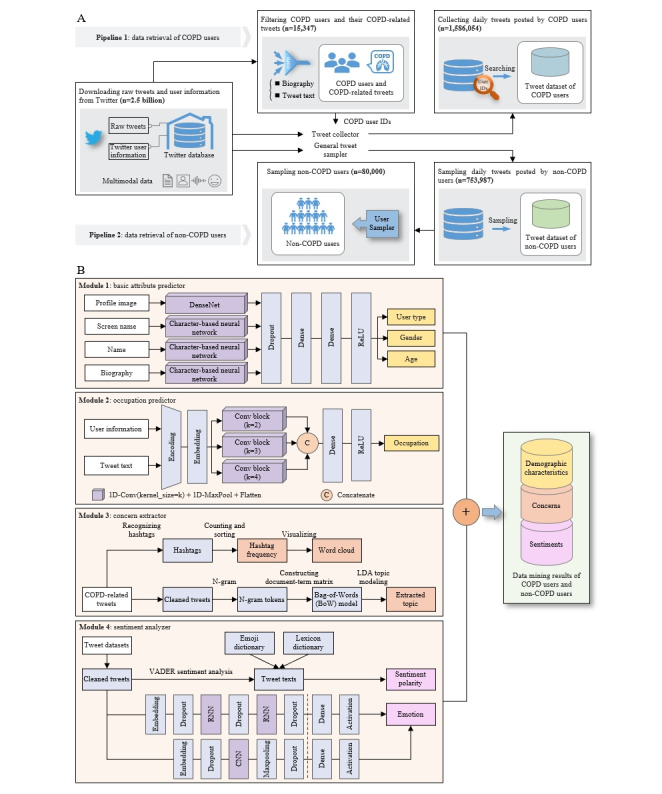
Methods: A 2-stage deep learning framework was designed in this study. The first stage involved a data retrieval procedure to identify COPD and non-COPD users and to collect their daily tweets. In the second stage, a data mining procedure leveraged various deep learning algorithms to extract demographic characteristics, hashtags, topics, and sentiments from the collected tweets. Based on these data, multiple analytical methods, namely, odds ratio (OR), difference-in-difference, and emotion pattern methods, were used to examine the psychological effects.
Results: A cohort of 15,347 COPD users was identified from the data that we collected in the Twitter database, comprising over 2.5 billion tweets, spanning from January 2020 to June 2023. The attentiveness toward COPD was significantly affected by gender, age, and occupation; it was lower in females (OR 0.91, 95% CI 0.87-0.94; P<.001) than in males, higher in adults aged 40 years and older (OR 7.23, 95% CI 6.95-7.52; P<.001) than in those younger than 40 years, and higher in individuals with lower socioeconomic status (OR 1.66, 95% CI 1.60-1.72; P<.001) than in those with higher socioeconomic status. Across the study duration, COPD users showed decreasing concerns for COVID-19 and increasing health-related concerns. After the middle phase of COVID-19 (July 2021), a distinct decrease in sentiments among COPD users contrasted sharply with the upward trend among non-COPD users. Notably, in the post-COVID era (June 2023), COPD users showed reduced levels of joy and trust and increased levels of fear compared to their levels of joy and trust in the middle phase of COVID-19. Moreover, males, older adults, and individuals with lower socioeconomic status showed heightened fear compared to their counterparts.
Conclusions: Our data analysis results suggest that populations with COPD experienced heightened mental stress in the post-COVID era. This underscores the importance of developing tailored interventions and support systems that account for diverse population characteristics.
期刊介绍:
The Journal of Medical Internet Research (JMIR) is a highly respected publication in the field of health informatics and health services. With a founding date in 1999, JMIR has been a pioneer in the field for over two decades.
As a leader in the industry, the journal focuses on digital health, data science, health informatics, and emerging technologies for health, medicine, and biomedical research. It is recognized as a top publication in these disciplines, ranking in the first quartile (Q1) by Impact Factor.
Notably, JMIR holds the prestigious position of being ranked #1 on Google Scholar within the "Medical Informatics" discipline.






 京公网安备 11010802042870号
京ICP备2023020795号-1
京公网安备 11010802042870号
京ICP备2023020795号-1

 分享
分享

 求助内容:
求助内容: 应助结果提醒方式:
 扫码关注我们
