{"title":"以马尾藻为还原剂的二氧化钛纳米颗粒的生物合成及其对白色念珠菌的抗菌作用","authors":"Nazurudeen Jabeen , Karuppiah Prabhalakshmi , Ganapathy Dhanraj , Ramasamy Ramasubburayan","doi":"10.1016/j.micpath.2025.107452","DOIUrl":null,"url":null,"abstract":"<div><div>The present study aimed to biosynthesize titanium dioxide nanoparticles (TiO<sub>2</sub>NPs) using marine macroalgae <em>Sargassum tenerrimum</em> (ST) and ascertain its ability to impede biofilm formation, exopolysaccharide production and induce protein leakage in dental caries-forming <em>Candida albicans</em>. Characterization of ST-TiO<sub>2</sub>NPs by UV–Vis spectra recorded a sharp peak at 365 nm. FT-IR results showed active functional groups involved in stabilizing the ST-TiO<sub>2</sub>NPs. XRD results confirmed the nano-crystalline nature with a mean grain size of 65.8 nm. FE-SEM results revealed that ST-TiO<sub>2</sub>NPs were spherical and square-shaped, and EDX affirmed titanium. Zeta potential analysis affirmed the stability of the ST-TiO<sub>2</sub> nanoparticles. TiO<sub>2</sub>NPs efficiently impeded biofilm formation (32 %–97 %) by <em>C. albicans</em> in a dose-dependent manner. Antibiofilm assay by Confocal Laser Scanning Microscope (CLSM) study showed that at 150 μg/ml, the ST-TiO<sub>2</sub>NPs strongly disrupted the biofilm architecture of <em>C. albicans</em>. This was further substantiated by a notable reduction in exopolysaccharide and a rise in protein leakage with the increase in concentration (50–150 μg/ml) of ST-TiO<sub>2</sub>NPs and time interval (12 h–60 h). This is the first study emphasizing that <em>S.</em> <em>tenerrimum</em>-mediated TiO<sub>2</sub>NPs strongly deterred and distorted <em>C. albicans</em> biofilms and further suggested that it could be effectively utilized as nano-antibiotics by coating the surface of dental implants to mitigate biofilm formation by oral pathogens.</div></div>","PeriodicalId":18599,"journal":{"name":"Microbial pathogenesis","volume":"202 ","pages":"Article 107452"},"PeriodicalIF":3.5000,"publicationDate":"2025-05-01","publicationTypes":"Journal Article","fieldsOfStudy":null,"isOpenAccess":false,"openAccessPdf":"","citationCount":"0","resultStr":"{\"title\":\"Biosynthesis of titanium dioxide nanoparticles using Sargassum tenerrimum as reductant and deciphering its antibiofilm role against cariogenic Candida albicans\",\"authors\":\"Nazurudeen Jabeen , Karuppiah Prabhalakshmi , Ganapathy Dhanraj , Ramasamy Ramasubburayan\",\"doi\":\"10.1016/j.micpath.2025.107452\",\"DOIUrl\":null,\"url\":null,\"abstract\":\"<div><div>The present study aimed to biosynthesize titanium dioxide nanoparticles (TiO<sub>2</sub>NPs) using marine macroalgae <em>Sargassum tenerrimum</em> (ST) and ascertain its ability to impede biofilm formation, exopolysaccharide production and induce protein leakage in dental caries-forming <em>Candida albicans</em>. Characterization of ST-TiO<sub>2</sub>NPs by UV–Vis spectra recorded a sharp peak at 365 nm. FT-IR results showed active functional groups involved in stabilizing the ST-TiO<sub>2</sub>NPs. XRD results confirmed the nano-crystalline nature with a mean grain size of 65.8 nm. FE-SEM results revealed that ST-TiO<sub>2</sub>NPs were spherical and square-shaped, and EDX affirmed titanium. Zeta potential analysis affirmed the stability of the ST-TiO<sub>2</sub> nanoparticles. TiO<sub>2</sub>NPs efficiently impeded biofilm formation (32 %–97 %) by <em>C. albicans</em> in a dose-dependent manner. Antibiofilm assay by Confocal Laser Scanning Microscope (CLSM) study showed that at 150 μg/ml, the ST-TiO<sub>2</sub>NPs strongly disrupted the biofilm architecture of <em>C. albicans</em>. This was further substantiated by a notable reduction in exopolysaccharide and a rise in protein leakage with the increase in concentration (50–150 μg/ml) of ST-TiO<sub>2</sub>NPs and time interval (12 h–60 h). This is the first study emphasizing that <em>S.</em> <em>tenerrimum</em>-mediated TiO<sub>2</sub>NPs strongly deterred and distorted <em>C. albicans</em> biofilms and further suggested that it could be effectively utilized as nano-antibiotics by coating the surface of dental implants to mitigate biofilm formation by oral pathogens.</div></div>\",\"PeriodicalId\":18599,\"journal\":{\"name\":\"Microbial pathogenesis\",\"volume\":\"202 \",\"pages\":\"Article 107452\"},\"PeriodicalIF\":3.5000,\"publicationDate\":\"2025-05-01\",\"publicationTypes\":\"Journal Article\",\"fieldsOfStudy\":null,\"isOpenAccess\":false,\"openAccessPdf\":\"\",\"citationCount\":\"0\",\"resultStr\":null,\"platform\":\"Semanticscholar\",\"paperid\":null,\"PeriodicalName\":\"Microbial pathogenesis\",\"FirstCategoryId\":\"3\",\"ListUrlMain\":\"https://www.sciencedirect.com/science/article/pii/S0882401025001779\",\"RegionNum\":3,\"RegionCategory\":\"医学\",\"ArticlePicture\":[],\"TitleCN\":null,\"AbstractTextCN\":null,\"PMCID\":null,\"EPubDate\":\"2025/3/6 0:00:00\",\"PubModel\":\"Epub\",\"JCR\":\"Q3\",\"JCRName\":\"IMMUNOLOGY\",\"Score\":null,\"Total\":0}","platform":"Semanticscholar","paperid":null,"PeriodicalName":"Microbial pathogenesis","FirstCategoryId":"3","ListUrlMain":"https://www.sciencedirect.com/science/article/pii/S0882401025001779","RegionNum":3,"RegionCategory":"医学","ArticlePicture":[],"TitleCN":null,"AbstractTextCN":null,"PMCID":null,"EPubDate":"2025/3/6 0:00:00","PubModel":"Epub","JCR":"Q3","JCRName":"IMMUNOLOGY","Score":null,"Total":0}
Biosynthesis of titanium dioxide nanoparticles using Sargassum tenerrimum as reductant and deciphering its antibiofilm role against cariogenic Candida albicans
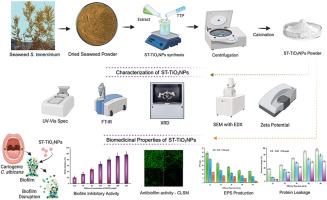
The present study aimed to biosynthesize titanium dioxide nanoparticles (TiO2NPs) using marine macroalgae Sargassum tenerrimum (ST) and ascertain its ability to impede biofilm formation, exopolysaccharide production and induce protein leakage in dental caries-forming Candida albicans. Characterization of ST-TiO2NPs by UV–Vis spectra recorded a sharp peak at 365 nm. FT-IR results showed active functional groups involved in stabilizing the ST-TiO2NPs. XRD results confirmed the nano-crystalline nature with a mean grain size of 65.8 nm. FE-SEM results revealed that ST-TiO2NPs were spherical and square-shaped, and EDX affirmed titanium. Zeta potential analysis affirmed the stability of the ST-TiO2 nanoparticles. TiO2NPs efficiently impeded biofilm formation (32 %–97 %) by C. albicans in a dose-dependent manner. Antibiofilm assay by Confocal Laser Scanning Microscope (CLSM) study showed that at 150 μg/ml, the ST-TiO2NPs strongly disrupted the biofilm architecture of C. albicans. This was further substantiated by a notable reduction in exopolysaccharide and a rise in protein leakage with the increase in concentration (50–150 μg/ml) of ST-TiO2NPs and time interval (12 h–60 h). This is the first study emphasizing that S.tenerrimum-mediated TiO2NPs strongly deterred and distorted C. albicans biofilms and further suggested that it could be effectively utilized as nano-antibiotics by coating the surface of dental implants to mitigate biofilm formation by oral pathogens.
期刊介绍:
Microbial Pathogenesis publishes original contributions and reviews about the molecular and cellular mechanisms of infectious diseases. It covers microbiology, host-pathogen interaction and immunology related to infectious agents, including bacteria, fungi, viruses and protozoa. It also accepts papers in the field of clinical microbiology, with the exception of case reports.
Research Areas Include:
-Pathogenesis
-Virulence factors
-Host susceptibility or resistance
-Immune mechanisms
-Identification, cloning and sequencing of relevant genes
-Genetic studies
-Viruses, prokaryotic organisms and protozoa
-Microbiota
-Systems biology related to infectious diseases
-Targets for vaccine design (pre-clinical studies)




 京公网安备 11010802042870号
京ICP备2023020795号-1
京公网安备 11010802042870号
京ICP备2023020795号-1

 分享
分享
 求助内容:
求助内容: 应助结果提醒方式:
 扫码关注我们
