Andrey P. Kroitor, Alexander A. Dmitrienko, Gayane A. Kirakosyan, Chantal Lorentz, Alexander G. Martynov, Yulia G. Gorbunova, Aslan Yu. Tsivadze, Alexander B. Sorokin
{"title":"(1R,2S,5R)-薄荷氧基形成手性袋的酞菁钌对映选择性催化设计","authors":"Andrey P. Kroitor, Alexander A. Dmitrienko, Gayane A. Kirakosyan, Chantal Lorentz, Alexander G. Martynov, Yulia G. Gorbunova, Aslan Yu. Tsivadze, Alexander B. Sorokin","doi":"10.1021/acscatal.4c07696","DOIUrl":null,"url":null,"abstract":"Unprecedented chiral ruthenium(II) complexes with phthalocyanines having chiral motifs near the catalytic metal site have been prepared by cross condensation of the chiral 3,6-bis-aryloxy-phthalonitrile (<b>α-Ar*O</b>)<sub>2</sub><b>Pn</b> bearing two (1<i>R</i>,2<i>S</i>,5<i>R</i>)-menthoxy groups orthogonal to the aromatic plane and (15-crown-5)phthalonitrile. Four complexes containing chiral menthyl groups (<b>M</b>) and 15-crown-5 units (<b>C</b>), notably <b>RuPc[MC</b><sub><b>3</b></sub><b>](CO)</b>, <b>RuPc[</b><i>opp</i><b>-M</b><sub><b>2</b></sub><b>C</b><sub><b>2</b></sub><b>](CO)</b>, <b>RuPc[</b><i>adj</i><b>-M</b><sub><b>2</b></sub><b>C</b><sub><b>2</b></sub><b>](CO)</b>, and <b>RuPc[M</b><sub><b>3</b></sub><b>C](CO)</b>, were isolated in pure form and fully characterized by UV–vis, circular dichroism, HRMS, and various <sup>1</sup>H NMR and <sup>13</sup>C NMR techniques. Their evaluation in the benchmark asymmetric cyclopropanation reaction of styrene derivatives by ethyl diazoacetate indicated that the <b>RuPc[</b><i>opp</i><b>-M</b><sub><b>2</b></sub><b>C</b><sub><b>2</b></sub><b>](CO)</b> complex was the most efficient in terms of diastereo- and enantioselectivity. Further study revealed the strong dependence of the stereoselectivity on the solvent nature and salt additives, which caused conformational rearrangement of the flexible chiral surrounding, as evidenced by multinuclear NMR and CD spectra. For instance, upon moving from commonly used CH<sub>2</sub>Cl<sub>2</sub> to EtOH with the addition of NaPF<sub>6</sub>, a significant enhancement of enantioselectivity (from 35 to 84% with <i>p</i>-methylstyrene) was obtained. Of particular importance is a very high diastereoselectivity of cyclopropanation of many substrates promoted by the incorporation of sodium cations into crown ether cavities of phthalocyanine to attain a <i>trans</i>/<i>cis</i> ratio up to 499:1. Such a regulating effect in chiral catalysis involving tetrapyrrolic complexes has not been previously observed, rendering this complex a prominent example of the phthalocyanine tunable catalyst. The developed synthetic strategy paves the way to phthalocyanine complexes with a chiral environment around the metal site and crown ether receptors to tune the catalytic properties.","PeriodicalId":9,"journal":{"name":"ACS Catalysis ","volume":"18 1","pages":""},"PeriodicalIF":13.1000,"publicationDate":"2025-03-10","publicationTypes":"Journal Article","fieldsOfStudy":null,"isOpenAccess":false,"openAccessPdf":"","citationCount":"0","resultStr":"{\"title\":\"Designing Ruthenium Phthalocyanine with Chiral Pockets Formed by (1R,2S,5R)-Menthoxy Groups for Enantioselective Catalysis\",\"authors\":\"Andrey P. Kroitor, Alexander A. Dmitrienko, Gayane A. Kirakosyan, Chantal Lorentz, Alexander G. Martynov, Yulia G. Gorbunova, Aslan Yu. Tsivadze, Alexander B. Sorokin\",\"doi\":\"10.1021/acscatal.4c07696\",\"DOIUrl\":null,\"url\":null,\"abstract\":\"Unprecedented chiral ruthenium(II) complexes with phthalocyanines having chiral motifs near the catalytic metal site have been prepared by cross condensation of the chiral 3,6-bis-aryloxy-phthalonitrile (<b>α-Ar*O</b>)<sub>2</sub><b>Pn</b> bearing two (1<i>R</i>,2<i>S</i>,5<i>R</i>)-menthoxy groups orthogonal to the aromatic plane and (15-crown-5)phthalonitrile. Four complexes containing chiral menthyl groups (<b>M</b>) and 15-crown-5 units (<b>C</b>), notably <b>RuPc[MC</b><sub><b>3</b></sub><b>](CO)</b>, <b>RuPc[</b><i>opp</i><b>-M</b><sub><b>2</b></sub><b>C</b><sub><b>2</b></sub><b>](CO)</b>, <b>RuPc[</b><i>adj</i><b>-M</b><sub><b>2</b></sub><b>C</b><sub><b>2</b></sub><b>](CO)</b>, and <b>RuPc[M</b><sub><b>3</b></sub><b>C](CO)</b>, were isolated in pure form and fully characterized by UV–vis, circular dichroism, HRMS, and various <sup>1</sup>H NMR and <sup>13</sup>C NMR techniques. Their evaluation in the benchmark asymmetric cyclopropanation reaction of styrene derivatives by ethyl diazoacetate indicated that the <b>RuPc[</b><i>opp</i><b>-M</b><sub><b>2</b></sub><b>C</b><sub><b>2</b></sub><b>](CO)</b> complex was the most efficient in terms of diastereo- and enantioselectivity. Further study revealed the strong dependence of the stereoselectivity on the solvent nature and salt additives, which caused conformational rearrangement of the flexible chiral surrounding, as evidenced by multinuclear NMR and CD spectra. For instance, upon moving from commonly used CH<sub>2</sub>Cl<sub>2</sub> to EtOH with the addition of NaPF<sub>6</sub>, a significant enhancement of enantioselectivity (from 35 to 84% with <i>p</i>-methylstyrene) was obtained. Of particular importance is a very high diastereoselectivity of cyclopropanation of many substrates promoted by the incorporation of sodium cations into crown ether cavities of phthalocyanine to attain a <i>trans</i>/<i>cis</i> ratio up to 499:1. Such a regulating effect in chiral catalysis involving tetrapyrrolic complexes has not been previously observed, rendering this complex a prominent example of the phthalocyanine tunable catalyst. The developed synthetic strategy paves the way to phthalocyanine complexes with a chiral environment around the metal site and crown ether receptors to tune the catalytic properties.\",\"PeriodicalId\":9,\"journal\":{\"name\":\"ACS Catalysis \",\"volume\":\"18 1\",\"pages\":\"\"},\"PeriodicalIF\":13.1000,\"publicationDate\":\"2025-03-10\",\"publicationTypes\":\"Journal Article\",\"fieldsOfStudy\":null,\"isOpenAccess\":false,\"openAccessPdf\":\"\",\"citationCount\":\"0\",\"resultStr\":null,\"platform\":\"Semanticscholar\",\"paperid\":null,\"PeriodicalName\":\"ACS Catalysis \",\"FirstCategoryId\":\"92\",\"ListUrlMain\":\"https://doi.org/10.1021/acscatal.4c07696\",\"RegionNum\":1,\"RegionCategory\":\"化学\",\"ArticlePicture\":[],\"TitleCN\":null,\"AbstractTextCN\":null,\"PMCID\":null,\"EPubDate\":\"\",\"PubModel\":\"\",\"JCR\":\"Q1\",\"JCRName\":\"CHEMISTRY, PHYSICAL\",\"Score\":null,\"Total\":0}","platform":"Semanticscholar","paperid":null,"PeriodicalName":"ACS Catalysis ","FirstCategoryId":"92","ListUrlMain":"https://doi.org/10.1021/acscatal.4c07696","RegionNum":1,"RegionCategory":"化学","ArticlePicture":[],"TitleCN":null,"AbstractTextCN":null,"PMCID":null,"EPubDate":"","PubModel":"","JCR":"Q1","JCRName":"CHEMISTRY, PHYSICAL","Score":null,"Total":0}
Designing Ruthenium Phthalocyanine with Chiral Pockets Formed by (1R,2S,5R)-Menthoxy Groups for Enantioselective Catalysis
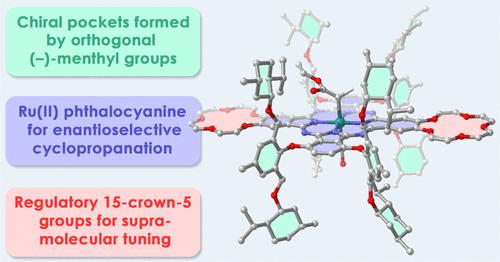
Unprecedented chiral ruthenium(II) complexes with phthalocyanines having chiral motifs near the catalytic metal site have been prepared by cross condensation of the chiral 3,6-bis-aryloxy-phthalonitrile (α-Ar*O)2Pn bearing two (1R,2S,5R)-menthoxy groups orthogonal to the aromatic plane and (15-crown-5)phthalonitrile. Four complexes containing chiral menthyl groups (M) and 15-crown-5 units (C), notably RuPc[MC3](CO), RuPc[opp-M2C2](CO), RuPc[adj-M2C2](CO), and RuPc[M3C](CO), were isolated in pure form and fully characterized by UV–vis, circular dichroism, HRMS, and various 1H NMR and 13C NMR techniques. Their evaluation in the benchmark asymmetric cyclopropanation reaction of styrene derivatives by ethyl diazoacetate indicated that the RuPc[opp-M2C2](CO) complex was the most efficient in terms of diastereo- and enantioselectivity. Further study revealed the strong dependence of the stereoselectivity on the solvent nature and salt additives, which caused conformational rearrangement of the flexible chiral surrounding, as evidenced by multinuclear NMR and CD spectra. For instance, upon moving from commonly used CH2Cl2 to EtOH with the addition of NaPF6, a significant enhancement of enantioselectivity (from 35 to 84% with p-methylstyrene) was obtained. Of particular importance is a very high diastereoselectivity of cyclopropanation of many substrates promoted by the incorporation of sodium cations into crown ether cavities of phthalocyanine to attain a trans/cis ratio up to 499:1. Such a regulating effect in chiral catalysis involving tetrapyrrolic complexes has not been previously observed, rendering this complex a prominent example of the phthalocyanine tunable catalyst. The developed synthetic strategy paves the way to phthalocyanine complexes with a chiral environment around the metal site and crown ether receptors to tune the catalytic properties.
期刊介绍:
ACS Catalysis is an esteemed journal that publishes original research in the fields of heterogeneous catalysis, molecular catalysis, and biocatalysis. It offers broad coverage across diverse areas such as life sciences, organometallics and synthesis, photochemistry and electrochemistry, drug discovery and synthesis, materials science, environmental protection, polymer discovery and synthesis, and energy and fuels.
The scope of the journal is to showcase innovative work in various aspects of catalysis. This includes new reactions and novel synthetic approaches utilizing known catalysts, the discovery or modification of new catalysts, elucidation of catalytic mechanisms through cutting-edge investigations, practical enhancements of existing processes, as well as conceptual advances in the field. Contributions to ACS Catalysis can encompass both experimental and theoretical research focused on catalytic molecules, macromolecules, and materials that exhibit catalytic turnover.




 京公网安备 11010802042870号
京ICP备2023020795号-1
京公网安备 11010802042870号
京ICP备2023020795号-1

 分享
分享
 求助内容:
求助内容: 应助结果提醒方式:
 扫码关注我们
