Jovana Petkovska, Marija Radoičić, Darka Marković, Danixa Rodriguez-Melendez, Dallin L. Smith, Ethan T. Iverson, Vesna Dimova, Maja Radetić, Jaime C. Grunlan and Igor Jordanov
{"title":"可持续的两步聚电解质复合阻燃尼龙-棉织物†","authors":"Jovana Petkovska, Marija Radoičić, Darka Marković, Danixa Rodriguez-Melendez, Dallin L. Smith, Ethan T. Iverson, Vesna Dimova, Maja Radetić, Jaime C. Grunlan and Igor Jordanov","doi":"10.1039/D5NJ00441A","DOIUrl":null,"url":null,"abstract":"<p >Blended nylon-cotton (NYCO) fabric is frequently used due to its unique combination of comfort and strength, but it suffers from high flammability. Flame-retardant NYCO is created by applying a simple two-step process of an eco-friendly, water-based polyelectrolyte complex consisting of egg white proteins (EWP), pectin (P), and guanidine phosphate (GP). The addition of GP to the EWP/P system facilitates charge screening of the P macromolecule, allowing a sufficient coating to form and impart flame-retardant properties to the fabric. The NYCO fabric coated with a positively charged 4% EWP solution at pH 3 and a negatively charged 1% P + 20% GP solution at pH 3 exhibits self-extinguishing behavior during vertical flame testing and retains mechanical properties similar to those of the uncoated fabric. This coating modifies the thermal degradation behavior of NYCO by promoting the formation of an intumescent charred layer that protects the fabric from further decomposition. As a result, the coated fabric shows 10.8% residue at 700 °C in air and 29.2% in nitrogen, which is significantly higher than the uncoated fabric, which retains only 2.5% residue in air and 10.4% in nitrogen. Additionally, the coated fabric releases 32.6% less heat and exhibits a 37.9% reduction in fire growth capacity. This simple and completely bio-based coating provides an effective and benign way to protect this important class of textiles from fire.</p>","PeriodicalId":95,"journal":{"name":"New Journal of Chemistry","volume":" 11","pages":" 4464-4476"},"PeriodicalIF":2.5000,"publicationDate":"2025-02-17","publicationTypes":"Journal Article","fieldsOfStudy":null,"isOpenAccess":false,"openAccessPdf":"","citationCount":"0","resultStr":"{\"title\":\"Sustainable two-step polyelectrolyte complex for flame retardant nylon-cotton fabric†\",\"authors\":\"Jovana Petkovska, Marija Radoičić, Darka Marković, Danixa Rodriguez-Melendez, Dallin L. Smith, Ethan T. Iverson, Vesna Dimova, Maja Radetić, Jaime C. Grunlan and Igor Jordanov\",\"doi\":\"10.1039/D5NJ00441A\",\"DOIUrl\":null,\"url\":null,\"abstract\":\"<p >Blended nylon-cotton (NYCO) fabric is frequently used due to its unique combination of comfort and strength, but it suffers from high flammability. Flame-retardant NYCO is created by applying a simple two-step process of an eco-friendly, water-based polyelectrolyte complex consisting of egg white proteins (EWP), pectin (P), and guanidine phosphate (GP). The addition of GP to the EWP/P system facilitates charge screening of the P macromolecule, allowing a sufficient coating to form and impart flame-retardant properties to the fabric. The NYCO fabric coated with a positively charged 4% EWP solution at pH 3 and a negatively charged 1% P + 20% GP solution at pH 3 exhibits self-extinguishing behavior during vertical flame testing and retains mechanical properties similar to those of the uncoated fabric. This coating modifies the thermal degradation behavior of NYCO by promoting the formation of an intumescent charred layer that protects the fabric from further decomposition. As a result, the coated fabric shows 10.8% residue at 700 °C in air and 29.2% in nitrogen, which is significantly higher than the uncoated fabric, which retains only 2.5% residue in air and 10.4% in nitrogen. Additionally, the coated fabric releases 32.6% less heat and exhibits a 37.9% reduction in fire growth capacity. This simple and completely bio-based coating provides an effective and benign way to protect this important class of textiles from fire.</p>\",\"PeriodicalId\":95,\"journal\":{\"name\":\"New Journal of Chemistry\",\"volume\":\" 11\",\"pages\":\" 4464-4476\"},\"PeriodicalIF\":2.5000,\"publicationDate\":\"2025-02-17\",\"publicationTypes\":\"Journal Article\",\"fieldsOfStudy\":null,\"isOpenAccess\":false,\"openAccessPdf\":\"\",\"citationCount\":\"0\",\"resultStr\":null,\"platform\":\"Semanticscholar\",\"paperid\":null,\"PeriodicalName\":\"New Journal of Chemistry\",\"FirstCategoryId\":\"92\",\"ListUrlMain\":\"https://pubs.rsc.org/en/content/articlelanding/2025/nj/d5nj00441a\",\"RegionNum\":3,\"RegionCategory\":\"化学\",\"ArticlePicture\":[],\"TitleCN\":null,\"AbstractTextCN\":null,\"PMCID\":null,\"EPubDate\":\"\",\"PubModel\":\"\",\"JCR\":\"Q2\",\"JCRName\":\"CHEMISTRY, MULTIDISCIPLINARY\",\"Score\":null,\"Total\":0}","platform":"Semanticscholar","paperid":null,"PeriodicalName":"New Journal of Chemistry","FirstCategoryId":"92","ListUrlMain":"https://pubs.rsc.org/en/content/articlelanding/2025/nj/d5nj00441a","RegionNum":3,"RegionCategory":"化学","ArticlePicture":[],"TitleCN":null,"AbstractTextCN":null,"PMCID":null,"EPubDate":"","PubModel":"","JCR":"Q2","JCRName":"CHEMISTRY, MULTIDISCIPLINARY","Score":null,"Total":0}
引用次数: 0
摘要
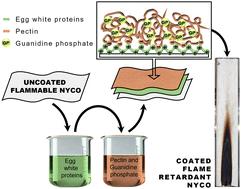
尼龙-棉混纺(NYCO)织物由于其独特的舒适性和强度的组合而经常被使用,但它的可燃性很高。阻燃NYCO是一种由蛋清蛋白(EWP)、果胶(P)和磷酸胍(GP)组成的水基聚电解质复合物,采用简单的两步工艺制成的。在EWP/P系统中添加GP有助于P大分子的电荷筛选,从而形成足够的涂层并赋予织物阻燃性能。NYCO织物在pH值为3时涂有带正电的4% EWP溶液,在pH值为3时涂有带负电的1% P + 20% GP溶液,在垂直火焰测试中表现出自熄行为,并保持与未涂覆织物相似的机械性能。这种涂层通过促进膨胀烧焦层的形成来改变NYCO的热降解行为,从而保护织物免受进一步分解。结果表明,涂层织物在700℃空气中残留10.8%,在氮气中残留29.2%,明显高于未涂层织物在空气中残留2.5%,在氮气中残留10.4%。此外,涂层织物释放的热量减少了32.6%,火灾生长能力降低了37.9%。这种简单而完全的生物基涂层提供了一种有效而良性的方式来保护这类重要的纺织品免受火灾的伤害。
Sustainable two-step polyelectrolyte complex for flame retardant nylon-cotton fabric†
Blended nylon-cotton (NYCO) fabric is frequently used due to its unique combination of comfort and strength, but it suffers from high flammability. Flame-retardant NYCO is created by applying a simple two-step process of an eco-friendly, water-based polyelectrolyte complex consisting of egg white proteins (EWP), pectin (P), and guanidine phosphate (GP). The addition of GP to the EWP/P system facilitates charge screening of the P macromolecule, allowing a sufficient coating to form and impart flame-retardant properties to the fabric. The NYCO fabric coated with a positively charged 4% EWP solution at pH 3 and a negatively charged 1% P + 20% GP solution at pH 3 exhibits self-extinguishing behavior during vertical flame testing and retains mechanical properties similar to those of the uncoated fabric. This coating modifies the thermal degradation behavior of NYCO by promoting the formation of an intumescent charred layer that protects the fabric from further decomposition. As a result, the coated fabric shows 10.8% residue at 700 °C in air and 29.2% in nitrogen, which is significantly higher than the uncoated fabric, which retains only 2.5% residue in air and 10.4% in nitrogen. Additionally, the coated fabric releases 32.6% less heat and exhibits a 37.9% reduction in fire growth capacity. This simple and completely bio-based coating provides an effective and benign way to protect this important class of textiles from fire.




 京公网安备 11010802042870号
京ICP备2023020795号-1
京公网安备 11010802042870号
京ICP备2023020795号-1

 分享
分享
 求助内容:
求助内容: 应助结果提醒方式:
 扫码关注我们
