{"title":"钾掺杂对无机和杂化溴化铋钙钛矿薄膜(A3Bi2Br9, A = Cs+, MA)†光电性能的影响","authors":"Deepak Aloysius and Satyajit Gupta","doi":"10.1039/D4NJ05274A","DOIUrl":null,"url":null,"abstract":"<p >The development of affordable and sustainable semiconductor materials is vital for meeting future technological demands. Over the past few years, halide perovskites have proven to be potential semiconductor materials. So far, lead halide perovskites have demonstrated remarkable performance in various applications, including solar cells, LEDs, and photocatalytic reactions. However, water instability and toxicity are substantial concerns when considering Pb<small><sup>2+</sup></small> based perovskites on a commercial scale. Nowadays, bismuth (Bi<small><sup>3+</sup></small>)-based perovskite materials are considered a promising alternative to Pb<small><sup>2+</sup></small>. This study explores the impact of doping on the optoelectronic properties of inorganic and hybrid bismuth bromide-based perovskites. In this work, a specific amount of KBr is incorporated into the perovskite material, and its effects are analyzed. We found that KBr incorporation induces structural distortion in the perovskite lattice, which affects the bandgap. Additionally, KBr increases the grain size and aids in passivating defect states in the material. As a result, the photocurrent response, and device performance of the KBr-incorporated Cs<small><sub>3</sub></small>Bi<small><sub>2</sub></small>Br<small><sub>9</sub></small> perovskite are improved.</p>","PeriodicalId":95,"journal":{"name":"New Journal of Chemistry","volume":" 11","pages":" 4438-4445"},"PeriodicalIF":2.6000,"publicationDate":"2025-02-12","publicationTypes":"Journal Article","fieldsOfStudy":null,"isOpenAccess":false,"openAccessPdf":"","citationCount":"0","resultStr":"{\"title\":\"Impact of potassium doping on the optoelectronic properties over inorganic and hybrid bismuth bromide perovskite thin films (A3Bi2Br9, A = Cs+, MA)†\",\"authors\":\"Deepak Aloysius and Satyajit Gupta\",\"doi\":\"10.1039/D4NJ05274A\",\"DOIUrl\":null,\"url\":null,\"abstract\":\"<p >The development of affordable and sustainable semiconductor materials is vital for meeting future technological demands. Over the past few years, halide perovskites have proven to be potential semiconductor materials. So far, lead halide perovskites have demonstrated remarkable performance in various applications, including solar cells, LEDs, and photocatalytic reactions. However, water instability and toxicity are substantial concerns when considering Pb<small><sup>2+</sup></small> based perovskites on a commercial scale. Nowadays, bismuth (Bi<small><sup>3+</sup></small>)-based perovskite materials are considered a promising alternative to Pb<small><sup>2+</sup></small>. This study explores the impact of doping on the optoelectronic properties of inorganic and hybrid bismuth bromide-based perovskites. In this work, a specific amount of KBr is incorporated into the perovskite material, and its effects are analyzed. We found that KBr incorporation induces structural distortion in the perovskite lattice, which affects the bandgap. Additionally, KBr increases the grain size and aids in passivating defect states in the material. As a result, the photocurrent response, and device performance of the KBr-incorporated Cs<small><sub>3</sub></small>Bi<small><sub>2</sub></small>Br<small><sub>9</sub></small> perovskite are improved.</p>\",\"PeriodicalId\":95,\"journal\":{\"name\":\"New Journal of Chemistry\",\"volume\":\" 11\",\"pages\":\" 4438-4445\"},\"PeriodicalIF\":2.6000,\"publicationDate\":\"2025-02-12\",\"publicationTypes\":\"Journal Article\",\"fieldsOfStudy\":null,\"isOpenAccess\":false,\"openAccessPdf\":\"\",\"citationCount\":\"0\",\"resultStr\":null,\"platform\":\"Semanticscholar\",\"paperid\":null,\"PeriodicalName\":\"New Journal of Chemistry\",\"FirstCategoryId\":\"92\",\"ListUrlMain\":\"https://pubs.rsc.org/en/content/articlelanding/2025/nj/d4nj05274a\",\"RegionNum\":3,\"RegionCategory\":\"化学\",\"ArticlePicture\":[],\"TitleCN\":null,\"AbstractTextCN\":null,\"PMCID\":null,\"EPubDate\":\"\",\"PubModel\":\"\",\"JCR\":\"Q2\",\"JCRName\":\"CHEMISTRY, MULTIDISCIPLINARY\",\"Score\":null,\"Total\":0}","platform":"Semanticscholar","paperid":null,"PeriodicalName":"New Journal of Chemistry","FirstCategoryId":"92","ListUrlMain":"https://pubs.rsc.org/en/content/articlelanding/2025/nj/d4nj05274a","RegionNum":3,"RegionCategory":"化学","ArticlePicture":[],"TitleCN":null,"AbstractTextCN":null,"PMCID":null,"EPubDate":"","PubModel":"","JCR":"Q2","JCRName":"CHEMISTRY, MULTIDISCIPLINARY","Score":null,"Total":0}
Impact of potassium doping on the optoelectronic properties over inorganic and hybrid bismuth bromide perovskite thin films (A3Bi2Br9, A = Cs+, MA)†
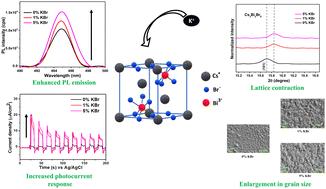
The development of affordable and sustainable semiconductor materials is vital for meeting future technological demands. Over the past few years, halide perovskites have proven to be potential semiconductor materials. So far, lead halide perovskites have demonstrated remarkable performance in various applications, including solar cells, LEDs, and photocatalytic reactions. However, water instability and toxicity are substantial concerns when considering Pb2+ based perovskites on a commercial scale. Nowadays, bismuth (Bi3+)-based perovskite materials are considered a promising alternative to Pb2+. This study explores the impact of doping on the optoelectronic properties of inorganic and hybrid bismuth bromide-based perovskites. In this work, a specific amount of KBr is incorporated into the perovskite material, and its effects are analyzed. We found that KBr incorporation induces structural distortion in the perovskite lattice, which affects the bandgap. Additionally, KBr increases the grain size and aids in passivating defect states in the material. As a result, the photocurrent response, and device performance of the KBr-incorporated Cs3Bi2Br9 perovskite are improved.




 京公网安备 11010802042870号
京ICP备2023020795号-1
京公网安备 11010802042870号
京ICP备2023020795号-1

 分享
分享
 求助内容:
求助内容: 应助结果提醒方式:
 扫码关注我们
