Katharina Tatjana Kopp , Maarten De Beer , Jody Voorspoels , Dorien Van Lysebetten , Guy Van den Mooter
{"title":"喷雾干燥作为蛋白质稳定工艺的价值。","authors":"Katharina Tatjana Kopp , Maarten De Beer , Jody Voorspoels , Dorien Van Lysebetten , Guy Van den Mooter","doi":"10.1016/j.ijpharm.2025.125422","DOIUrl":null,"url":null,"abstract":"<div><div>Protein stability in solution state is often poor due to the intrinsic instability of proteins. A solution is to solidify them by using techniques like freeze or spray drying (SD). To shield therapeutic proteins from stress (e.g., heat or shear stress) related to the solidification process, suitable buffers and excipients are added during formulation development. In this work, buffers and excipients were identified for the stabilization of three protein model compounds (BSA, IgG and lysozyme) in solution state using a design of experiments (DoE) approach based on screening results from differential scanning fluorimetry (DSF) combined with static light scattering (SLS). The aim was to investigate whether it is possible to predict protein stability in solid state using data from protein stabilization in solution state according to DSF/SLS. Therefore, three concepts per protein were analyzed after SD, two of which were expected to stabilize the protein, and one less stabilizing and compared these results to screening results obtained in solution state. Analytical techniques prior to and post SD were reversed-phase and size-exclusion chromatography (RPC and SEC, respectively), dynamic light scattering (DLS), UV and circular dichroism (CD). Furthermore, yield and residual moisture were analyzed. BSA and lysozyme showed high stability during SD and therefore only minor changes were observed. IgG was more affected by solidification which partly resulted in a loss of more than 15 % of the initial protein concentration in comparison to before SD. In future studies, the use of analytical techniques that do not require reconstitution would give additional value.</div></div>","PeriodicalId":14187,"journal":{"name":"International Journal of Pharmaceutics","volume":"674 ","pages":"Article 125422"},"PeriodicalIF":6.0000,"publicationDate":"2025-04-15","publicationTypes":"Journal Article","fieldsOfStudy":null,"isOpenAccess":false,"openAccessPdf":"","citationCount":"0","resultStr":"{\"title\":\"The value of spray drying as stabilization process for proteins\",\"authors\":\"Katharina Tatjana Kopp , Maarten De Beer , Jody Voorspoels , Dorien Van Lysebetten , Guy Van den Mooter\",\"doi\":\"10.1016/j.ijpharm.2025.125422\",\"DOIUrl\":null,\"url\":null,\"abstract\":\"<div><div>Protein stability in solution state is often poor due to the intrinsic instability of proteins. A solution is to solidify them by using techniques like freeze or spray drying (SD). To shield therapeutic proteins from stress (e.g., heat or shear stress) related to the solidification process, suitable buffers and excipients are added during formulation development. In this work, buffers and excipients were identified for the stabilization of three protein model compounds (BSA, IgG and lysozyme) in solution state using a design of experiments (DoE) approach based on screening results from differential scanning fluorimetry (DSF) combined with static light scattering (SLS). The aim was to investigate whether it is possible to predict protein stability in solid state using data from protein stabilization in solution state according to DSF/SLS. Therefore, three concepts per protein were analyzed after SD, two of which were expected to stabilize the protein, and one less stabilizing and compared these results to screening results obtained in solution state. Analytical techniques prior to and post SD were reversed-phase and size-exclusion chromatography (RPC and SEC, respectively), dynamic light scattering (DLS), UV and circular dichroism (CD). Furthermore, yield and residual moisture were analyzed. BSA and lysozyme showed high stability during SD and therefore only minor changes were observed. IgG was more affected by solidification which partly resulted in a loss of more than 15 % of the initial protein concentration in comparison to before SD. In future studies, the use of analytical techniques that do not require reconstitution would give additional value.</div></div>\",\"PeriodicalId\":14187,\"journal\":{\"name\":\"International Journal of Pharmaceutics\",\"volume\":\"674 \",\"pages\":\"Article 125422\"},\"PeriodicalIF\":6.0000,\"publicationDate\":\"2025-04-15\",\"publicationTypes\":\"Journal Article\",\"fieldsOfStudy\":null,\"isOpenAccess\":false,\"openAccessPdf\":\"\",\"citationCount\":\"0\",\"resultStr\":null,\"platform\":\"Semanticscholar\",\"paperid\":null,\"PeriodicalName\":\"International Journal of Pharmaceutics\",\"FirstCategoryId\":\"3\",\"ListUrlMain\":\"https://www.sciencedirect.com/science/article/pii/S0378517325002583\",\"RegionNum\":2,\"RegionCategory\":\"医学\",\"ArticlePicture\":[],\"TitleCN\":null,\"AbstractTextCN\":null,\"PMCID\":null,\"EPubDate\":\"2025/3/6 0:00:00\",\"PubModel\":\"Epub\",\"JCR\":\"Q1\",\"JCRName\":\"PHARMACOLOGY & PHARMACY\",\"Score\":null,\"Total\":0}","platform":"Semanticscholar","paperid":null,"PeriodicalName":"International Journal of Pharmaceutics","FirstCategoryId":"3","ListUrlMain":"https://www.sciencedirect.com/science/article/pii/S0378517325002583","RegionNum":2,"RegionCategory":"医学","ArticlePicture":[],"TitleCN":null,"AbstractTextCN":null,"PMCID":null,"EPubDate":"2025/3/6 0:00:00","PubModel":"Epub","JCR":"Q1","JCRName":"PHARMACOLOGY & PHARMACY","Score":null,"Total":0}
The value of spray drying as stabilization process for proteins
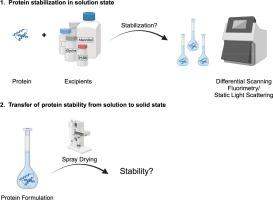
Protein stability in solution state is often poor due to the intrinsic instability of proteins. A solution is to solidify them by using techniques like freeze or spray drying (SD). To shield therapeutic proteins from stress (e.g., heat or shear stress) related to the solidification process, suitable buffers and excipients are added during formulation development. In this work, buffers and excipients were identified for the stabilization of three protein model compounds (BSA, IgG and lysozyme) in solution state using a design of experiments (DoE) approach based on screening results from differential scanning fluorimetry (DSF) combined with static light scattering (SLS). The aim was to investigate whether it is possible to predict protein stability in solid state using data from protein stabilization in solution state according to DSF/SLS. Therefore, three concepts per protein were analyzed after SD, two of which were expected to stabilize the protein, and one less stabilizing and compared these results to screening results obtained in solution state. Analytical techniques prior to and post SD were reversed-phase and size-exclusion chromatography (RPC and SEC, respectively), dynamic light scattering (DLS), UV and circular dichroism (CD). Furthermore, yield and residual moisture were analyzed. BSA and lysozyme showed high stability during SD and therefore only minor changes were observed. IgG was more affected by solidification which partly resulted in a loss of more than 15 % of the initial protein concentration in comparison to before SD. In future studies, the use of analytical techniques that do not require reconstitution would give additional value.
期刊介绍:
The International Journal of Pharmaceutics is the third most cited journal in the "Pharmacy & Pharmacology" category out of 366 journals, being the true home for pharmaceutical scientists concerned with the physical, chemical and biological properties of devices and delivery systems for drugs, vaccines and biologicals, including their design, manufacture and evaluation. This includes evaluation of the properties of drugs, excipients such as surfactants and polymers and novel materials. The journal has special sections on pharmaceutical nanotechnology and personalized medicines, and publishes research papers, reviews, commentaries and letters to the editor as well as special issues.




 京公网安备 11010802042870号
京ICP备2023020795号-1
京公网安备 11010802042870号
京ICP备2023020795号-1

 分享
分享
 求助内容:
求助内容: 应助结果提醒方式:
 扫码关注我们
