Sarah Harmening, Boris Bogdanow, Karen Wagner, Fan Liu, Martin Messerle, Eva Maria Borst
{"title":"人类巨细胞病毒pUL52与病毒DNA包衣网络主要组分的相互作用强调了其在基因组切割包装中的重要作用。","authors":"Sarah Harmening, Boris Bogdanow, Karen Wagner, Fan Liu, Martin Messerle, Eva Maria Borst","doi":"10.1128/jvi.02201-24","DOIUrl":null,"url":null,"abstract":"<p><p>Cleavage of human cytomegalovirus (HCMV) genomes and their packaging into capsids requires at least seven essential viral proteins, yet it is not completely understood how these proteins cooperate to accomplish this task. Besides the portal protein pUL104 and the terminase subunits pUL51, pUL56, and pUL89, the UL52 protein is also necessary for HCMV genome encapsidation; however, knowledge about pUL52 is scant. In the absence of pUL52, viral concatemers are not cleaved into unit-length genomes and no DNA-filled capsids are observed, yet no viral or cellular proteins interacting with pUL52 have been identified that would explain how pUL52 exerts its essential role in the HCMV infection cycle. In this study, we aimed at a comprehensive definition of pUL52-interacting proteins in infected cells. Using suitable HCMV mutants, we employed three complementary state-of-the-art proteomic approaches, namely biotin ligase-dependent proximity labeling, affinity purification, and cross-linking mass spectrometry. These experiments, combined with thorough validation by immunoblotting, pointed to several viral DNA-associated proteins and key players pivotal for genome encapsidation as interactors of pUL52. The most noticeable direct pUL52 interaction partners were the terminase subunits pUL56 and pUL89 as well as the portal protein pUL104. Hence, we suggest a model of pUL52 function in which pUL52 mediates association of HCMV genomes with the terminase subunits and the capsid portal. Taken together, our data contribute to the understanding of an essential viral process previously recognized as a prominent antiviral target. Disturbing the identified pUL52 interactions may provide a starting point to develop novel antiviral medication.</p><p><strong>Importance: </strong>Human cytomegalovirus (HCMV) can evoke severe disease in immunocompromised patients and, moreover, is the most frequent viral cause of malformations in newborns. The virus-specific process of genome cleavage and packaging into capsids has emerged as an Achilles heel in the HCMV life cycle, which can be targeted by novel antiviral drugs, yet the mechanism of viral DNA encapsidation is only partially understood. Here, we report that the essential viral cleavage-packaging protein pUL52 interacts with several HCMV proteins known to be crucial for genome packaging, with the most prominent ones being the terminase complex and the portal protein. These data provide insight into the role of pUL52 during HCMV infection and may lay the basis for the development of additional antiviral substances tackling viral DNA packaging.</p>","PeriodicalId":17583,"journal":{"name":"Journal of Virology","volume":" ","pages":"e0220124"},"PeriodicalIF":3.8000,"publicationDate":"2025-04-15","publicationTypes":"Journal Article","fieldsOfStudy":null,"isOpenAccess":false,"openAccessPdf":"https://www.ncbi.nlm.nih.gov/pmc/articles/PMC11998523/pdf/","citationCount":"0","resultStr":"{\"title\":\"Interaction of human cytomegalovirus pUL52 with major components of the viral DNA encapsidation network underlines its essential role in genome cleavage-packaging.\",\"authors\":\"Sarah Harmening, Boris Bogdanow, Karen Wagner, Fan Liu, Martin Messerle, Eva Maria Borst\",\"doi\":\"10.1128/jvi.02201-24\",\"DOIUrl\":null,\"url\":null,\"abstract\":\"<p><p>Cleavage of human cytomegalovirus (HCMV) genomes and their packaging into capsids requires at least seven essential viral proteins, yet it is not completely understood how these proteins cooperate to accomplish this task. Besides the portal protein pUL104 and the terminase subunits pUL51, pUL56, and pUL89, the UL52 protein is also necessary for HCMV genome encapsidation; however, knowledge about pUL52 is scant. In the absence of pUL52, viral concatemers are not cleaved into unit-length genomes and no DNA-filled capsids are observed, yet no viral or cellular proteins interacting with pUL52 have been identified that would explain how pUL52 exerts its essential role in the HCMV infection cycle. In this study, we aimed at a comprehensive definition of pUL52-interacting proteins in infected cells. Using suitable HCMV mutants, we employed three complementary state-of-the-art proteomic approaches, namely biotin ligase-dependent proximity labeling, affinity purification, and cross-linking mass spectrometry. These experiments, combined with thorough validation by immunoblotting, pointed to several viral DNA-associated proteins and key players pivotal for genome encapsidation as interactors of pUL52. The most noticeable direct pUL52 interaction partners were the terminase subunits pUL56 and pUL89 as well as the portal protein pUL104. Hence, we suggest a model of pUL52 function in which pUL52 mediates association of HCMV genomes with the terminase subunits and the capsid portal. Taken together, our data contribute to the understanding of an essential viral process previously recognized as a prominent antiviral target. Disturbing the identified pUL52 interactions may provide a starting point to develop novel antiviral medication.</p><p><strong>Importance: </strong>Human cytomegalovirus (HCMV) can evoke severe disease in immunocompromised patients and, moreover, is the most frequent viral cause of malformations in newborns. The virus-specific process of genome cleavage and packaging into capsids has emerged as an Achilles heel in the HCMV life cycle, which can be targeted by novel antiviral drugs, yet the mechanism of viral DNA encapsidation is only partially understood. Here, we report that the essential viral cleavage-packaging protein pUL52 interacts with several HCMV proteins known to be crucial for genome packaging, with the most prominent ones being the terminase complex and the portal protein. These data provide insight into the role of pUL52 during HCMV infection and may lay the basis for the development of additional antiviral substances tackling viral DNA packaging.</p>\",\"PeriodicalId\":17583,\"journal\":{\"name\":\"Journal of Virology\",\"volume\":\" \",\"pages\":\"e0220124\"},\"PeriodicalIF\":3.8000,\"publicationDate\":\"2025-04-15\",\"publicationTypes\":\"Journal Article\",\"fieldsOfStudy\":null,\"isOpenAccess\":false,\"openAccessPdf\":\"https://www.ncbi.nlm.nih.gov/pmc/articles/PMC11998523/pdf/\",\"citationCount\":\"0\",\"resultStr\":null,\"platform\":\"Semanticscholar\",\"paperid\":null,\"PeriodicalName\":\"Journal of Virology\",\"FirstCategoryId\":\"3\",\"ListUrlMain\":\"https://doi.org/10.1128/jvi.02201-24\",\"RegionNum\":2,\"RegionCategory\":\"医学\",\"ArticlePicture\":[],\"TitleCN\":null,\"AbstractTextCN\":null,\"PMCID\":null,\"EPubDate\":\"2025/3/10 0:00:00\",\"PubModel\":\"Epub\",\"JCR\":\"Q2\",\"JCRName\":\"VIROLOGY\",\"Score\":null,\"Total\":0}","platform":"Semanticscholar","paperid":null,"PeriodicalName":"Journal of Virology","FirstCategoryId":"3","ListUrlMain":"https://doi.org/10.1128/jvi.02201-24","RegionNum":2,"RegionCategory":"医学","ArticlePicture":[],"TitleCN":null,"AbstractTextCN":null,"PMCID":null,"EPubDate":"2025/3/10 0:00:00","PubModel":"Epub","JCR":"Q2","JCRName":"VIROLOGY","Score":null,"Total":0}
Interaction of human cytomegalovirus pUL52 with major components of the viral DNA encapsidation network underlines its essential role in genome cleavage-packaging.
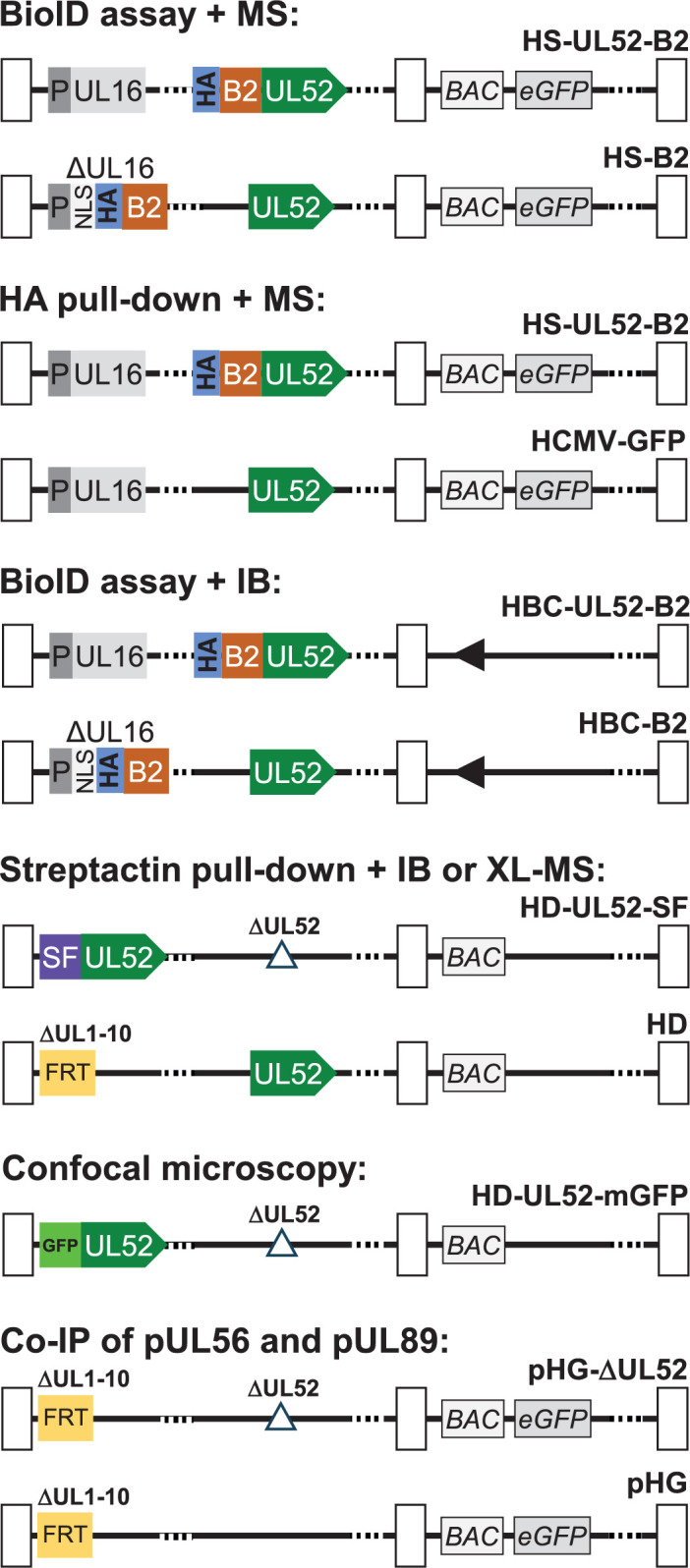
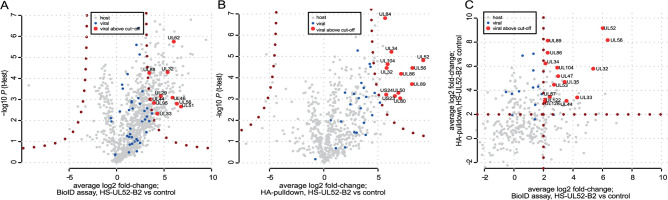
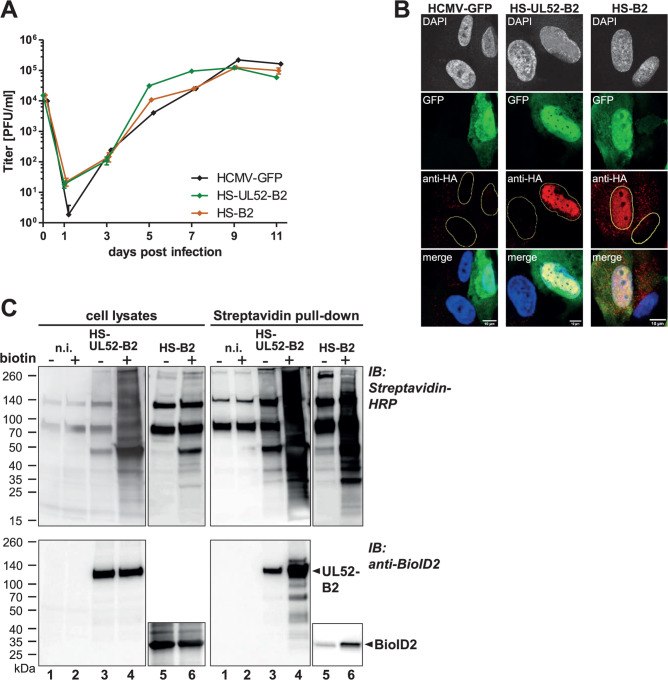
Cleavage of human cytomegalovirus (HCMV) genomes and their packaging into capsids requires at least seven essential viral proteins, yet it is not completely understood how these proteins cooperate to accomplish this task. Besides the portal protein pUL104 and the terminase subunits pUL51, pUL56, and pUL89, the UL52 protein is also necessary for HCMV genome encapsidation; however, knowledge about pUL52 is scant. In the absence of pUL52, viral concatemers are not cleaved into unit-length genomes and no DNA-filled capsids are observed, yet no viral or cellular proteins interacting with pUL52 have been identified that would explain how pUL52 exerts its essential role in the HCMV infection cycle. In this study, we aimed at a comprehensive definition of pUL52-interacting proteins in infected cells. Using suitable HCMV mutants, we employed three complementary state-of-the-art proteomic approaches, namely biotin ligase-dependent proximity labeling, affinity purification, and cross-linking mass spectrometry. These experiments, combined with thorough validation by immunoblotting, pointed to several viral DNA-associated proteins and key players pivotal for genome encapsidation as interactors of pUL52. The most noticeable direct pUL52 interaction partners were the terminase subunits pUL56 and pUL89 as well as the portal protein pUL104. Hence, we suggest a model of pUL52 function in which pUL52 mediates association of HCMV genomes with the terminase subunits and the capsid portal. Taken together, our data contribute to the understanding of an essential viral process previously recognized as a prominent antiviral target. Disturbing the identified pUL52 interactions may provide a starting point to develop novel antiviral medication.
Importance: Human cytomegalovirus (HCMV) can evoke severe disease in immunocompromised patients and, moreover, is the most frequent viral cause of malformations in newborns. The virus-specific process of genome cleavage and packaging into capsids has emerged as an Achilles heel in the HCMV life cycle, which can be targeted by novel antiviral drugs, yet the mechanism of viral DNA encapsidation is only partially understood. Here, we report that the essential viral cleavage-packaging protein pUL52 interacts with several HCMV proteins known to be crucial for genome packaging, with the most prominent ones being the terminase complex and the portal protein. These data provide insight into the role of pUL52 during HCMV infection and may lay the basis for the development of additional antiviral substances tackling viral DNA packaging.
期刊介绍:
Journal of Virology (JVI) explores the nature of the viruses of animals, archaea, bacteria, fungi, plants, and protozoa. We welcome papers on virion structure and assembly, viral genome replication and regulation of gene expression, genetic diversity and evolution, virus-cell interactions, cellular responses to infection, transformation and oncogenesis, gene delivery, viral pathogenesis and immunity, and vaccines and antiviral agents.




 京公网安备 11010802042870号
京ICP备2023020795号-1
京公网安备 11010802042870号
京ICP备2023020795号-1

 分享
分享
 求助内容:
求助内容: 应助结果提醒方式:
 扫码关注我们
