Minghao Lin , Gangan Wang , Junqi Li , Chaoyi Chen , Yuanpei Lan
{"title":"硫酸钛(TiOSO4)水解沉淀法制备煅烧高岭石/TiO2复合物","authors":"Minghao Lin , Gangan Wang , Junqi Li , Chaoyi Chen , Yuanpei Lan","doi":"10.1016/j.molstruc.2025.141989","DOIUrl":null,"url":null,"abstract":"<div><div>Calcined kaolinite (CK)/TiO<sub>2</sub> composites were synthesized through hydrolysis precipitation of titanyl sulfate (TiOSO<sub>4</sub>) and calcination. Under optimized hydrolysis conditions (pH 2.5, duration 2.0 h, temperature 90 °C, and mass ratio (TiO<sub>2</sub>/CK) = 1.0), a precipitation efficiency of 81.4 % was achieved. The phase composition remained consistent under varying hydrolysis conditions after significant TiO<sub>2</sub> formation. Furthermore, the oil absorption (mass ratio = 2.0) and hiding power (mass ratio = 1.4) of the composites were determined to be 38.8 g/100 g and 88.4 %, respectively. The composites exhibited high good chemical stability as a pigment, maintaining resistance to strong acid erosion, with only 4.0 % dissolution observed after a 15-day immersion in a pH 2.0 solution. H<sub>2</sub>TiO<sub>3</sub> underwent the dehydration and desulfurization more rapidly in an oxygen-rich environment, and anatase formation was well-developed at a calcination temperature of 750 °C for 1 h. Further analysis revealed that phase transition process of TiO<sub>2</sub> was influenced by TiO<sub>2</sub> content, disordered structure of CK and calcination conditions. TiO<sub>2</sub> particles formed single- or multi-layered chemical coatings on the active CK surface, although the presence of exposed mullite impeded coating formation. This study successfully developed cost-effective CK/TiO<sub>2</sub> composites with favorable pigment properties, providing a certain reference for CK selection. The composites have potential applications in coatings, pigments and related fields.</div></div>","PeriodicalId":16414,"journal":{"name":"Journal of Molecular Structure","volume":"1335 ","pages":"Article 141989"},"PeriodicalIF":4.7000,"publicationDate":"2025-07-15","publicationTypes":"Journal Article","fieldsOfStudy":null,"isOpenAccess":false,"openAccessPdf":"","citationCount":"0","resultStr":"{\"title\":\"Preparation of Calcined kaolinite/TiO2 composites by titanyl sulfate (TiOSO4) hydrolysis precipitation\",\"authors\":\"Minghao Lin , Gangan Wang , Junqi Li , Chaoyi Chen , Yuanpei Lan\",\"doi\":\"10.1016/j.molstruc.2025.141989\",\"DOIUrl\":null,\"url\":null,\"abstract\":\"<div><div>Calcined kaolinite (CK)/TiO<sub>2</sub> composites were synthesized through hydrolysis precipitation of titanyl sulfate (TiOSO<sub>4</sub>) and calcination. Under optimized hydrolysis conditions (pH 2.5, duration 2.0 h, temperature 90 °C, and mass ratio (TiO<sub>2</sub>/CK) = 1.0), a precipitation efficiency of 81.4 % was achieved. The phase composition remained consistent under varying hydrolysis conditions after significant TiO<sub>2</sub> formation. Furthermore, the oil absorption (mass ratio = 2.0) and hiding power (mass ratio = 1.4) of the composites were determined to be 38.8 g/100 g and 88.4 %, respectively. The composites exhibited high good chemical stability as a pigment, maintaining resistance to strong acid erosion, with only 4.0 % dissolution observed after a 15-day immersion in a pH 2.0 solution. H<sub>2</sub>TiO<sub>3</sub> underwent the dehydration and desulfurization more rapidly in an oxygen-rich environment, and anatase formation was well-developed at a calcination temperature of 750 °C for 1 h. Further analysis revealed that phase transition process of TiO<sub>2</sub> was influenced by TiO<sub>2</sub> content, disordered structure of CK and calcination conditions. TiO<sub>2</sub> particles formed single- or multi-layered chemical coatings on the active CK surface, although the presence of exposed mullite impeded coating formation. This study successfully developed cost-effective CK/TiO<sub>2</sub> composites with favorable pigment properties, providing a certain reference for CK selection. The composites have potential applications in coatings, pigments and related fields.</div></div>\",\"PeriodicalId\":16414,\"journal\":{\"name\":\"Journal of Molecular Structure\",\"volume\":\"1335 \",\"pages\":\"Article 141989\"},\"PeriodicalIF\":4.7000,\"publicationDate\":\"2025-07-15\",\"publicationTypes\":\"Journal Article\",\"fieldsOfStudy\":null,\"isOpenAccess\":false,\"openAccessPdf\":\"\",\"citationCount\":\"0\",\"resultStr\":null,\"platform\":\"Semanticscholar\",\"paperid\":null,\"PeriodicalName\":\"Journal of Molecular Structure\",\"FirstCategoryId\":\"92\",\"ListUrlMain\":\"https://www.sciencedirect.com/science/article/pii/S002228602500674X\",\"RegionNum\":2,\"RegionCategory\":\"化学\",\"ArticlePicture\":[],\"TitleCN\":null,\"AbstractTextCN\":null,\"PMCID\":null,\"EPubDate\":\"2025/3/10 0:00:00\",\"PubModel\":\"Epub\",\"JCR\":\"Q2\",\"JCRName\":\"CHEMISTRY, PHYSICAL\",\"Score\":null,\"Total\":0}","platform":"Semanticscholar","paperid":null,"PeriodicalName":"Journal of Molecular Structure","FirstCategoryId":"92","ListUrlMain":"https://www.sciencedirect.com/science/article/pii/S002228602500674X","RegionNum":2,"RegionCategory":"化学","ArticlePicture":[],"TitleCN":null,"AbstractTextCN":null,"PMCID":null,"EPubDate":"2025/3/10 0:00:00","PubModel":"Epub","JCR":"Q2","JCRName":"CHEMISTRY, PHYSICAL","Score":null,"Total":0}
Preparation of Calcined kaolinite/TiO2 composites by titanyl sulfate (TiOSO4) hydrolysis precipitation
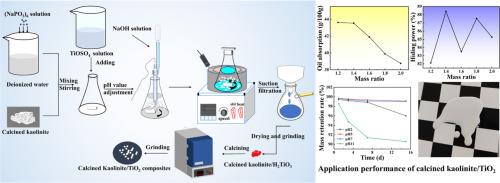
Calcined kaolinite (CK)/TiO2 composites were synthesized through hydrolysis precipitation of titanyl sulfate (TiOSO4) and calcination. Under optimized hydrolysis conditions (pH 2.5, duration 2.0 h, temperature 90 °C, and mass ratio (TiO2/CK) = 1.0), a precipitation efficiency of 81.4 % was achieved. The phase composition remained consistent under varying hydrolysis conditions after significant TiO2 formation. Furthermore, the oil absorption (mass ratio = 2.0) and hiding power (mass ratio = 1.4) of the composites were determined to be 38.8 g/100 g and 88.4 %, respectively. The composites exhibited high good chemical stability as a pigment, maintaining resistance to strong acid erosion, with only 4.0 % dissolution observed after a 15-day immersion in a pH 2.0 solution. H2TiO3 underwent the dehydration and desulfurization more rapidly in an oxygen-rich environment, and anatase formation was well-developed at a calcination temperature of 750 °C for 1 h. Further analysis revealed that phase transition process of TiO2 was influenced by TiO2 content, disordered structure of CK and calcination conditions. TiO2 particles formed single- or multi-layered chemical coatings on the active CK surface, although the presence of exposed mullite impeded coating formation. This study successfully developed cost-effective CK/TiO2 composites with favorable pigment properties, providing a certain reference for CK selection. The composites have potential applications in coatings, pigments and related fields.
期刊介绍:
The Journal of Molecular Structure is dedicated to the publication of full-length articles and review papers, providing important new structural information on all types of chemical species including:
• Stable and unstable molecules in all types of environments (vapour, molecular beam, liquid, solution, liquid crystal, solid state, matrix-isolated, surface-absorbed etc.)
• Chemical intermediates
• Molecules in excited states
• Biological molecules
• Polymers.
The methods used may include any combination of spectroscopic and non-spectroscopic techniques, for example:
• Infrared spectroscopy (mid, far, near)
• Raman spectroscopy and non-linear Raman methods (CARS, etc.)
• Electronic absorption spectroscopy
• Optical rotatory dispersion and circular dichroism
• Fluorescence and phosphorescence techniques
• Electron spectroscopies (PES, XPS), EXAFS, etc.
• Microwave spectroscopy
• Electron diffraction
• NMR and ESR spectroscopies
• Mössbauer spectroscopy
• X-ray crystallography
• Charge Density Analyses
• Computational Studies (supplementing experimental methods)
We encourage publications combining theoretical and experimental approaches. The structural insights gained by the studies should be correlated with the properties, activity and/ or reactivity of the molecule under investigation and the relevance of this molecule and its implications should be discussed.





 京公网安备 11010802042870号
京ICP备2023020795号-1
京公网安备 11010802042870号
京ICP备2023020795号-1

 分享
分享
 求助内容:
求助内容: 应助结果提醒方式:
 扫码关注我们
