Alexandre Benaïche, Ingrid Billaut-Laden, Herivelo Randriamihaja, Jean-Philippe Bertocchio
{"title":"基于chatgpt的工具MyGenAssist在行业药物警戒部门用于病例记录的效率评估:交叉研究。","authors":"Alexandre Benaïche, Ingrid Billaut-Laden, Herivelo Randriamihaja, Jean-Philippe Bertocchio","doi":"10.2196/65651","DOIUrl":null,"url":null,"abstract":"<p><strong>Background: </strong>At the end of 2023, Bayer AG launched its own internal large language model (LLM), MyGenAssist, based on ChatGPT technology to overcome data privacy concerns. It may offer the possibility to decrease their harshness and save time spent on repetitive and recurrent tasks that could then be dedicated to activities with higher added value. Although there is a current worldwide reflection on whether artificial intelligence should be integrated into pharmacovigilance, medical literature does not provide enough data concerning LLMs and their daily applications in such a setting. Here, we studied how this tool could improve the case documentation process, which is a duty for authorization holders as per European and French good vigilance practices.</p><p><strong>Objective: </strong>The aim of the study is to test whether the use of an LLM could improve the pharmacovigilance documentation process.</p><p><strong>Methods: </strong>MyGenAssist was trained to draft templates for case documentation letters meant to be sent to the reporters. Information provided within the template changes depending on the case: such data come from a table sent to the LLM. We then measured the time spent on each case for a period of 4 months (2 months before using the tool and 2 months after its implementation). A multiple linear regression model was created with the time spent on each case as the explained variable, and all parameters that could influence this time were included as explanatory variables (use of MyGenAssist, type of recipient, number of questions, and user). To test if the use of this tool impacts the process, we compared the recipients' response rates with and without the use of MyGenAssist.</p><p><strong>Results: </strong>An average of 23.3% (95% CI 13.8%-32.8%) of time saving was made thanks to MyGenAssist (P<.001; adjusted R<sup>2</sup>=0.286) on each case, which could represent an average of 10.7 (SD 3.6) working days saved each year. The answer rate was not modified by the use of MyGenAssist (20/48, 42% vs 27/74, 36%; P=.57) whether the recipient was a physician or a patient. No significant difference was found regarding the time spent by the recipient to answer (mean 2.20, SD 3.27 days vs mean 2.65, SD 3.30 days after the last attempt of contact; P=.64). The implementation of MyGenAssist for this activity only required a 2-hour training session for the pharmacovigilance team.</p><p><strong>Conclusions: </strong>Our study is the first to show that a ChatGPT-based tool can improve the efficiency of a good practice activity without needing a long training session for the affected workforce. These first encouraging results could be an incentive for the implementation of LLMs in other processes.</p>","PeriodicalId":16337,"journal":{"name":"Journal of Medical Internet Research","volume":"27 ","pages":"e65651"},"PeriodicalIF":8.2000,"publicationDate":"2025-03-10","publicationTypes":"Journal Article","fieldsOfStudy":null,"isOpenAccess":false,"openAccessPdf":"https://www.ncbi.nlm.nih.gov/pmc/articles/PMC11933758/pdf/","citationCount":"0","resultStr":"{\"title\":\"Assessment of the Efficiency of a ChatGPT-Based Tool, MyGenAssist, in an Industry Pharmacovigilance Department for Case Documentation: Cross-Over Study.\",\"authors\":\"Alexandre Benaïche, Ingrid Billaut-Laden, Herivelo Randriamihaja, Jean-Philippe Bertocchio\",\"doi\":\"10.2196/65651\",\"DOIUrl\":null,\"url\":null,\"abstract\":\"<p><strong>Background: </strong>At the end of 2023, Bayer AG launched its own internal large language model (LLM), MyGenAssist, based on ChatGPT technology to overcome data privacy concerns. It may offer the possibility to decrease their harshness and save time spent on repetitive and recurrent tasks that could then be dedicated to activities with higher added value. Although there is a current worldwide reflection on whether artificial intelligence should be integrated into pharmacovigilance, medical literature does not provide enough data concerning LLMs and their daily applications in such a setting. Here, we studied how this tool could improve the case documentation process, which is a duty for authorization holders as per European and French good vigilance practices.</p><p><strong>Objective: </strong>The aim of the study is to test whether the use of an LLM could improve the pharmacovigilance documentation process.</p><p><strong>Methods: </strong>MyGenAssist was trained to draft templates for case documentation letters meant to be sent to the reporters. Information provided within the template changes depending on the case: such data come from a table sent to the LLM. We then measured the time spent on each case for a period of 4 months (2 months before using the tool and 2 months after its implementation). A multiple linear regression model was created with the time spent on each case as the explained variable, and all parameters that could influence this time were included as explanatory variables (use of MyGenAssist, type of recipient, number of questions, and user). To test if the use of this tool impacts the process, we compared the recipients' response rates with and without the use of MyGenAssist.</p><p><strong>Results: </strong>An average of 23.3% (95% CI 13.8%-32.8%) of time saving was made thanks to MyGenAssist (P<.001; adjusted R<sup>2</sup>=0.286) on each case, which could represent an average of 10.7 (SD 3.6) working days saved each year. The answer rate was not modified by the use of MyGenAssist (20/48, 42% vs 27/74, 36%; P=.57) whether the recipient was a physician or a patient. No significant difference was found regarding the time spent by the recipient to answer (mean 2.20, SD 3.27 days vs mean 2.65, SD 3.30 days after the last attempt of contact; P=.64). The implementation of MyGenAssist for this activity only required a 2-hour training session for the pharmacovigilance team.</p><p><strong>Conclusions: </strong>Our study is the first to show that a ChatGPT-based tool can improve the efficiency of a good practice activity without needing a long training session for the affected workforce. These first encouraging results could be an incentive for the implementation of LLMs in other processes.</p>\",\"PeriodicalId\":16337,\"journal\":{\"name\":\"Journal of Medical Internet Research\",\"volume\":\"27 \",\"pages\":\"e65651\"},\"PeriodicalIF\":8.2000,\"publicationDate\":\"2025-03-10\",\"publicationTypes\":\"Journal Article\",\"fieldsOfStudy\":null,\"isOpenAccess\":false,\"openAccessPdf\":\"https://www.ncbi.nlm.nih.gov/pmc/articles/PMC11933758/pdf/\",\"citationCount\":\"0\",\"resultStr\":null,\"platform\":\"Semanticscholar\",\"paperid\":null,\"PeriodicalName\":\"Journal of Medical Internet Research\",\"FirstCategoryId\":\"3\",\"ListUrlMain\":\"https://doi.org/10.2196/65651\",\"RegionNum\":2,\"RegionCategory\":\"医学\",\"ArticlePicture\":[],\"TitleCN\":null,\"AbstractTextCN\":null,\"PMCID\":null,\"EPubDate\":\"\",\"PubModel\":\"\",\"JCR\":\"Q1\",\"JCRName\":\"HEALTH CARE SCIENCES & SERVICES\",\"Score\":null,\"Total\":0}","platform":"Semanticscholar","paperid":null,"PeriodicalName":"Journal of Medical Internet Research","FirstCategoryId":"3","ListUrlMain":"https://doi.org/10.2196/65651","RegionNum":2,"RegionCategory":"医学","ArticlePicture":[],"TitleCN":null,"AbstractTextCN":null,"PMCID":null,"EPubDate":"","PubModel":"","JCR":"Q1","JCRName":"HEALTH CARE SCIENCES & SERVICES","Score":null,"Total":0}
引用次数: 0
摘要
背景:2023年底,拜耳公司推出了自己的内部大型语言模型(LLM), MyGenAssist,基于ChatGPT技术,以克服数据隐私问题。它可能提供减少其严酷性的可能性,并节省花费在重复和循环任务上的时间,然后可以将其用于具有更高附加值的活动。尽管目前世界范围内都在思考人工智能是否应该被纳入药物警戒,但医学文献并没有提供足够的关于llm及其在这种环境下的日常应用的数据。在这里,我们研究了该工具如何改进案例文档流程,根据欧洲和法国的良好警戒实践,这是授权持有人的职责。目的:本研究的目的是测试LLM的使用是否可以改善药物警戒记录过程。方法:对MyGenAssist进行培训,以便为发送给记者的病例文档信件起草模板。模板中提供的信息根据具体情况而变化:这些数据来自发送到LLM的表。然后,我们测量了每个病例花费的时间,为期4个月(使用工具前2个月和实施工具后2个月)。创建了一个多元线性回归模型,将在每个案例上花费的时间作为解释变量,并将可能影响该时间的所有参数作为解释变量(MyGenAssist的使用、收件人类型、问题数量和用户)包含在内。为了测试使用此工具是否会影响流程,我们比较了使用MyGenAssist和不使用MyGenAssist时收件人的响应率。结果:MyGenAssist (P2=0.286)在每个病例上平均节省23.3% (95% CI 13.8%-32.8%)的时间,平均每年节省10.7 (SD 3.6)个工作日。使用MyGenAssist (20/48, 42% vs 27/74, 36%;P=.57),无论接受者是医生还是病人。接收人回答的时间没有显著差异(平均2.20天,SD 3.27天vs平均2.65天,SD 3.30天);P = .64点)。MyGenAssist的实施只需要对药物警戒小组进行2小时的培训。结论:我们的研究首次表明,基于chatgpt的工具可以提高良好实践活动的效率,而不需要对受影响的劳动力进行长时间的培训。这些最初令人鼓舞的结果可能会激励法学硕士在其他过程中的实施。
Assessment of the Efficiency of a ChatGPT-Based Tool, MyGenAssist, in an Industry Pharmacovigilance Department for Case Documentation: Cross-Over Study.
Background: At the end of 2023, Bayer AG launched its own internal large language model (LLM), MyGenAssist, based on ChatGPT technology to overcome data privacy concerns. It may offer the possibility to decrease their harshness and save time spent on repetitive and recurrent tasks that could then be dedicated to activities with higher added value. Although there is a current worldwide reflection on whether artificial intelligence should be integrated into pharmacovigilance, medical literature does not provide enough data concerning LLMs and their daily applications in such a setting. Here, we studied how this tool could improve the case documentation process, which is a duty for authorization holders as per European and French good vigilance practices.
Objective: The aim of the study is to test whether the use of an LLM could improve the pharmacovigilance documentation process.
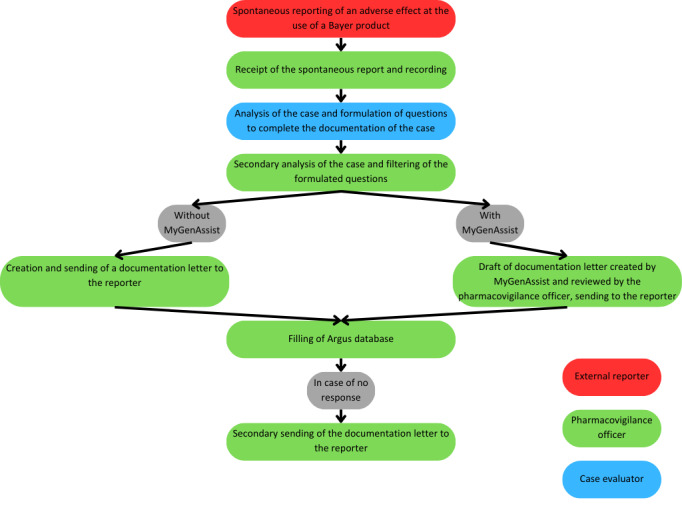
Methods: MyGenAssist was trained to draft templates for case documentation letters meant to be sent to the reporters. Information provided within the template changes depending on the case: such data come from a table sent to the LLM. We then measured the time spent on each case for a period of 4 months (2 months before using the tool and 2 months after its implementation). A multiple linear regression model was created with the time spent on each case as the explained variable, and all parameters that could influence this time were included as explanatory variables (use of MyGenAssist, type of recipient, number of questions, and user). To test if the use of this tool impacts the process, we compared the recipients' response rates with and without the use of MyGenAssist.
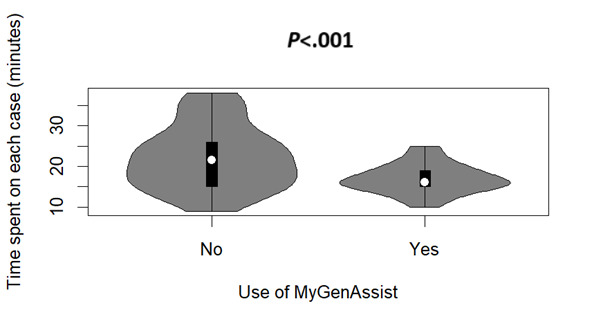
Results: An average of 23.3% (95% CI 13.8%-32.8%) of time saving was made thanks to MyGenAssist (P<.001; adjusted R2=0.286) on each case, which could represent an average of 10.7 (SD 3.6) working days saved each year. The answer rate was not modified by the use of MyGenAssist (20/48, 42% vs 27/74, 36%; P=.57) whether the recipient was a physician or a patient. No significant difference was found regarding the time spent by the recipient to answer (mean 2.20, SD 3.27 days vs mean 2.65, SD 3.30 days after the last attempt of contact; P=.64). The implementation of MyGenAssist for this activity only required a 2-hour training session for the pharmacovigilance team.
Conclusions: Our study is the first to show that a ChatGPT-based tool can improve the efficiency of a good practice activity without needing a long training session for the affected workforce. These first encouraging results could be an incentive for the implementation of LLMs in other processes.
期刊介绍:
The Journal of Medical Internet Research (JMIR) is a highly respected publication in the field of health informatics and health services. With a founding date in 1999, JMIR has been a pioneer in the field for over two decades.
As a leader in the industry, the journal focuses on digital health, data science, health informatics, and emerging technologies for health, medicine, and biomedical research. It is recognized as a top publication in these disciplines, ranking in the first quartile (Q1) by Impact Factor.
Notably, JMIR holds the prestigious position of being ranked #1 on Google Scholar within the "Medical Informatics" discipline.





 京公网安备 11010802042870号
京ICP备2023020795号-1
京公网安备 11010802042870号
京ICP备2023020795号-1

 分享
分享
 求助内容:
求助内容: 应助结果提醒方式:
 扫码关注我们
