{"title":"单克隆抗体配方中新型降粘稳定辅料的加性效应。","authors":"Monika Prašnikar , Maja Bjelošević Žiberna , Nika Kržišnik , Robert Roškar , Iztok Grabnar , Aleš Žula , Pegi Ahlin Grabnar","doi":"10.1016/j.ijpharm.2025.125451","DOIUrl":null,"url":null,"abstract":"<div><div>The subcutaneous administration of biopharmaceuticals is advantageous over intravenous administration, particularly with regard to improved patient compliance. However, in highly concentrated protein formulations lower viscosity of the formulation and stability of the protein is difficult to achieve. One approach involves using the viscosity-reducing excipients to diminish the interactions between protein molecules. In this context, the main objective of the study was to develop an optimal formulation for a model monoclonal antibody (mAb) and to evaluate new test compounds as viscosity-reducing agents. The test compounds were investigated both individually at increasing concentrations up to 200 mM and in combinations for their viscosity-reducing effect. Our results showed that all individual test compounds reduced the viscosity of the mAb formulation by more than 30 %, with reduction achieved by the six test compounds exceeding that achieved by proline (Pro). A reduction in the viscosity of the formulation below the 20 mPas threshold was achieved either by combining two test compounds or by increasing the concentration of a single compound above 25 mM. An accelerated stability study showed similar stabilization effects regardless of whether the test compounds were used alone or in combination. The percentage of aggregates was below 5 % in most formulations. These viscosity-reducing and stabilization effects corresponded to the dynamic light scattering results, which indicated that the test compounds reduced the attractive forces between the mAb molecules.</div></div>","PeriodicalId":14187,"journal":{"name":"International Journal of Pharmaceutics","volume":"674 ","pages":"Article 125451"},"PeriodicalIF":5.2000,"publicationDate":"2025-04-15","publicationTypes":"Journal Article","fieldsOfStudy":null,"isOpenAccess":false,"openAccessPdf":"","citationCount":"0","resultStr":"{\"title\":\"Additive effects of the new viscosity-reducing and stabilizing excipients for monoclonal antibody formulation\",\"authors\":\"Monika Prašnikar , Maja Bjelošević Žiberna , Nika Kržišnik , Robert Roškar , Iztok Grabnar , Aleš Žula , Pegi Ahlin Grabnar\",\"doi\":\"10.1016/j.ijpharm.2025.125451\",\"DOIUrl\":null,\"url\":null,\"abstract\":\"<div><div>The subcutaneous administration of biopharmaceuticals is advantageous over intravenous administration, particularly with regard to improved patient compliance. However, in highly concentrated protein formulations lower viscosity of the formulation and stability of the protein is difficult to achieve. One approach involves using the viscosity-reducing excipients to diminish the interactions between protein molecules. In this context, the main objective of the study was to develop an optimal formulation for a model monoclonal antibody (mAb) and to evaluate new test compounds as viscosity-reducing agents. The test compounds were investigated both individually at increasing concentrations up to 200 mM and in combinations for their viscosity-reducing effect. Our results showed that all individual test compounds reduced the viscosity of the mAb formulation by more than 30 %, with reduction achieved by the six test compounds exceeding that achieved by proline (Pro). A reduction in the viscosity of the formulation below the 20 mPas threshold was achieved either by combining two test compounds or by increasing the concentration of a single compound above 25 mM. An accelerated stability study showed similar stabilization effects regardless of whether the test compounds were used alone or in combination. The percentage of aggregates was below 5 % in most formulations. These viscosity-reducing and stabilization effects corresponded to the dynamic light scattering results, which indicated that the test compounds reduced the attractive forces between the mAb molecules.</div></div>\",\"PeriodicalId\":14187,\"journal\":{\"name\":\"International Journal of Pharmaceutics\",\"volume\":\"674 \",\"pages\":\"Article 125451\"},\"PeriodicalIF\":5.2000,\"publicationDate\":\"2025-04-15\",\"publicationTypes\":\"Journal Article\",\"fieldsOfStudy\":null,\"isOpenAccess\":false,\"openAccessPdf\":\"\",\"citationCount\":\"0\",\"resultStr\":null,\"platform\":\"Semanticscholar\",\"paperid\":null,\"PeriodicalName\":\"International Journal of Pharmaceutics\",\"FirstCategoryId\":\"3\",\"ListUrlMain\":\"https://www.sciencedirect.com/science/article/pii/S037851732500287X\",\"RegionNum\":2,\"RegionCategory\":\"医学\",\"ArticlePicture\":[],\"TitleCN\":null,\"AbstractTextCN\":null,\"PMCID\":null,\"EPubDate\":\"2025/3/8 0:00:00\",\"PubModel\":\"Epub\",\"JCR\":\"Q1\",\"JCRName\":\"PHARMACOLOGY & PHARMACY\",\"Score\":null,\"Total\":0}","platform":"Semanticscholar","paperid":null,"PeriodicalName":"International Journal of Pharmaceutics","FirstCategoryId":"3","ListUrlMain":"https://www.sciencedirect.com/science/article/pii/S037851732500287X","RegionNum":2,"RegionCategory":"医学","ArticlePicture":[],"TitleCN":null,"AbstractTextCN":null,"PMCID":null,"EPubDate":"2025/3/8 0:00:00","PubModel":"Epub","JCR":"Q1","JCRName":"PHARMACOLOGY & PHARMACY","Score":null,"Total":0}
Additive effects of the new viscosity-reducing and stabilizing excipients for monoclonal antibody formulation
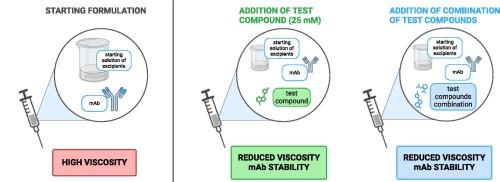
The subcutaneous administration of biopharmaceuticals is advantageous over intravenous administration, particularly with regard to improved patient compliance. However, in highly concentrated protein formulations lower viscosity of the formulation and stability of the protein is difficult to achieve. One approach involves using the viscosity-reducing excipients to diminish the interactions between protein molecules. In this context, the main objective of the study was to develop an optimal formulation for a model monoclonal antibody (mAb) and to evaluate new test compounds as viscosity-reducing agents. The test compounds were investigated both individually at increasing concentrations up to 200 mM and in combinations for their viscosity-reducing effect. Our results showed that all individual test compounds reduced the viscosity of the mAb formulation by more than 30 %, with reduction achieved by the six test compounds exceeding that achieved by proline (Pro). A reduction in the viscosity of the formulation below the 20 mPas threshold was achieved either by combining two test compounds or by increasing the concentration of a single compound above 25 mM. An accelerated stability study showed similar stabilization effects regardless of whether the test compounds were used alone or in combination. The percentage of aggregates was below 5 % in most formulations. These viscosity-reducing and stabilization effects corresponded to the dynamic light scattering results, which indicated that the test compounds reduced the attractive forces between the mAb molecules.
期刊介绍:
The International Journal of Pharmaceutics is the third most cited journal in the "Pharmacy & Pharmacology" category out of 366 journals, being the true home for pharmaceutical scientists concerned with the physical, chemical and biological properties of devices and delivery systems for drugs, vaccines and biologicals, including their design, manufacture and evaluation. This includes evaluation of the properties of drugs, excipients such as surfactants and polymers and novel materials. The journal has special sections on pharmaceutical nanotechnology and personalized medicines, and publishes research papers, reviews, commentaries and letters to the editor as well as special issues.




 京公网安备 11010802042870号
京ICP备2023020795号-1
京公网安备 11010802042870号
京ICP备2023020795号-1

 分享
分享
 求助内容:
求助内容: 应助结果提醒方式:
 扫码关注我们
