{"title":"贝伐单抗玻璃体内注射溶液的物理稳定性:调理材料和储存条件的影响","authors":"Joëlle Claves , Philip Chennell , Christelle Blavignac , Valérie Sautou","doi":"10.1016/j.ijpharm.2025.125453","DOIUrl":null,"url":null,"abstract":"<div><div>The treatment of numerous retinal pathologies requires the use of intravitreal medications administered and compounded in medical 3-piece syringes. Particle formation influenced by storage conditions is a source of concern as it can have clinical impacts such as endophtalmitis or reduced visual acuity. The aim of this work was therefore to investigate and compare the physical stability of bevacizumab stored in syringes made of polypropylene lubricated with silicone oil (PP-SOL) or Cyclic Olefin Copolymer with crosslinked silicone at the surface of the barrel (COC-CLS). 0.2 mL of bevacizumab solutions were conditioned in both syringes types and the physical stability and particles or aggregate generation was followed after 3 days, 1 month and 3 months of storage, under three different storage conditions: refrigerated temperature (5 ± 3 °C), with or without mechanical stress after the storage period to simulate user manipulations before patient administration, and heat stress temperature (35 ± 2 °C). Particle counting, dynamic light scattering, size exclusion chromatography, size diffusion by taylor dispersion analysis, Fourier transform infrared spectroscopy, scanning electron microscopy and microanalysis X and calculated aggregation index via UV visible absorption were performed on the samples. Overall, the COC-CLS syringes generated less particles than the PP-SOL ones, in particular when submitted to a mechanical stress. The physical stability of the bevacizumab solutions was superior in COC-CLS syringes than in PP-SOL syringes.</div></div>","PeriodicalId":14187,"journal":{"name":"International Journal of Pharmaceutics","volume":"674 ","pages":"Article 125453"},"PeriodicalIF":6.0000,"publicationDate":"2025-04-15","publicationTypes":"Journal Article","fieldsOfStudy":null,"isOpenAccess":false,"openAccessPdf":"","citationCount":"0","resultStr":"{\"title\":\"Physical stability of bevacizumab solutions for intravitreal injections: Influence of conditioning material and storage conditions\",\"authors\":\"Joëlle Claves , Philip Chennell , Christelle Blavignac , Valérie Sautou\",\"doi\":\"10.1016/j.ijpharm.2025.125453\",\"DOIUrl\":null,\"url\":null,\"abstract\":\"<div><div>The treatment of numerous retinal pathologies requires the use of intravitreal medications administered and compounded in medical 3-piece syringes. Particle formation influenced by storage conditions is a source of concern as it can have clinical impacts such as endophtalmitis or reduced visual acuity. The aim of this work was therefore to investigate and compare the physical stability of bevacizumab stored in syringes made of polypropylene lubricated with silicone oil (PP-SOL) or Cyclic Olefin Copolymer with crosslinked silicone at the surface of the barrel (COC-CLS). 0.2 mL of bevacizumab solutions were conditioned in both syringes types and the physical stability and particles or aggregate generation was followed after 3 days, 1 month and 3 months of storage, under three different storage conditions: refrigerated temperature (5 ± 3 °C), with or without mechanical stress after the storage period to simulate user manipulations before patient administration, and heat stress temperature (35 ± 2 °C). Particle counting, dynamic light scattering, size exclusion chromatography, size diffusion by taylor dispersion analysis, Fourier transform infrared spectroscopy, scanning electron microscopy and microanalysis X and calculated aggregation index via UV visible absorption were performed on the samples. Overall, the COC-CLS syringes generated less particles than the PP-SOL ones, in particular when submitted to a mechanical stress. The physical stability of the bevacizumab solutions was superior in COC-CLS syringes than in PP-SOL syringes.</div></div>\",\"PeriodicalId\":14187,\"journal\":{\"name\":\"International Journal of Pharmaceutics\",\"volume\":\"674 \",\"pages\":\"Article 125453\"},\"PeriodicalIF\":6.0000,\"publicationDate\":\"2025-04-15\",\"publicationTypes\":\"Journal Article\",\"fieldsOfStudy\":null,\"isOpenAccess\":false,\"openAccessPdf\":\"\",\"citationCount\":\"0\",\"resultStr\":null,\"platform\":\"Semanticscholar\",\"paperid\":null,\"PeriodicalName\":\"International Journal of Pharmaceutics\",\"FirstCategoryId\":\"3\",\"ListUrlMain\":\"https://www.sciencedirect.com/science/article/pii/S0378517325002893\",\"RegionNum\":2,\"RegionCategory\":\"医学\",\"ArticlePicture\":[],\"TitleCN\":null,\"AbstractTextCN\":null,\"PMCID\":null,\"EPubDate\":\"2025/3/8 0:00:00\",\"PubModel\":\"Epub\",\"JCR\":\"Q1\",\"JCRName\":\"PHARMACOLOGY & PHARMACY\",\"Score\":null,\"Total\":0}","platform":"Semanticscholar","paperid":null,"PeriodicalName":"International Journal of Pharmaceutics","FirstCategoryId":"3","ListUrlMain":"https://www.sciencedirect.com/science/article/pii/S0378517325002893","RegionNum":2,"RegionCategory":"医学","ArticlePicture":[],"TitleCN":null,"AbstractTextCN":null,"PMCID":null,"EPubDate":"2025/3/8 0:00:00","PubModel":"Epub","JCR":"Q1","JCRName":"PHARMACOLOGY & PHARMACY","Score":null,"Total":0}
引用次数: 0
摘要
许多视网膜病变的治疗需要使用玻璃体内药物,并在医用三件套注射器中混合。受储存条件影响的颗粒形成是一个值得关注的问题,因为它可以产生诸如眼内炎或视力下降等临床影响。因此,这项工作的目的是研究和比较贝伐单抗储存在用硅油润滑的聚丙烯(PP-SOL)或在桶表面具有交联硅胶的环烯烃共聚物(COC-CLS)制成的注射器中的物理稳定性。 0.2毫升的贝伐单抗的解决方案在注射器类型和条件的物理稳定性和粒子或总代之后3 天后,1和3 月个月的存储,在三个不同的储存条件:冷藏温度(5 ± 3°C),有或没有机械应力在贮藏期模拟用户操作后病人管理、和热应力温度(35 ±2 °C)。对样品进行了颗粒计数、动态光散射、粒度排除色谱、taylor色散分析粒度扩散、傅里叶变换红外光谱、扫描电镜和微量分析 X ,并通过紫外可见吸收计算了聚集指数。总体而言,COC-CLS注射器比PP-SOL注射器产生的颗粒更少,特别是在受到机械应力时。贝伐单抗溶液在COC-CLS注射器中的物理稳定性优于PP-SOL注射器。
Physical stability of bevacizumab solutions for intravitreal injections: Influence of conditioning material and storage conditions
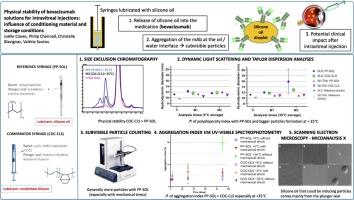
The treatment of numerous retinal pathologies requires the use of intravitreal medications administered and compounded in medical 3-piece syringes. Particle formation influenced by storage conditions is a source of concern as it can have clinical impacts such as endophtalmitis or reduced visual acuity. The aim of this work was therefore to investigate and compare the physical stability of bevacizumab stored in syringes made of polypropylene lubricated with silicone oil (PP-SOL) or Cyclic Olefin Copolymer with crosslinked silicone at the surface of the barrel (COC-CLS). 0.2 mL of bevacizumab solutions were conditioned in both syringes types and the physical stability and particles or aggregate generation was followed after 3 days, 1 month and 3 months of storage, under three different storage conditions: refrigerated temperature (5 ± 3 °C), with or without mechanical stress after the storage period to simulate user manipulations before patient administration, and heat stress temperature (35 ± 2 °C). Particle counting, dynamic light scattering, size exclusion chromatography, size diffusion by taylor dispersion analysis, Fourier transform infrared spectroscopy, scanning electron microscopy and microanalysis X and calculated aggregation index via UV visible absorption were performed on the samples. Overall, the COC-CLS syringes generated less particles than the PP-SOL ones, in particular when submitted to a mechanical stress. The physical stability of the bevacizumab solutions was superior in COC-CLS syringes than in PP-SOL syringes.
期刊介绍:
The International Journal of Pharmaceutics is the third most cited journal in the "Pharmacy & Pharmacology" category out of 366 journals, being the true home for pharmaceutical scientists concerned with the physical, chemical and biological properties of devices and delivery systems for drugs, vaccines and biologicals, including their design, manufacture and evaluation. This includes evaluation of the properties of drugs, excipients such as surfactants and polymers and novel materials. The journal has special sections on pharmaceutical nanotechnology and personalized medicines, and publishes research papers, reviews, commentaries and letters to the editor as well as special issues.




 京公网安备 11010802042870号
京ICP备2023020795号-1
京公网安备 11010802042870号
京ICP备2023020795号-1

 分享
分享
 求助内容:
求助内容: 应助结果提醒方式:
 扫码关注我们
