{"title":"乙醇转化为1,3-丁二烯的金属-沸石催化剂的最新进展:活性金属位点、机制和未来挑战","authors":"Xianquan Li, Yujia Zhao, Jifeng Pang, Pan Gao, Mingyuan Zheng, Guangjin Hou","doi":"10.1021/acscatal.5c00888","DOIUrl":null,"url":null,"abstract":"The catalytic upgrading of ethanol to 1,3-butadiene (1,3-BD) (ETB) plays a pivotal role in developing renewable industrial technologies. This process has the promising potential to replace the 1,3-BD traditional production technology, which relies on fossil energy, such as naphtha cracking byproducts for ethylene production. The utilization of metal–zeolite catalysts has significantly enhanced catalytic performance; however, a comprehensive review of the progress made in this field is still lacking. In this review, we summarize recent advancements in catalytic performance achieved by employing various metal components supported on silicon-based catalysts through diverse design strategies. Furthermore, the structure–activity relationships of the catalysts, identification of active sites, and the corresponding reaction mechanisms are comprehensively demonstrated. Finally, we discuss the current challenges and future research avenues for designing high-performance catalysts to improve the prospects for the industrial application of ETB.","PeriodicalId":9,"journal":{"name":"ACS Catalysis ","volume":"54 1","pages":""},"PeriodicalIF":13.6000,"publicationDate":"2025-03-11","publicationTypes":"Journal Article","fieldsOfStudy":null,"isOpenAccess":false,"openAccessPdf":"","citationCount":"0","resultStr":"{\"title\":\"Recent Advances in Metal–Zeolite Catalysts for Ethanol to 1,3-Butadiene Conversion: Active Metal Sites, Mechanisms, and Future Challenges\",\"authors\":\"Xianquan Li, Yujia Zhao, Jifeng Pang, Pan Gao, Mingyuan Zheng, Guangjin Hou\",\"doi\":\"10.1021/acscatal.5c00888\",\"DOIUrl\":null,\"url\":null,\"abstract\":\"The catalytic upgrading of ethanol to 1,3-butadiene (1,3-BD) (ETB) plays a pivotal role in developing renewable industrial technologies. This process has the promising potential to replace the 1,3-BD traditional production technology, which relies on fossil energy, such as naphtha cracking byproducts for ethylene production. The utilization of metal–zeolite catalysts has significantly enhanced catalytic performance; however, a comprehensive review of the progress made in this field is still lacking. In this review, we summarize recent advancements in catalytic performance achieved by employing various metal components supported on silicon-based catalysts through diverse design strategies. Furthermore, the structure–activity relationships of the catalysts, identification of active sites, and the corresponding reaction mechanisms are comprehensively demonstrated. Finally, we discuss the current challenges and future research avenues for designing high-performance catalysts to improve the prospects for the industrial application of ETB.\",\"PeriodicalId\":9,\"journal\":{\"name\":\"ACS Catalysis \",\"volume\":\"54 1\",\"pages\":\"\"},\"PeriodicalIF\":13.6000,\"publicationDate\":\"2025-03-11\",\"publicationTypes\":\"Journal Article\",\"fieldsOfStudy\":null,\"isOpenAccess\":false,\"openAccessPdf\":\"\",\"citationCount\":\"0\",\"resultStr\":null,\"platform\":\"Semanticscholar\",\"paperid\":null,\"PeriodicalName\":\"ACS Catalysis \",\"FirstCategoryId\":\"92\",\"ListUrlMain\":\"https://doi.org/10.1021/acscatal.5c00888\",\"RegionNum\":1,\"RegionCategory\":\"化学\",\"ArticlePicture\":[],\"TitleCN\":null,\"AbstractTextCN\":null,\"PMCID\":null,\"EPubDate\":\"\",\"PubModel\":\"\",\"JCR\":\"Q1\",\"JCRName\":\"CHEMISTRY, PHYSICAL\",\"Score\":null,\"Total\":0}","platform":"Semanticscholar","paperid":null,"PeriodicalName":"ACS Catalysis ","FirstCategoryId":"92","ListUrlMain":"https://doi.org/10.1021/acscatal.5c00888","RegionNum":1,"RegionCategory":"化学","ArticlePicture":[],"TitleCN":null,"AbstractTextCN":null,"PMCID":null,"EPubDate":"","PubModel":"","JCR":"Q1","JCRName":"CHEMISTRY, PHYSICAL","Score":null,"Total":0}
Recent Advances in Metal–Zeolite Catalysts for Ethanol to 1,3-Butadiene Conversion: Active Metal Sites, Mechanisms, and Future Challenges
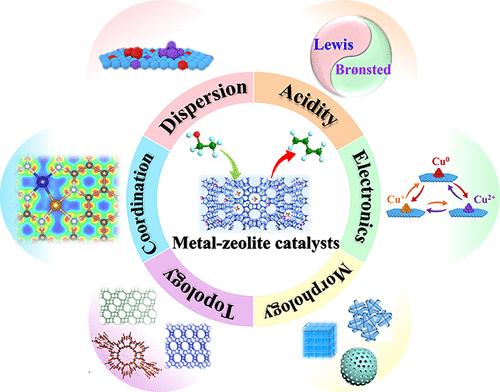
The catalytic upgrading of ethanol to 1,3-butadiene (1,3-BD) (ETB) plays a pivotal role in developing renewable industrial technologies. This process has the promising potential to replace the 1,3-BD traditional production technology, which relies on fossil energy, such as naphtha cracking byproducts for ethylene production. The utilization of metal–zeolite catalysts has significantly enhanced catalytic performance; however, a comprehensive review of the progress made in this field is still lacking. In this review, we summarize recent advancements in catalytic performance achieved by employing various metal components supported on silicon-based catalysts through diverse design strategies. Furthermore, the structure–activity relationships of the catalysts, identification of active sites, and the corresponding reaction mechanisms are comprehensively demonstrated. Finally, we discuss the current challenges and future research avenues for designing high-performance catalysts to improve the prospects for the industrial application of ETB.
期刊介绍:
ACS Catalysis is an esteemed journal that publishes original research in the fields of heterogeneous catalysis, molecular catalysis, and biocatalysis. It offers broad coverage across diverse areas such as life sciences, organometallics and synthesis, photochemistry and electrochemistry, drug discovery and synthesis, materials science, environmental protection, polymer discovery and synthesis, and energy and fuels.
The scope of the journal is to showcase innovative work in various aspects of catalysis. This includes new reactions and novel synthetic approaches utilizing known catalysts, the discovery or modification of new catalysts, elucidation of catalytic mechanisms through cutting-edge investigations, practical enhancements of existing processes, as well as conceptual advances in the field. Contributions to ACS Catalysis can encompass both experimental and theoretical research focused on catalytic molecules, macromolecules, and materials that exhibit catalytic turnover.




 京公网安备 11010802042870号
京ICP备2023020795号-1
京公网安备 11010802042870号
京ICP备2023020795号-1

 分享
分享
 求助内容:
求助内容: 应助结果提醒方式:
 扫码关注我们
