Jia-qi Bai, Mei Ma, Huangfei Liu, Zhangkai Qian, Durui Liu, Yuncai Zhao, Yijing Gao, Jingshuai Chen, Mengdie Cai, Song Sun
{"title":"高效Cu-Ni /W20O58催化剂催化腈加氢制仲胺","authors":"Jia-qi Bai, Mei Ma, Huangfei Liu, Zhangkai Qian, Durui Liu, Yuncai Zhao, Yijing Gao, Jingshuai Chen, Mengdie Cai, Song Sun","doi":"10.1021/acscatal.5c00668","DOIUrl":null,"url":null,"abstract":"The hydrogenation of nitriles is an environmentally friendly and atom-economical route to prepare high-value amines; however, it is still a challenge to control selectivity because of the occurrence of hydrogenation, self-coupling, and hydrogenolysis reactions during the hydrogenation process. It is highly desirable to develop efficient non-noble-metal catalysts for the hydrogenation of nitriles to secondary amines, although several noble metal catalysts have been reported. Herein, we successfully prepared a Cu–Ni/W<sub>20</sub>O<sub>58</sub> catalyst and found that the Cu<sub>4.4</sub>–Ni<sub>0.6</sub>/W<sub>20</sub>O<sub>58</sub> catalyst showed a 92.3% yield with initial TOF<sub>s</sub> of 270.0 h<sup>–1</sup> at 373 K and 3 MPa H<sub>2</sub> for the hydrogenation of benzonitrile (BN) to dibenzylamine (DBA), which was much superior to that of the monometallic Cu<sub>4.4</sub>/W<sub>20</sub>O<sub>58</sub> and Ni<sub>0.6</sub>/W<sub>20</sub>O<sub>58</sub> catalysts. Moreover, the Cu<sub>4.4</sub>–Ni<sub>0.6</sub>/W<sub>20</sub>O<sub>58</sub> catalyst could be reused at least 4 times and was effective for the hydrogenation of various nitriles with superior selectivity to secondary amines. Furthermore, the reaction mechanism of BN hydrogenation for the Cu–Ni alloy of Cu<sub>4.4</sub>–Ni<sub>0.6</sub>/W<sub>20</sub>O<sub>58</sub> was proposed on the basis of spectroscopic studies such as XRD, TPR, TEM, XAFS, and XPS, kinetic studies such as the effect of BN concentration and H<sub>2</sub> pressure, the isotopic effect of hydrogen, and the effect of the reaction temperature and DFT calculations. The rate-determining step was the hydrogenation of benzylidenamine (BI) to the half-hydrogenated intermediate by one H atom over the Cu<sub>4.4</sub>–Ni<sub>0.6</sub>/W<sub>20</sub>O<sub>58</sub> catalyst. The Ni–W<sub>20</sub>O<sub>58</sub> interface was responsible for the adsorption and activation of BN, and the electron-rich Cu acted as the site for H<sub>2</sub> dissociation; the synergistic effect of Cu and Ni led to the superior catalytic performance of the Cu<sub>4.4</sub>–Ni<sub>0.6</sub>/W<sub>20</sub>O<sub>58</sub> catalyst.","PeriodicalId":9,"journal":{"name":"ACS Catalysis ","volume":"596 1","pages":""},"PeriodicalIF":13.6000,"publicationDate":"2025-03-11","publicationTypes":"Journal Article","fieldsOfStudy":null,"isOpenAccess":false,"openAccessPdf":"","citationCount":"0","resultStr":"{\"title\":\"Efficient Cu–Ni/W20O58 Catalysts for Hydrogenation of Nitriles to Secondary Amines\",\"authors\":\"Jia-qi Bai, Mei Ma, Huangfei Liu, Zhangkai Qian, Durui Liu, Yuncai Zhao, Yijing Gao, Jingshuai Chen, Mengdie Cai, Song Sun\",\"doi\":\"10.1021/acscatal.5c00668\",\"DOIUrl\":null,\"url\":null,\"abstract\":\"The hydrogenation of nitriles is an environmentally friendly and atom-economical route to prepare high-value amines; however, it is still a challenge to control selectivity because of the occurrence of hydrogenation, self-coupling, and hydrogenolysis reactions during the hydrogenation process. It is highly desirable to develop efficient non-noble-metal catalysts for the hydrogenation of nitriles to secondary amines, although several noble metal catalysts have been reported. Herein, we successfully prepared a Cu–Ni/W<sub>20</sub>O<sub>58</sub> catalyst and found that the Cu<sub>4.4</sub>–Ni<sub>0.6</sub>/W<sub>20</sub>O<sub>58</sub> catalyst showed a 92.3% yield with initial TOF<sub>s</sub> of 270.0 h<sup>–1</sup> at 373 K and 3 MPa H<sub>2</sub> for the hydrogenation of benzonitrile (BN) to dibenzylamine (DBA), which was much superior to that of the monometallic Cu<sub>4.4</sub>/W<sub>20</sub>O<sub>58</sub> and Ni<sub>0.6</sub>/W<sub>20</sub>O<sub>58</sub> catalysts. Moreover, the Cu<sub>4.4</sub>–Ni<sub>0.6</sub>/W<sub>20</sub>O<sub>58</sub> catalyst could be reused at least 4 times and was effective for the hydrogenation of various nitriles with superior selectivity to secondary amines. Furthermore, the reaction mechanism of BN hydrogenation for the Cu–Ni alloy of Cu<sub>4.4</sub>–Ni<sub>0.6</sub>/W<sub>20</sub>O<sub>58</sub> was proposed on the basis of spectroscopic studies such as XRD, TPR, TEM, XAFS, and XPS, kinetic studies such as the effect of BN concentration and H<sub>2</sub> pressure, the isotopic effect of hydrogen, and the effect of the reaction temperature and DFT calculations. The rate-determining step was the hydrogenation of benzylidenamine (BI) to the half-hydrogenated intermediate by one H atom over the Cu<sub>4.4</sub>–Ni<sub>0.6</sub>/W<sub>20</sub>O<sub>58</sub> catalyst. The Ni–W<sub>20</sub>O<sub>58</sub> interface was responsible for the adsorption and activation of BN, and the electron-rich Cu acted as the site for H<sub>2</sub> dissociation; the synergistic effect of Cu and Ni led to the superior catalytic performance of the Cu<sub>4.4</sub>–Ni<sub>0.6</sub>/W<sub>20</sub>O<sub>58</sub> catalyst.\",\"PeriodicalId\":9,\"journal\":{\"name\":\"ACS Catalysis \",\"volume\":\"596 1\",\"pages\":\"\"},\"PeriodicalIF\":13.6000,\"publicationDate\":\"2025-03-11\",\"publicationTypes\":\"Journal Article\",\"fieldsOfStudy\":null,\"isOpenAccess\":false,\"openAccessPdf\":\"\",\"citationCount\":\"0\",\"resultStr\":null,\"platform\":\"Semanticscholar\",\"paperid\":null,\"PeriodicalName\":\"ACS Catalysis \",\"FirstCategoryId\":\"92\",\"ListUrlMain\":\"https://doi.org/10.1021/acscatal.5c00668\",\"RegionNum\":1,\"RegionCategory\":\"化学\",\"ArticlePicture\":[],\"TitleCN\":null,\"AbstractTextCN\":null,\"PMCID\":null,\"EPubDate\":\"\",\"PubModel\":\"\",\"JCR\":\"Q1\",\"JCRName\":\"CHEMISTRY, PHYSICAL\",\"Score\":null,\"Total\":0}","platform":"Semanticscholar","paperid":null,"PeriodicalName":"ACS Catalysis ","FirstCategoryId":"92","ListUrlMain":"https://doi.org/10.1021/acscatal.5c00668","RegionNum":1,"RegionCategory":"化学","ArticlePicture":[],"TitleCN":null,"AbstractTextCN":null,"PMCID":null,"EPubDate":"","PubModel":"","JCR":"Q1","JCRName":"CHEMISTRY, PHYSICAL","Score":null,"Total":0}
Efficient Cu–Ni/W20O58 Catalysts for Hydrogenation of Nitriles to Secondary Amines
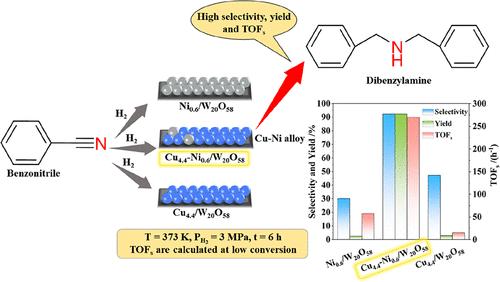
The hydrogenation of nitriles is an environmentally friendly and atom-economical route to prepare high-value amines; however, it is still a challenge to control selectivity because of the occurrence of hydrogenation, self-coupling, and hydrogenolysis reactions during the hydrogenation process. It is highly desirable to develop efficient non-noble-metal catalysts for the hydrogenation of nitriles to secondary amines, although several noble metal catalysts have been reported. Herein, we successfully prepared a Cu–Ni/W20O58 catalyst and found that the Cu4.4–Ni0.6/W20O58 catalyst showed a 92.3% yield with initial TOFs of 270.0 h–1 at 373 K and 3 MPa H2 for the hydrogenation of benzonitrile (BN) to dibenzylamine (DBA), which was much superior to that of the monometallic Cu4.4/W20O58 and Ni0.6/W20O58 catalysts. Moreover, the Cu4.4–Ni0.6/W20O58 catalyst could be reused at least 4 times and was effective for the hydrogenation of various nitriles with superior selectivity to secondary amines. Furthermore, the reaction mechanism of BN hydrogenation for the Cu–Ni alloy of Cu4.4–Ni0.6/W20O58 was proposed on the basis of spectroscopic studies such as XRD, TPR, TEM, XAFS, and XPS, kinetic studies such as the effect of BN concentration and H2 pressure, the isotopic effect of hydrogen, and the effect of the reaction temperature and DFT calculations. The rate-determining step was the hydrogenation of benzylidenamine (BI) to the half-hydrogenated intermediate by one H atom over the Cu4.4–Ni0.6/W20O58 catalyst. The Ni–W20O58 interface was responsible for the adsorption and activation of BN, and the electron-rich Cu acted as the site for H2 dissociation; the synergistic effect of Cu and Ni led to the superior catalytic performance of the Cu4.4–Ni0.6/W20O58 catalyst.
期刊介绍:
ACS Catalysis is an esteemed journal that publishes original research in the fields of heterogeneous catalysis, molecular catalysis, and biocatalysis. It offers broad coverage across diverse areas such as life sciences, organometallics and synthesis, photochemistry and electrochemistry, drug discovery and synthesis, materials science, environmental protection, polymer discovery and synthesis, and energy and fuels.
The scope of the journal is to showcase innovative work in various aspects of catalysis. This includes new reactions and novel synthetic approaches utilizing known catalysts, the discovery or modification of new catalysts, elucidation of catalytic mechanisms through cutting-edge investigations, practical enhancements of existing processes, as well as conceptual advances in the field. Contributions to ACS Catalysis can encompass both experimental and theoretical research focused on catalytic molecules, macromolecules, and materials that exhibit catalytic turnover.




 京公网安备 11010802042870号
京ICP备2023020795号-1
京公网安备 11010802042870号
京ICP备2023020795号-1

 分享
分享
 求助内容:
求助内容: 应助结果提醒方式:
 扫码关注我们
