Yutong Song, Yewei Ding, Junyi Su, Jian Li, Yuanhui Ji
{"title":"通过一种整合分子热力学的新方法释放机器学习在共晶预测中的潜力。","authors":"Yutong Song, Yewei Ding, Junyi Su, Jian Li, Yuanhui Ji","doi":"10.1002/anie.202502410","DOIUrl":null,"url":null,"abstract":"<p>Co-crystal engineering is of interest for many applications in pharmaceutical, chemical, and materials fields, but rational design of co-crystals is still challenging. Although artificial intelligence has revolutionized decision-making processes in material design, limitations in generalization and mechanistic understanding remain. Herein, we sought to improve prediction of co-crystals by combining mechanistic thermodynamic modeling with machine learning. We constructed a brand-new co-crystal database, integrating drug, coformer, and reaction solvent information. By incorporating various thermodynamic models, the predictive performance was significantly enhanced. Benefiting from the complementarity of thermodynamic mechanisms and structural descriptors, the model coupling three thermodynamic models achieved optimal predictive performance in coformer and solvent screening. The model was rigorously validated against benchmark models using challenging independent test sets, showcasing superior performance in both coformer and solvent predicting with accuracy over 90%. Further, we employed SHAP analysis for model interpretation, suggesting that thermodynamic mechanisms are prominent in the model's decision-making. Proof-of-concept studies on ketoconazole validated the model's efficacy in identifying coformers/solvents, demonstrating its potential in practical application. Overall, our work enhanced the understanding of co-crystallization and highlighted the strategy that integrates mechanistic insights with data-driven models to accelerate the rational design and synthesis of co-crystals, as well as various other functional materials.</p>","PeriodicalId":125,"journal":{"name":"Angewandte Chemie International Edition","volume":"64 21","pages":""},"PeriodicalIF":16.9000,"publicationDate":"2025-03-12","publicationTypes":"Journal Article","fieldsOfStudy":null,"isOpenAccess":false,"openAccessPdf":"","citationCount":"0","resultStr":"{\"title\":\"Unlocking the Potential of Machine Learning in Co-crystal Prediction by a Novel Approach Integrating Molecular Thermodynamics\",\"authors\":\"Yutong Song, Yewei Ding, Junyi Su, Jian Li, Yuanhui Ji\",\"doi\":\"10.1002/anie.202502410\",\"DOIUrl\":null,\"url\":null,\"abstract\":\"<p>Co-crystal engineering is of interest for many applications in pharmaceutical, chemical, and materials fields, but rational design of co-crystals is still challenging. Although artificial intelligence has revolutionized decision-making processes in material design, limitations in generalization and mechanistic understanding remain. Herein, we sought to improve prediction of co-crystals by combining mechanistic thermodynamic modeling with machine learning. We constructed a brand-new co-crystal database, integrating drug, coformer, and reaction solvent information. By incorporating various thermodynamic models, the predictive performance was significantly enhanced. Benefiting from the complementarity of thermodynamic mechanisms and structural descriptors, the model coupling three thermodynamic models achieved optimal predictive performance in coformer and solvent screening. The model was rigorously validated against benchmark models using challenging independent test sets, showcasing superior performance in both coformer and solvent predicting with accuracy over 90%. Further, we employed SHAP analysis for model interpretation, suggesting that thermodynamic mechanisms are prominent in the model's decision-making. Proof-of-concept studies on ketoconazole validated the model's efficacy in identifying coformers/solvents, demonstrating its potential in practical application. Overall, our work enhanced the understanding of co-crystallization and highlighted the strategy that integrates mechanistic insights with data-driven models to accelerate the rational design and synthesis of co-crystals, as well as various other functional materials.</p>\",\"PeriodicalId\":125,\"journal\":{\"name\":\"Angewandte Chemie International Edition\",\"volume\":\"64 21\",\"pages\":\"\"},\"PeriodicalIF\":16.9000,\"publicationDate\":\"2025-03-12\",\"publicationTypes\":\"Journal Article\",\"fieldsOfStudy\":null,\"isOpenAccess\":false,\"openAccessPdf\":\"\",\"citationCount\":\"0\",\"resultStr\":null,\"platform\":\"Semanticscholar\",\"paperid\":null,\"PeriodicalName\":\"Angewandte Chemie International Edition\",\"FirstCategoryId\":\"92\",\"ListUrlMain\":\"https://onlinelibrary.wiley.com/doi/10.1002/anie.202502410\",\"RegionNum\":1,\"RegionCategory\":\"化学\",\"ArticlePicture\":[],\"TitleCN\":null,\"AbstractTextCN\":null,\"PMCID\":null,\"EPubDate\":\"\",\"PubModel\":\"\",\"JCR\":\"Q1\",\"JCRName\":\"CHEMISTRY, MULTIDISCIPLINARY\",\"Score\":null,\"Total\":0}","platform":"Semanticscholar","paperid":null,"PeriodicalName":"Angewandte Chemie International Edition","FirstCategoryId":"92","ListUrlMain":"https://onlinelibrary.wiley.com/doi/10.1002/anie.202502410","RegionNum":1,"RegionCategory":"化学","ArticlePicture":[],"TitleCN":null,"AbstractTextCN":null,"PMCID":null,"EPubDate":"","PubModel":"","JCR":"Q1","JCRName":"CHEMISTRY, MULTIDISCIPLINARY","Score":null,"Total":0}
Unlocking the Potential of Machine Learning in Co-crystal Prediction by a Novel Approach Integrating Molecular Thermodynamics
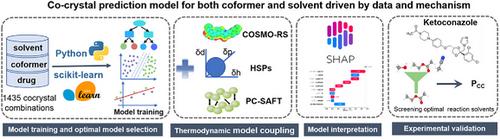
Co-crystal engineering is of interest for many applications in pharmaceutical, chemical, and materials fields, but rational design of co-crystals is still challenging. Although artificial intelligence has revolutionized decision-making processes in material design, limitations in generalization and mechanistic understanding remain. Herein, we sought to improve prediction of co-crystals by combining mechanistic thermodynamic modeling with machine learning. We constructed a brand-new co-crystal database, integrating drug, coformer, and reaction solvent information. By incorporating various thermodynamic models, the predictive performance was significantly enhanced. Benefiting from the complementarity of thermodynamic mechanisms and structural descriptors, the model coupling three thermodynamic models achieved optimal predictive performance in coformer and solvent screening. The model was rigorously validated against benchmark models using challenging independent test sets, showcasing superior performance in both coformer and solvent predicting with accuracy over 90%. Further, we employed SHAP analysis for model interpretation, suggesting that thermodynamic mechanisms are prominent in the model's decision-making. Proof-of-concept studies on ketoconazole validated the model's efficacy in identifying coformers/solvents, demonstrating its potential in practical application. Overall, our work enhanced the understanding of co-crystallization and highlighted the strategy that integrates mechanistic insights with data-driven models to accelerate the rational design and synthesis of co-crystals, as well as various other functional materials.
期刊介绍:
Angewandte Chemie, a journal of the German Chemical Society (GDCh), maintains a leading position among scholarly journals in general chemistry with an impressive Impact Factor of 16.6 (2022 Journal Citation Reports, Clarivate, 2023). Published weekly in a reader-friendly format, it features new articles almost every day. Established in 1887, Angewandte Chemie is a prominent chemistry journal, offering a dynamic blend of Review-type articles, Highlights, Communications, and Research Articles on a weekly basis, making it unique in the field.




 京公网安备 11010802042870号
京ICP备2023020795号-1
京公网安备 11010802042870号
京ICP备2023020795号-1

 分享
分享
 求助内容:
求助内容: 应助结果提醒方式:
 扫码关注我们
