Michael R Folkert, Ryoko Sato, James B Yu, Danielle Vannan, Samir Bhattacharyya, Carrie Noriega, Daniel A Hamstra
{"title":"前列腺癌放疗患者肠道疾病发生率和直肠间隔剂的使用。","authors":"Michael R Folkert, Ryoko Sato, James B Yu, Danielle Vannan, Samir Bhattacharyya, Carrie Noriega, Daniel A Hamstra","doi":"10.1001/jamanetworkopen.2025.0491","DOIUrl":null,"url":null,"abstract":"<p><strong>Importance: </strong>The polyethylene glycol-based hydrogel spacer (PHS) system temporarily separates the rectum from the prostate in patients undergoing radiotherapy (RT) for prostate cancer (PCa).</p><p><strong>Objective: </strong>To compare incidence of bowel disorders and related procedures in patients receiving RT with and without PHS.</p><p><strong>Design, setting, and participants: </strong>This retrospective cohort study used 4 datasets: Medicare 5% Standard Analytic Files, Medicare 100% Standard Analytic Files, Merative MarketScan Commercial Database, and Premier Healthcare Database. Participants included adult patients with PCa undergoing RT from 2015 to 2021.</p><p><strong>Exposure: </strong>Placement of PHS.</p><p><strong>Main outcomes: </strong>All-cause bowel disorders and related procedures, identified from diagnosis and procedure codes. Results were compared with age-matched male general population without PCa or RT.</p><p><strong>Results: </strong>Of 261 906 patients with PCa included in the study, 25 167 (9.6%) received PHS (mean [SD] age, 70.7 [6.5] years) and 236 739 did not (mean [SD] age, 71.1 [7.5] years). One year prior to RT, patients who received PHS had a lower mean (SD) Charlson Comorbidity Index score than those who did not (2.48 [1.08] vs 3.14 [1.95]; P < .001). Stereotactic RT was more common in patients who received PHS (2743 [10.9%] vs 8810 [3.7%]; P < .001), while intensity-modulated RT was less common (12 755 [50.7%] vs 142 402 [60.2%]; P < .001). After 4 years post RT, patients who received PHS had a 25% lower hazard of bowel disorders (hazard ratio [HR], 0.75 [95% CI, 0.72-0.78]; P < .001) and a 46% lower hazard of related procedures (HR, 0.54 [95% CI, 0.47-0.62]; P < .001) than patients who did not receive PHS. Patients without PHS had higher hazard compared with an age-matched general population (disorders: 17.1% [95% CI, 17.3%-17.6%] vs 10.3% [95% CI, 10.1%-10.5%]; HR, 1.35 [95% CI, 1.32-1.37]; P < .001; procedures: 2.0% [95% CI, 1.9%-2.1%] vs 0.7% [95% CI, 0.7%-0.8%]; HR, 1.92 [95% CI, 1.79-2.06]; P < .001), while patients who received PHS did not (disorders: 12.4% vs 10.3%; HR, 1.00 [95% CI, 0.98-1.05]; P = .82; procedures: 1.1% [95% CI, 1.0%-1.3%] vs 0.7% [95% CI, 0.7%-0.8%]; HR, 1.11 [95% CI, 0.96-1.29]; P = .15). Common procedures included colonoscopy, sigmoidoscopy, and rectal resection.</p><p><strong>Conclusions and relevance: </strong>In this cohort study of patients with PCa receiving RT, those receiving a PHS had a significantly lower incidence of all-cause bowel disorders and related procedures compared with patients who did not receive a PHS over the 4-year follow-up. The incidence among patients with PHS was similar to the general population. These findings are consistent with prior phase 3 trial results, where patients receiving PHS experienced no decline in bowel quality of life.</p>","PeriodicalId":14694,"journal":{"name":"JAMA Network Open","volume":"8 3","pages":"e250491"},"PeriodicalIF":9.7000,"publicationDate":"2025-03-03","publicationTypes":"Journal Article","fieldsOfStudy":null,"isOpenAccess":false,"openAccessPdf":"https://www.ncbi.nlm.nih.gov/pmc/articles/PMC11897833/pdf/","citationCount":"0","resultStr":"{\"title\":\"Bowel Disorder Incidence and Rectal Spacer Use in Patients With Prostate Cancer Undergoing Radiotherapy.\",\"authors\":\"Michael R Folkert, Ryoko Sato, James B Yu, Danielle Vannan, Samir Bhattacharyya, Carrie Noriega, Daniel A Hamstra\",\"doi\":\"10.1001/jamanetworkopen.2025.0491\",\"DOIUrl\":null,\"url\":null,\"abstract\":\"<p><strong>Importance: </strong>The polyethylene glycol-based hydrogel spacer (PHS) system temporarily separates the rectum from the prostate in patients undergoing radiotherapy (RT) for prostate cancer (PCa).</p><p><strong>Objective: </strong>To compare incidence of bowel disorders and related procedures in patients receiving RT with and without PHS.</p><p><strong>Design, setting, and participants: </strong>This retrospective cohort study used 4 datasets: Medicare 5% Standard Analytic Files, Medicare 100% Standard Analytic Files, Merative MarketScan Commercial Database, and Premier Healthcare Database. Participants included adult patients with PCa undergoing RT from 2015 to 2021.</p><p><strong>Exposure: </strong>Placement of PHS.</p><p><strong>Main outcomes: </strong>All-cause bowel disorders and related procedures, identified from diagnosis and procedure codes. Results were compared with age-matched male general population without PCa or RT.</p><p><strong>Results: </strong>Of 261 906 patients with PCa included in the study, 25 167 (9.6%) received PHS (mean [SD] age, 70.7 [6.5] years) and 236 739 did not (mean [SD] age, 71.1 [7.5] years). One year prior to RT, patients who received PHS had a lower mean (SD) Charlson Comorbidity Index score than those who did not (2.48 [1.08] vs 3.14 [1.95]; P < .001). Stereotactic RT was more common in patients who received PHS (2743 [10.9%] vs 8810 [3.7%]; P < .001), while intensity-modulated RT was less common (12 755 [50.7%] vs 142 402 [60.2%]; P < .001). After 4 years post RT, patients who received PHS had a 25% lower hazard of bowel disorders (hazard ratio [HR], 0.75 [95% CI, 0.72-0.78]; P < .001) and a 46% lower hazard of related procedures (HR, 0.54 [95% CI, 0.47-0.62]; P < .001) than patients who did not receive PHS. Patients without PHS had higher hazard compared with an age-matched general population (disorders: 17.1% [95% CI, 17.3%-17.6%] vs 10.3% [95% CI, 10.1%-10.5%]; HR, 1.35 [95% CI, 1.32-1.37]; P < .001; procedures: 2.0% [95% CI, 1.9%-2.1%] vs 0.7% [95% CI, 0.7%-0.8%]; HR, 1.92 [95% CI, 1.79-2.06]; P < .001), while patients who received PHS did not (disorders: 12.4% vs 10.3%; HR, 1.00 [95% CI, 0.98-1.05]; P = .82; procedures: 1.1% [95% CI, 1.0%-1.3%] vs 0.7% [95% CI, 0.7%-0.8%]; HR, 1.11 [95% CI, 0.96-1.29]; P = .15). Common procedures included colonoscopy, sigmoidoscopy, and rectal resection.</p><p><strong>Conclusions and relevance: </strong>In this cohort study of patients with PCa receiving RT, those receiving a PHS had a significantly lower incidence of all-cause bowel disorders and related procedures compared with patients who did not receive a PHS over the 4-year follow-up. The incidence among patients with PHS was similar to the general population. These findings are consistent with prior phase 3 trial results, where patients receiving PHS experienced no decline in bowel quality of life.</p>\",\"PeriodicalId\":14694,\"journal\":{\"name\":\"JAMA Network Open\",\"volume\":\"8 3\",\"pages\":\"e250491\"},\"PeriodicalIF\":9.7000,\"publicationDate\":\"2025-03-03\",\"publicationTypes\":\"Journal Article\",\"fieldsOfStudy\":null,\"isOpenAccess\":false,\"openAccessPdf\":\"https://www.ncbi.nlm.nih.gov/pmc/articles/PMC11897833/pdf/\",\"citationCount\":\"0\",\"resultStr\":null,\"platform\":\"Semanticscholar\",\"paperid\":null,\"PeriodicalName\":\"JAMA Network Open\",\"FirstCategoryId\":\"3\",\"ListUrlMain\":\"https://doi.org/10.1001/jamanetworkopen.2025.0491\",\"RegionNum\":1,\"RegionCategory\":\"医学\",\"ArticlePicture\":[],\"TitleCN\":null,\"AbstractTextCN\":null,\"PMCID\":null,\"EPubDate\":\"\",\"PubModel\":\"\",\"JCR\":\"Q1\",\"JCRName\":\"MEDICINE, GENERAL & INTERNAL\",\"Score\":null,\"Total\":0}","platform":"Semanticscholar","paperid":null,"PeriodicalName":"JAMA Network Open","FirstCategoryId":"3","ListUrlMain":"https://doi.org/10.1001/jamanetworkopen.2025.0491","RegionNum":1,"RegionCategory":"医学","ArticlePicture":[],"TitleCN":null,"AbstractTextCN":null,"PMCID":null,"EPubDate":"","PubModel":"","JCR":"Q1","JCRName":"MEDICINE, GENERAL & INTERNAL","Score":null,"Total":0}
Bowel Disorder Incidence and Rectal Spacer Use in Patients With Prostate Cancer Undergoing Radiotherapy.
Importance: The polyethylene glycol-based hydrogel spacer (PHS) system temporarily separates the rectum from the prostate in patients undergoing radiotherapy (RT) for prostate cancer (PCa).
Objective: To compare incidence of bowel disorders and related procedures in patients receiving RT with and without PHS.
Design, setting, and participants: This retrospective cohort study used 4 datasets: Medicare 5% Standard Analytic Files, Medicare 100% Standard Analytic Files, Merative MarketScan Commercial Database, and Premier Healthcare Database. Participants included adult patients with PCa undergoing RT from 2015 to 2021.
Exposure: Placement of PHS.
Main outcomes: All-cause bowel disorders and related procedures, identified from diagnosis and procedure codes. Results were compared with age-matched male general population without PCa or RT.
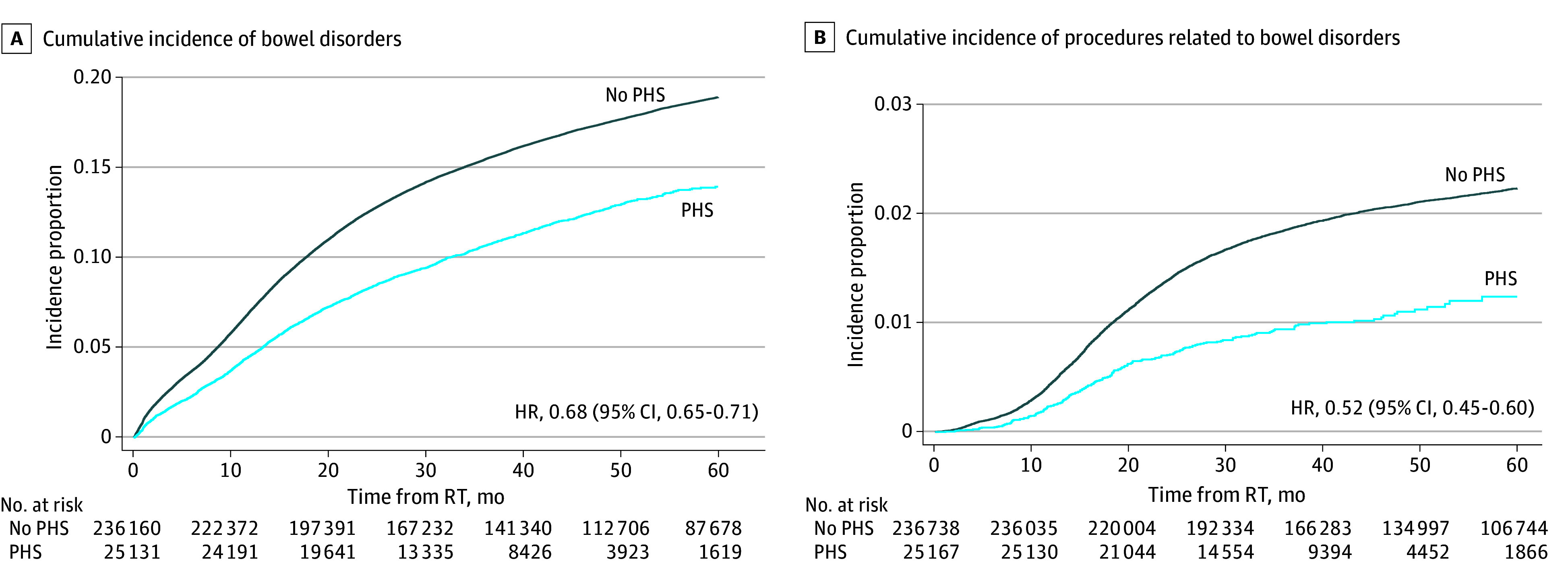
Results: Of 261 906 patients with PCa included in the study, 25 167 (9.6%) received PHS (mean [SD] age, 70.7 [6.5] years) and 236 739 did not (mean [SD] age, 71.1 [7.5] years). One year prior to RT, patients who received PHS had a lower mean (SD) Charlson Comorbidity Index score than those who did not (2.48 [1.08] vs 3.14 [1.95]; P < .001). Stereotactic RT was more common in patients who received PHS (2743 [10.9%] vs 8810 [3.7%]; P < .001), while intensity-modulated RT was less common (12 755 [50.7%] vs 142 402 [60.2%]; P < .001). After 4 years post RT, patients who received PHS had a 25% lower hazard of bowel disorders (hazard ratio [HR], 0.75 [95% CI, 0.72-0.78]; P < .001) and a 46% lower hazard of related procedures (HR, 0.54 [95% CI, 0.47-0.62]; P < .001) than patients who did not receive PHS. Patients without PHS had higher hazard compared with an age-matched general population (disorders: 17.1% [95% CI, 17.3%-17.6%] vs 10.3% [95% CI, 10.1%-10.5%]; HR, 1.35 [95% CI, 1.32-1.37]; P < .001; procedures: 2.0% [95% CI, 1.9%-2.1%] vs 0.7% [95% CI, 0.7%-0.8%]; HR, 1.92 [95% CI, 1.79-2.06]; P < .001), while patients who received PHS did not (disorders: 12.4% vs 10.3%; HR, 1.00 [95% CI, 0.98-1.05]; P = .82; procedures: 1.1% [95% CI, 1.0%-1.3%] vs 0.7% [95% CI, 0.7%-0.8%]; HR, 1.11 [95% CI, 0.96-1.29]; P = .15). Common procedures included colonoscopy, sigmoidoscopy, and rectal resection.
Conclusions and relevance: In this cohort study of patients with PCa receiving RT, those receiving a PHS had a significantly lower incidence of all-cause bowel disorders and related procedures compared with patients who did not receive a PHS over the 4-year follow-up. The incidence among patients with PHS was similar to the general population. These findings are consistent with prior phase 3 trial results, where patients receiving PHS experienced no decline in bowel quality of life.
期刊介绍:
JAMA Network Open, a member of the esteemed JAMA Network, stands as an international, peer-reviewed, open-access general medical journal.The publication is dedicated to disseminating research across various health disciplines and countries, encompassing clinical care, innovation in health care, health policy, and global health.
JAMA Network Open caters to clinicians, investigators, and policymakers, providing a platform for valuable insights and advancements in the medical field. As part of the JAMA Network, a consortium of peer-reviewed general medical and specialty publications, JAMA Network Open contributes to the collective knowledge and understanding within the medical community.





 京公网安备 11010802042870号
京ICP备2023020795号-1
京公网安备 11010802042870号
京ICP备2023020795号-1

 分享
分享
 求助内容:
求助内容: 应助结果提醒方式:
 扫码关注我们
