{"title":"双结构笼型Ni-MOF高效分离C2H2/CO2的实验与计算研究","authors":"Di-Ming Chen, Han-Dong Qiao, Pei-Feng Wang, Zi-Jun Zhao, Shao-Ming Fang","doi":"10.1016/j.molstruc.2025.142042","DOIUrl":null,"url":null,"abstract":"<div><div>In this study, a porous Ni-MOF formulated as {(H<sub>2</sub>NMe<sub>2</sub>)[Ni<sub>3</sub>(μ<sub>3<img></sub>OH)(TPT)(TZB)<sub>3</sub>](H<sub>2</sub>O)<sub>6</sub>(DMA)<sub>7</sub>}<sub>n</sub> (TZB = 4-(1H-tetrazol-5-yl)benzoate, TPT = 2,4,6-tri(4-pyridyl)-1,3,5-triazine, and DMA = N,N-dimethylacetamide) was prepared and its C<sub>2</sub>H<sub>2</sub> and CO<sub>2</sub> adsorption performances were systemically studied both experimentally and computationally. The structural analysis by single crystal X-ray diffraction studies reveals that the prepared Ni-MOF crystallizes in the space group P6<sub>3</sub>mc and features a porous <strong><em>pacs</em></strong>-type network composed of trigonal bipyramidal and octahedral cages. The activated Ni-MOF (Ni-MOF-a) shows a high C<sub>2</sub>H<sub>2</sub> uptake capacity of 157 cm<sup>3</sup>/g with a moderate C<sub>2</sub>H<sub>2</sub>/CO<sub>2</sub> IAST selectivity of 3.3 at 298 K and 1 bar. More importantly, Ni-MOF-a shows a low adsorption heat for C<sub>2</sub>H<sub>2</sub> ranging from 24.6 to 27.1 kJ/mol at 298 K with a high separation potential of 2.85 mol/kg. In the computational simulation section, six sets of point charge derived from different approaches (Qeq, Mulliken, PACMOF, mCBAC, Mepoml, PACMAN) and two different force-fields (UFF and Dreiding) were used to calculate the C<sub>2</sub>H<sub>2</sub> and CO<sub>2</sub> adsorption isotherms and then compared with the experimental values. Our results reveal that great care should be taken in the selection of point charges and force fields, and the unsuitable combinations might result in an inappropriate C<sub>2</sub>H<sub>2</sub>/CO<sub>2</sub> selectivity which is against the experimental results.</div></div>","PeriodicalId":16414,"journal":{"name":"Journal of Molecular Structure","volume":"1335 ","pages":"Article 142042"},"PeriodicalIF":4.7000,"publicationDate":"2025-07-15","publicationTypes":"Journal Article","fieldsOfStudy":null,"isOpenAccess":false,"openAccessPdf":"","citationCount":"0","resultStr":"{\"title\":\"Experimental and computational study on a dual structural cage-based Ni-MOF for efficient C2H2/CO2 separation\",\"authors\":\"Di-Ming Chen, Han-Dong Qiao, Pei-Feng Wang, Zi-Jun Zhao, Shao-Ming Fang\",\"doi\":\"10.1016/j.molstruc.2025.142042\",\"DOIUrl\":null,\"url\":null,\"abstract\":\"<div><div>In this study, a porous Ni-MOF formulated as {(H<sub>2</sub>NMe<sub>2</sub>)[Ni<sub>3</sub>(μ<sub>3<img></sub>OH)(TPT)(TZB)<sub>3</sub>](H<sub>2</sub>O)<sub>6</sub>(DMA)<sub>7</sub>}<sub>n</sub> (TZB = 4-(1H-tetrazol-5-yl)benzoate, TPT = 2,4,6-tri(4-pyridyl)-1,3,5-triazine, and DMA = N,N-dimethylacetamide) was prepared and its C<sub>2</sub>H<sub>2</sub> and CO<sub>2</sub> adsorption performances were systemically studied both experimentally and computationally. The structural analysis by single crystal X-ray diffraction studies reveals that the prepared Ni-MOF crystallizes in the space group P6<sub>3</sub>mc and features a porous <strong><em>pacs</em></strong>-type network composed of trigonal bipyramidal and octahedral cages. The activated Ni-MOF (Ni-MOF-a) shows a high C<sub>2</sub>H<sub>2</sub> uptake capacity of 157 cm<sup>3</sup>/g with a moderate C<sub>2</sub>H<sub>2</sub>/CO<sub>2</sub> IAST selectivity of 3.3 at 298 K and 1 bar. More importantly, Ni-MOF-a shows a low adsorption heat for C<sub>2</sub>H<sub>2</sub> ranging from 24.6 to 27.1 kJ/mol at 298 K with a high separation potential of 2.85 mol/kg. In the computational simulation section, six sets of point charge derived from different approaches (Qeq, Mulliken, PACMOF, mCBAC, Mepoml, PACMAN) and two different force-fields (UFF and Dreiding) were used to calculate the C<sub>2</sub>H<sub>2</sub> and CO<sub>2</sub> adsorption isotherms and then compared with the experimental values. Our results reveal that great care should be taken in the selection of point charges and force fields, and the unsuitable combinations might result in an inappropriate C<sub>2</sub>H<sub>2</sub>/CO<sub>2</sub> selectivity which is against the experimental results.</div></div>\",\"PeriodicalId\":16414,\"journal\":{\"name\":\"Journal of Molecular Structure\",\"volume\":\"1335 \",\"pages\":\"Article 142042\"},\"PeriodicalIF\":4.7000,\"publicationDate\":\"2025-07-15\",\"publicationTypes\":\"Journal Article\",\"fieldsOfStudy\":null,\"isOpenAccess\":false,\"openAccessPdf\":\"\",\"citationCount\":\"0\",\"resultStr\":null,\"platform\":\"Semanticscholar\",\"paperid\":null,\"PeriodicalName\":\"Journal of Molecular Structure\",\"FirstCategoryId\":\"92\",\"ListUrlMain\":\"https://www.sciencedirect.com/science/article/pii/S0022286025007276\",\"RegionNum\":2,\"RegionCategory\":\"化学\",\"ArticlePicture\":[],\"TitleCN\":null,\"AbstractTextCN\":null,\"PMCID\":null,\"EPubDate\":\"2025/3/11 0:00:00\",\"PubModel\":\"Epub\",\"JCR\":\"Q2\",\"JCRName\":\"CHEMISTRY, PHYSICAL\",\"Score\":null,\"Total\":0}","platform":"Semanticscholar","paperid":null,"PeriodicalName":"Journal of Molecular Structure","FirstCategoryId":"92","ListUrlMain":"https://www.sciencedirect.com/science/article/pii/S0022286025007276","RegionNum":2,"RegionCategory":"化学","ArticlePicture":[],"TitleCN":null,"AbstractTextCN":null,"PMCID":null,"EPubDate":"2025/3/11 0:00:00","PubModel":"Epub","JCR":"Q2","JCRName":"CHEMISTRY, PHYSICAL","Score":null,"Total":0}
Experimental and computational study on a dual structural cage-based Ni-MOF for efficient C2H2/CO2 separation
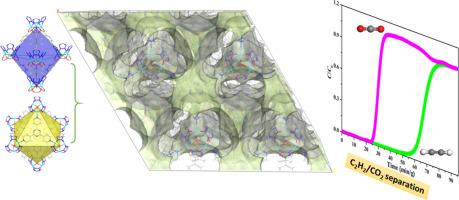
In this study, a porous Ni-MOF formulated as {(H2NMe2)[Ni3(μ3OH)(TPT)(TZB)3](H2O)6(DMA)7}n (TZB = 4-(1H-tetrazol-5-yl)benzoate, TPT = 2,4,6-tri(4-pyridyl)-1,3,5-triazine, and DMA = N,N-dimethylacetamide) was prepared and its C2H2 and CO2 adsorption performances were systemically studied both experimentally and computationally. The structural analysis by single crystal X-ray diffraction studies reveals that the prepared Ni-MOF crystallizes in the space group P63mc and features a porous pacs-type network composed of trigonal bipyramidal and octahedral cages. The activated Ni-MOF (Ni-MOF-a) shows a high C2H2 uptake capacity of 157 cm3/g with a moderate C2H2/CO2 IAST selectivity of 3.3 at 298 K and 1 bar. More importantly, Ni-MOF-a shows a low adsorption heat for C2H2 ranging from 24.6 to 27.1 kJ/mol at 298 K with a high separation potential of 2.85 mol/kg. In the computational simulation section, six sets of point charge derived from different approaches (Qeq, Mulliken, PACMOF, mCBAC, Mepoml, PACMAN) and two different force-fields (UFF and Dreiding) were used to calculate the C2H2 and CO2 adsorption isotherms and then compared with the experimental values. Our results reveal that great care should be taken in the selection of point charges and force fields, and the unsuitable combinations might result in an inappropriate C2H2/CO2 selectivity which is against the experimental results.
期刊介绍:
The Journal of Molecular Structure is dedicated to the publication of full-length articles and review papers, providing important new structural information on all types of chemical species including:
• Stable and unstable molecules in all types of environments (vapour, molecular beam, liquid, solution, liquid crystal, solid state, matrix-isolated, surface-absorbed etc.)
• Chemical intermediates
• Molecules in excited states
• Biological molecules
• Polymers.
The methods used may include any combination of spectroscopic and non-spectroscopic techniques, for example:
• Infrared spectroscopy (mid, far, near)
• Raman spectroscopy and non-linear Raman methods (CARS, etc.)
• Electronic absorption spectroscopy
• Optical rotatory dispersion and circular dichroism
• Fluorescence and phosphorescence techniques
• Electron spectroscopies (PES, XPS), EXAFS, etc.
• Microwave spectroscopy
• Electron diffraction
• NMR and ESR spectroscopies
• Mössbauer spectroscopy
• X-ray crystallography
• Charge Density Analyses
• Computational Studies (supplementing experimental methods)
We encourage publications combining theoretical and experimental approaches. The structural insights gained by the studies should be correlated with the properties, activity and/ or reactivity of the molecule under investigation and the relevance of this molecule and its implications should be discussed.





 京公网安备 11010802042870号
京ICP备2023020795号-1
京公网安备 11010802042870号
京ICP备2023020795号-1

 分享
分享
 求助内容:
求助内容: 应助结果提醒方式:
 扫码关注我们
