{"title":"用于电化学膜过滤和污水深度处理的导电CuO-CNT/PES膜","authors":"Paulomi Bose, Smruti Ranjan Dash, Jeonghwan Kim","doi":"10.1016/j.jwpe.2025.107441","DOIUrl":null,"url":null,"abstract":"<div><div>The prevalence of recalcitrant contaminants in wastewater, including organic dyes and pharmaceuticals poses serious threat to the environment owing to its complex structures and low degradability. Herein, we developed a covalently bonded CuO-CNT/polyethersulfone (PES) membrane by decorating CuO nanoparticles directly on CNT strands, followed by layer-by-layer depositions using a spray dispenser for advancing water treatment and fouling mitigation. Membrane performances were systematically evaluated using model organic compounds: the anionic Congo Red (CR), the cationic Methylene Blue (MB), and neutral antibiotic Sulfamethoxazole (SMX). At optimum external voltage (2.0 V), the organic removal efficiency was increased by 3, 4 and 5 times for CR, MB and SMX, respectively, compared to them observed without electric field. The corresponding flux recovery was improved by 59 %, 21 % and 14 % for CR, MB and SMX, respectively, exhibiting superior antifouling abilities. The performances of CuO-CNT/PES membrane under the electric field were attributed to the synergistic effects of electrostatic repulsion and indirect oxidation facilitated by hydroxyl radicals (<sup>●</sup>OH) produced. The presence of OH radicals and short-lived Cu<sup>+</sup> generated by redox conversion of Cu<sup>+2</sup> into Cu<sup>+</sup> electrochemically was validated by X-ray photoelectron spectroscopy (XPS). Furthermore, the CuO-CNT/PES membranes demonstrated exceptional stability with high conductivity under both cathodic and anodic potentials. The degradation of organic dye can be explained by first-order reaction rate with a K<sub>0</sub> value of 0.0175 s<sup>−1</sup> as rate constant. Furthermore, the synthesized membrane can separate binary mixtures selectively, highlighting the potential for applying it with real wastewater treatment.</div></div>","PeriodicalId":17528,"journal":{"name":"Journal of water process engineering","volume":"72 ","pages":"Article 107441"},"PeriodicalIF":6.6000,"publicationDate":"2025-04-01","publicationTypes":"Journal Article","fieldsOfStudy":null,"isOpenAccess":false,"openAccessPdf":"","citationCount":"0","resultStr":"{\"title\":\"Conductive CuO-CNT/PES membranes for electrochemical membrane filtration and advanced wastewater treatment\",\"authors\":\"Paulomi Bose, Smruti Ranjan Dash, Jeonghwan Kim\",\"doi\":\"10.1016/j.jwpe.2025.107441\",\"DOIUrl\":null,\"url\":null,\"abstract\":\"<div><div>The prevalence of recalcitrant contaminants in wastewater, including organic dyes and pharmaceuticals poses serious threat to the environment owing to its complex structures and low degradability. Herein, we developed a covalently bonded CuO-CNT/polyethersulfone (PES) membrane by decorating CuO nanoparticles directly on CNT strands, followed by layer-by-layer depositions using a spray dispenser for advancing water treatment and fouling mitigation. Membrane performances were systematically evaluated using model organic compounds: the anionic Congo Red (CR), the cationic Methylene Blue (MB), and neutral antibiotic Sulfamethoxazole (SMX). At optimum external voltage (2.0 V), the organic removal efficiency was increased by 3, 4 and 5 times for CR, MB and SMX, respectively, compared to them observed without electric field. The corresponding flux recovery was improved by 59 %, 21 % and 14 % for CR, MB and SMX, respectively, exhibiting superior antifouling abilities. The performances of CuO-CNT/PES membrane under the electric field were attributed to the synergistic effects of electrostatic repulsion and indirect oxidation facilitated by hydroxyl radicals (<sup>●</sup>OH) produced. The presence of OH radicals and short-lived Cu<sup>+</sup> generated by redox conversion of Cu<sup>+2</sup> into Cu<sup>+</sup> electrochemically was validated by X-ray photoelectron spectroscopy (XPS). Furthermore, the CuO-CNT/PES membranes demonstrated exceptional stability with high conductivity under both cathodic and anodic potentials. The degradation of organic dye can be explained by first-order reaction rate with a K<sub>0</sub> value of 0.0175 s<sup>−1</sup> as rate constant. Furthermore, the synthesized membrane can separate binary mixtures selectively, highlighting the potential for applying it with real wastewater treatment.</div></div>\",\"PeriodicalId\":17528,\"journal\":{\"name\":\"Journal of water process engineering\",\"volume\":\"72 \",\"pages\":\"Article 107441\"},\"PeriodicalIF\":6.6000,\"publicationDate\":\"2025-04-01\",\"publicationTypes\":\"Journal Article\",\"fieldsOfStudy\":null,\"isOpenAccess\":false,\"openAccessPdf\":\"\",\"citationCount\":\"0\",\"resultStr\":null,\"platform\":\"Semanticscholar\",\"paperid\":null,\"PeriodicalName\":\"Journal of water process engineering\",\"FirstCategoryId\":\"5\",\"ListUrlMain\":\"https://www.sciencedirect.com/science/article/pii/S2214714425005136\",\"RegionNum\":2,\"RegionCategory\":\"工程技术\",\"ArticlePicture\":[],\"TitleCN\":null,\"AbstractTextCN\":null,\"PMCID\":null,\"EPubDate\":\"2025/3/13 0:00:00\",\"PubModel\":\"Epub\",\"JCR\":\"Q1\",\"JCRName\":\"ENGINEERING, CHEMICAL\",\"Score\":null,\"Total\":0}","platform":"Semanticscholar","paperid":null,"PeriodicalName":"Journal of water process engineering","FirstCategoryId":"5","ListUrlMain":"https://www.sciencedirect.com/science/article/pii/S2214714425005136","RegionNum":2,"RegionCategory":"工程技术","ArticlePicture":[],"TitleCN":null,"AbstractTextCN":null,"PMCID":null,"EPubDate":"2025/3/13 0:00:00","PubModel":"Epub","JCR":"Q1","JCRName":"ENGINEERING, CHEMICAL","Score":null,"Total":0}
Conductive CuO-CNT/PES membranes for electrochemical membrane filtration and advanced wastewater treatment
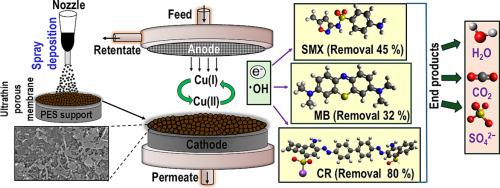
The prevalence of recalcitrant contaminants in wastewater, including organic dyes and pharmaceuticals poses serious threat to the environment owing to its complex structures and low degradability. Herein, we developed a covalently bonded CuO-CNT/polyethersulfone (PES) membrane by decorating CuO nanoparticles directly on CNT strands, followed by layer-by-layer depositions using a spray dispenser for advancing water treatment and fouling mitigation. Membrane performances were systematically evaluated using model organic compounds: the anionic Congo Red (CR), the cationic Methylene Blue (MB), and neutral antibiotic Sulfamethoxazole (SMX). At optimum external voltage (2.0 V), the organic removal efficiency was increased by 3, 4 and 5 times for CR, MB and SMX, respectively, compared to them observed without electric field. The corresponding flux recovery was improved by 59 %, 21 % and 14 % for CR, MB and SMX, respectively, exhibiting superior antifouling abilities. The performances of CuO-CNT/PES membrane under the electric field were attributed to the synergistic effects of electrostatic repulsion and indirect oxidation facilitated by hydroxyl radicals (●OH) produced. The presence of OH radicals and short-lived Cu+ generated by redox conversion of Cu+2 into Cu+ electrochemically was validated by X-ray photoelectron spectroscopy (XPS). Furthermore, the CuO-CNT/PES membranes demonstrated exceptional stability with high conductivity under both cathodic and anodic potentials. The degradation of organic dye can be explained by first-order reaction rate with a K0 value of 0.0175 s−1 as rate constant. Furthermore, the synthesized membrane can separate binary mixtures selectively, highlighting the potential for applying it with real wastewater treatment.
期刊介绍:
The Journal of Water Process Engineering aims to publish refereed, high-quality research papers with significant novelty and impact in all areas of the engineering of water and wastewater processing . Papers on advanced and novel treatment processes and technologies are particularly welcome. The Journal considers papers in areas such as nanotechnology and biotechnology applications in water, novel oxidation and separation processes, membrane processes (except those for desalination) , catalytic processes for the removal of water contaminants, sustainable processes, water reuse and recycling, water use and wastewater minimization, integrated/hybrid technology, process modeling of water treatment and novel treatment processes. Submissions on the subject of adsorbents, including standard measurements of adsorption kinetics and equilibrium will only be considered if there is a genuine case for novelty and contribution, for example highly novel, sustainable adsorbents and their use: papers on activated carbon-type materials derived from natural matter, or surfactant-modified clays and related minerals, would not fulfil this criterion. The Journal particularly welcomes contributions involving environmentally, economically and socially sustainable technology for water treatment, including those which are energy-efficient, with minimal or no chemical consumption, and capable of water recycling and reuse that minimizes the direct disposal of wastewater to the aquatic environment. Papers that describe novel ideas for solving issues related to water quality and availability are also welcome, as are those that show the transfer of techniques from other disciplines. The Journal will consider papers dealing with processes for various water matrices including drinking water (except desalination), domestic, urban and industrial wastewaters, in addition to their residues. It is expected that the journal will be of particular relevance to chemical and process engineers working in the field. The Journal welcomes Full Text papers, Short Communications, State-of-the-Art Reviews and Letters to Editors and Case Studies




 京公网安备 11010802042870号
京ICP备2023020795号-1
京公网安备 11010802042870号
京ICP备2023020795号-1

 分享
分享
 求助内容:
求助内容: 应助结果提醒方式:
 扫码关注我们
