Mingming Yang, Bin Liang, Xin Zhao, Yang Wang, Mingyuan Xue, Qipeng Song, Dan Wang
{"title":"髌骨骨折手术后个体化血流限制训练的有效性:一个病例系列。","authors":"Mingming Yang, Bin Liang, Xin Zhao, Yang Wang, Mingyuan Xue, Qipeng Song, Dan Wang","doi":"10.1186/s12891-025-08424-2","DOIUrl":null,"url":null,"abstract":"<p><strong>Background: </strong>Patellar fracture surgeries are associated with subsequent atrophy and weakness in the muscles of the lower limb. Individualized blood flow restriction training is progressively being recognized as a potential technique for improving muscular hypertrophy and accompanying strength in participants recovering from surgery. This study aimed to investigate the overall feasibility and observational outcomes of individualized blood flow restriction training for participants recovering from patellar fracture surgery.</p><p><strong>Methods: </strong>A 47-year-old male (Participant one, body mass: 65 kg, height: 1.75 m, body mass index: 21.2 kg/m<sup>2</sup>, three months post-patellar fracture surgery) and a 28-year-old female (Participant two, body mass: 53 kg, height: 1.67 m, body mass index: 19.8 kg/m<sup>2</sup>, three months post-patellar fracture surgery) performed straight leg raises and leg extensions with individualized blood flow restriction for six weeks. The blood supply to the leg with the patellar fracture was partially restricted using a thigh pressure cuff inflated to 60% of the limb occlusion pressure. Peak torque of knee extensor, rectus femoris cross-sectional area, rectus femoris stiffness, and Lysholm score were measured at baseline and post-training.</p><p><strong>Results: </strong>Compared to baseline, the post-training peak torque of the knee extensor, rectus femoris cross-sectional area, rectus femoris stiffness, and Lysholm score of participants one post-surgical leg increased by 48.2%, 7.9%, 7.9%, and 23 points, respectively; those of participant two increased by 134.7%, 6.8%, 14.2%, and 30 points, respectively.</p><p><strong>Conclusions: </strong>The results showed that the individualized blood flow restriction training was feasible and suggested promising outcomes for participants after surgery. Further research with a large sample size is required to flesh out and generalize the training program.</p><p><strong>Trial registration: </strong>The Nanjing First Hospital's ethics committee accepted the research before testing. The clinical test was documented with clinicaltrials.gov (NCT05371431, Registered 08-20-2020, prospectively registered).</p>","PeriodicalId":9189,"journal":{"name":"BMC Musculoskeletal Disorders","volume":"26 1","pages":"247"},"PeriodicalIF":2.4000,"publicationDate":"2025-03-12","publicationTypes":"Journal Article","fieldsOfStudy":null,"isOpenAccess":false,"openAccessPdf":"https://www.ncbi.nlm.nih.gov/pmc/articles/PMC11899750/pdf/","citationCount":"0","resultStr":"{\"title\":\"The effectiveness of individualized blood flow restriction training following patellar fracture surgery: a case series.\",\"authors\":\"Mingming Yang, Bin Liang, Xin Zhao, Yang Wang, Mingyuan Xue, Qipeng Song, Dan Wang\",\"doi\":\"10.1186/s12891-025-08424-2\",\"DOIUrl\":null,\"url\":null,\"abstract\":\"<p><strong>Background: </strong>Patellar fracture surgeries are associated with subsequent atrophy and weakness in the muscles of the lower limb. Individualized blood flow restriction training is progressively being recognized as a potential technique for improving muscular hypertrophy and accompanying strength in participants recovering from surgery. This study aimed to investigate the overall feasibility and observational outcomes of individualized blood flow restriction training for participants recovering from patellar fracture surgery.</p><p><strong>Methods: </strong>A 47-year-old male (Participant one, body mass: 65 kg, height: 1.75 m, body mass index: 21.2 kg/m<sup>2</sup>, three months post-patellar fracture surgery) and a 28-year-old female (Participant two, body mass: 53 kg, height: 1.67 m, body mass index: 19.8 kg/m<sup>2</sup>, three months post-patellar fracture surgery) performed straight leg raises and leg extensions with individualized blood flow restriction for six weeks. The blood supply to the leg with the patellar fracture was partially restricted using a thigh pressure cuff inflated to 60% of the limb occlusion pressure. Peak torque of knee extensor, rectus femoris cross-sectional area, rectus femoris stiffness, and Lysholm score were measured at baseline and post-training.</p><p><strong>Results: </strong>Compared to baseline, the post-training peak torque of the knee extensor, rectus femoris cross-sectional area, rectus femoris stiffness, and Lysholm score of participants one post-surgical leg increased by 48.2%, 7.9%, 7.9%, and 23 points, respectively; those of participant two increased by 134.7%, 6.8%, 14.2%, and 30 points, respectively.</p><p><strong>Conclusions: </strong>The results showed that the individualized blood flow restriction training was feasible and suggested promising outcomes for participants after surgery. Further research with a large sample size is required to flesh out and generalize the training program.</p><p><strong>Trial registration: </strong>The Nanjing First Hospital's ethics committee accepted the research before testing. The clinical test was documented with clinicaltrials.gov (NCT05371431, Registered 08-20-2020, prospectively registered).</p>\",\"PeriodicalId\":9189,\"journal\":{\"name\":\"BMC Musculoskeletal Disorders\",\"volume\":\"26 1\",\"pages\":\"247\"},\"PeriodicalIF\":2.4000,\"publicationDate\":\"2025-03-12\",\"publicationTypes\":\"Journal Article\",\"fieldsOfStudy\":null,\"isOpenAccess\":false,\"openAccessPdf\":\"https://www.ncbi.nlm.nih.gov/pmc/articles/PMC11899750/pdf/\",\"citationCount\":\"0\",\"resultStr\":null,\"platform\":\"Semanticscholar\",\"paperid\":null,\"PeriodicalName\":\"BMC Musculoskeletal Disorders\",\"FirstCategoryId\":\"3\",\"ListUrlMain\":\"https://doi.org/10.1186/s12891-025-08424-2\",\"RegionNum\":3,\"RegionCategory\":\"医学\",\"ArticlePicture\":[],\"TitleCN\":null,\"AbstractTextCN\":null,\"PMCID\":null,\"EPubDate\":\"\",\"PubModel\":\"\",\"JCR\":\"Q2\",\"JCRName\":\"ORTHOPEDICS\",\"Score\":null,\"Total\":0}","platform":"Semanticscholar","paperid":null,"PeriodicalName":"BMC Musculoskeletal Disorders","FirstCategoryId":"3","ListUrlMain":"https://doi.org/10.1186/s12891-025-08424-2","RegionNum":3,"RegionCategory":"医学","ArticlePicture":[],"TitleCN":null,"AbstractTextCN":null,"PMCID":null,"EPubDate":"","PubModel":"","JCR":"Q2","JCRName":"ORTHOPEDICS","Score":null,"Total":0}
The effectiveness of individualized blood flow restriction training following patellar fracture surgery: a case series.
Background: Patellar fracture surgeries are associated with subsequent atrophy and weakness in the muscles of the lower limb. Individualized blood flow restriction training is progressively being recognized as a potential technique for improving muscular hypertrophy and accompanying strength in participants recovering from surgery. This study aimed to investigate the overall feasibility and observational outcomes of individualized blood flow restriction training for participants recovering from patellar fracture surgery.
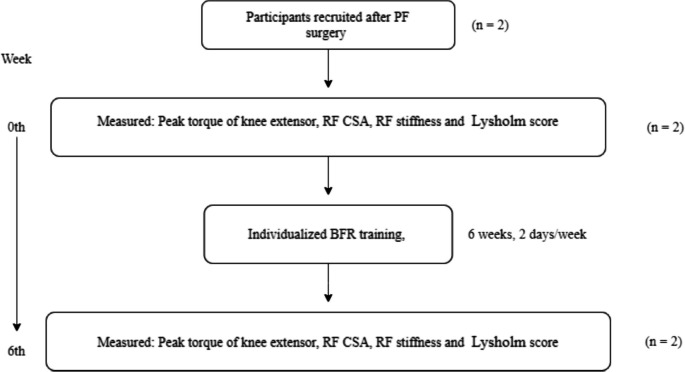
Methods: A 47-year-old male (Participant one, body mass: 65 kg, height: 1.75 m, body mass index: 21.2 kg/m2, three months post-patellar fracture surgery) and a 28-year-old female (Participant two, body mass: 53 kg, height: 1.67 m, body mass index: 19.8 kg/m2, three months post-patellar fracture surgery) performed straight leg raises and leg extensions with individualized blood flow restriction for six weeks. The blood supply to the leg with the patellar fracture was partially restricted using a thigh pressure cuff inflated to 60% of the limb occlusion pressure. Peak torque of knee extensor, rectus femoris cross-sectional area, rectus femoris stiffness, and Lysholm score were measured at baseline and post-training.
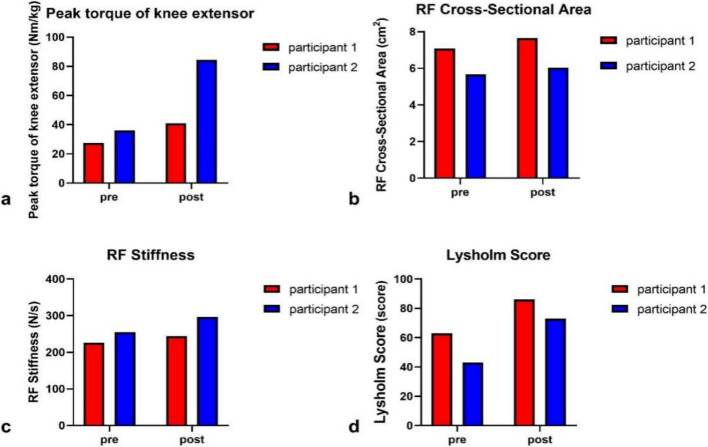
Results: Compared to baseline, the post-training peak torque of the knee extensor, rectus femoris cross-sectional area, rectus femoris stiffness, and Lysholm score of participants one post-surgical leg increased by 48.2%, 7.9%, 7.9%, and 23 points, respectively; those of participant two increased by 134.7%, 6.8%, 14.2%, and 30 points, respectively.
Conclusions: The results showed that the individualized blood flow restriction training was feasible and suggested promising outcomes for participants after surgery. Further research with a large sample size is required to flesh out and generalize the training program.
Trial registration: The Nanjing First Hospital's ethics committee accepted the research before testing. The clinical test was documented with clinicaltrials.gov (NCT05371431, Registered 08-20-2020, prospectively registered).
期刊介绍:
BMC Musculoskeletal Disorders is an open access, peer-reviewed journal that considers articles on all aspects of the prevention, diagnosis and management of musculoskeletal disorders, as well as related molecular genetics, pathophysiology, and epidemiology.
The scope of the Journal covers research into rheumatic diseases where the primary focus relates specifically to a component(s) of the musculoskeletal system.





 京公网安备 11010802042870号
京ICP备2023020795号-1
京公网安备 11010802042870号
京ICP备2023020795号-1

 分享
分享
 求助内容:
求助内容: 应助结果提醒方式:
 扫码关注我们
