David Martin, Mathilde Billy, Fabio Becce, Damien Maier, Michael Schneider, Clarisse Dromain, Dieter Hahnloser, Martin Hübner, Fabian Grass
{"title":"术前ct测量的肌减少症对直肠癌择期手术后临床、病理和肿瘤预后的影响。","authors":"David Martin, Mathilde Billy, Fabio Becce, Damien Maier, Michael Schneider, Clarisse Dromain, Dieter Hahnloser, Martin Hübner, Fabian Grass","doi":"10.3390/diagnostics15050629","DOIUrl":null,"url":null,"abstract":"<p><p><b>Background:</b> Patients with rectal cancer may be exposed to a loss of muscle strength and quality. This study aimed to assess the role of preoperative CT-based sarcopenia on postoperative clinical, pathological, and oncological outcomes after rectal cancer surgery. <b>Methods:</b> This retrospective monocentric study included patients who underwent elective oncologic resection for rectal adenocarcinoma between 01/2014 and 03/2022. The skeletal muscle index (SMI) was measured using CT at the third lumbar vertebral level, and sarcopenia was defined based on pre-established sex-specific cut-offs. Patients with sarcopenia were compared to those without sarcopenia in terms of outcomes. A Cox proportional hazard regression analysis was used to determine the independent prognostic factors of disease-free survival (DFS) and overall survival (OS). <b>Results:</b> A total of 208 patients were included, and 123 (59%) had preoperative sarcopenia. Patients with sarcopenia were significantly older (66 vs. 61 years, <i>p</i> = 0.003), had lower BMI (24 vs. 28 kg/m<sup>2</sup>, <i>p</i> < 0.001), and were mainly men (76 vs. 48%, <i>p</i> < 0.001). There was no difference in overall and major complication rates between the sarcopenia and non-sarcopenia group (43 vs. 37%, <i>p</i> = 0.389, and 17 vs. 17%, <i>p</i> = 1.000, respectively). Preoperative and postoperative features related to rectal surgery were comparable. The only predictive factor impacting OS was R1/R2 resection (HR 4.915, 95% CI, 1.141-11.282, <i>p</i> < 0.001), while sarcopenia (HR 2.013, 95% CI 0.972-4.173, <i>p</i> = 0.050) and T3/T4 status (HR 2.108, 95% CI 1.058-4.203, <i>p</i> = 0.034) were independently associated with DFS. <b>Conclusions:</b> A majority of patients undergoing rectal cancer surgery had preoperative CT-based sarcopenia. In this cohort, sarcopenia had no impact on postoperative morbidity and OS but was independently associated with DFS.</p>","PeriodicalId":11225,"journal":{"name":"Diagnostics","volume":"15 5","pages":""},"PeriodicalIF":3.3000,"publicationDate":"2025-03-05","publicationTypes":"Journal Article","fieldsOfStudy":null,"isOpenAccess":false,"openAccessPdf":"https://www.ncbi.nlm.nih.gov/pmc/articles/PMC11899399/pdf/","citationCount":"0","resultStr":"{\"title\":\"Impact of Preoperative CT-Measured Sarcopenia on Clinical, Pathological, and Oncological Outcomes After Elective Rectal Cancer Surgery.\",\"authors\":\"David Martin, Mathilde Billy, Fabio Becce, Damien Maier, Michael Schneider, Clarisse Dromain, Dieter Hahnloser, Martin Hübner, Fabian Grass\",\"doi\":\"10.3390/diagnostics15050629\",\"DOIUrl\":null,\"url\":null,\"abstract\":\"<p><p><b>Background:</b> Patients with rectal cancer may be exposed to a loss of muscle strength and quality. This study aimed to assess the role of preoperative CT-based sarcopenia on postoperative clinical, pathological, and oncological outcomes after rectal cancer surgery. <b>Methods:</b> This retrospective monocentric study included patients who underwent elective oncologic resection for rectal adenocarcinoma between 01/2014 and 03/2022. The skeletal muscle index (SMI) was measured using CT at the third lumbar vertebral level, and sarcopenia was defined based on pre-established sex-specific cut-offs. Patients with sarcopenia were compared to those without sarcopenia in terms of outcomes. A Cox proportional hazard regression analysis was used to determine the independent prognostic factors of disease-free survival (DFS) and overall survival (OS). <b>Results:</b> A total of 208 patients were included, and 123 (59%) had preoperative sarcopenia. Patients with sarcopenia were significantly older (66 vs. 61 years, <i>p</i> = 0.003), had lower BMI (24 vs. 28 kg/m<sup>2</sup>, <i>p</i> < 0.001), and were mainly men (76 vs. 48%, <i>p</i> < 0.001). There was no difference in overall and major complication rates between the sarcopenia and non-sarcopenia group (43 vs. 37%, <i>p</i> = 0.389, and 17 vs. 17%, <i>p</i> = 1.000, respectively). Preoperative and postoperative features related to rectal surgery were comparable. The only predictive factor impacting OS was R1/R2 resection (HR 4.915, 95% CI, 1.141-11.282, <i>p</i> < 0.001), while sarcopenia (HR 2.013, 95% CI 0.972-4.173, <i>p</i> = 0.050) and T3/T4 status (HR 2.108, 95% CI 1.058-4.203, <i>p</i> = 0.034) were independently associated with DFS. <b>Conclusions:</b> A majority of patients undergoing rectal cancer surgery had preoperative CT-based sarcopenia. In this cohort, sarcopenia had no impact on postoperative morbidity and OS but was independently associated with DFS.</p>\",\"PeriodicalId\":11225,\"journal\":{\"name\":\"Diagnostics\",\"volume\":\"15 5\",\"pages\":\"\"},\"PeriodicalIF\":3.3000,\"publicationDate\":\"2025-03-05\",\"publicationTypes\":\"Journal Article\",\"fieldsOfStudy\":null,\"isOpenAccess\":false,\"openAccessPdf\":\"https://www.ncbi.nlm.nih.gov/pmc/articles/PMC11899399/pdf/\",\"citationCount\":\"0\",\"resultStr\":null,\"platform\":\"Semanticscholar\",\"paperid\":null,\"PeriodicalName\":\"Diagnostics\",\"FirstCategoryId\":\"3\",\"ListUrlMain\":\"https://doi.org/10.3390/diagnostics15050629\",\"RegionNum\":3,\"RegionCategory\":\"医学\",\"ArticlePicture\":[],\"TitleCN\":null,\"AbstractTextCN\":null,\"PMCID\":null,\"EPubDate\":\"\",\"PubModel\":\"\",\"JCR\":\"Q1\",\"JCRName\":\"MEDICINE, GENERAL & INTERNAL\",\"Score\":null,\"Total\":0}","platform":"Semanticscholar","paperid":null,"PeriodicalName":"Diagnostics","FirstCategoryId":"3","ListUrlMain":"https://doi.org/10.3390/diagnostics15050629","RegionNum":3,"RegionCategory":"医学","ArticlePicture":[],"TitleCN":null,"AbstractTextCN":null,"PMCID":null,"EPubDate":"","PubModel":"","JCR":"Q1","JCRName":"MEDICINE, GENERAL & INTERNAL","Score":null,"Total":0}
引用次数: 0
摘要
背景:直肠癌患者可能面临肌肉力量和质量的丧失。本研究旨在评估术前基于ct的肌肉减少症对直肠癌手术后临床、病理和肿瘤预后的影响。方法:这项回顾性单中心研究纳入了2014年1月至2022年3月期间接受直肠腺癌选择性肿瘤切除术的患者。骨骼肌指数(SMI)使用CT在第三腰椎水平测量,肌肉减少症是基于预先建立的性别特异性截断。骨骼肌减少症患者与非骨骼肌减少症患者在结果方面进行了比较。采用Cox比例风险回归分析确定无病生存期(DFS)和总生存期(OS)的独立预后因素。结果:共纳入208例患者,术前肌少症123例(59%)。肌肉减少症患者明显年龄较大(66岁对61岁,p = 0.003), BMI较低(24对28 kg/m2, p < 0.001),且以男性为主(76对48%,p < 0.001)。肌少症组和非肌少症组的总并发症和主要并发症发生率无差异(分别为43比37%,p = 0.389, 17比17%,p = 1.000)。直肠手术的术前和术后特征具有可比性。影响OS的唯一预测因素是R1/R2切除(HR 4.915, 95% CI 1.141 ~ 11.282, p < 0.001),而肌少症(HR 2.013, 95% CI 0.972 ~ 4.173, p = 0.050)和T3/T4状态(HR 2.108, 95% CI 1.058 ~ 4.203, p = 0.034)与DFS独立相关。结论:大多数接受直肠癌手术的患者术前存在基于ct的肌肉减少症。在这个队列中,肌肉减少症对术后发病率和OS没有影响,但与DFS独立相关。
Impact of Preoperative CT-Measured Sarcopenia on Clinical, Pathological, and Oncological Outcomes After Elective Rectal Cancer Surgery.
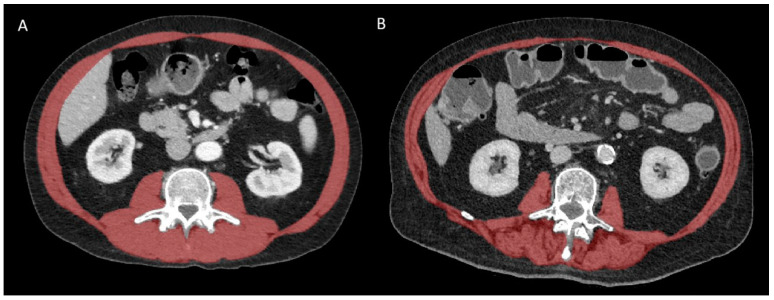
Background: Patients with rectal cancer may be exposed to a loss of muscle strength and quality. This study aimed to assess the role of preoperative CT-based sarcopenia on postoperative clinical, pathological, and oncological outcomes after rectal cancer surgery. Methods: This retrospective monocentric study included patients who underwent elective oncologic resection for rectal adenocarcinoma between 01/2014 and 03/2022. The skeletal muscle index (SMI) was measured using CT at the third lumbar vertebral level, and sarcopenia was defined based on pre-established sex-specific cut-offs. Patients with sarcopenia were compared to those without sarcopenia in terms of outcomes. A Cox proportional hazard regression analysis was used to determine the independent prognostic factors of disease-free survival (DFS) and overall survival (OS). Results: A total of 208 patients were included, and 123 (59%) had preoperative sarcopenia. Patients with sarcopenia were significantly older (66 vs. 61 years, p = 0.003), had lower BMI (24 vs. 28 kg/m2, p < 0.001), and were mainly men (76 vs. 48%, p < 0.001). There was no difference in overall and major complication rates between the sarcopenia and non-sarcopenia group (43 vs. 37%, p = 0.389, and 17 vs. 17%, p = 1.000, respectively). Preoperative and postoperative features related to rectal surgery were comparable. The only predictive factor impacting OS was R1/R2 resection (HR 4.915, 95% CI, 1.141-11.282, p < 0.001), while sarcopenia (HR 2.013, 95% CI 0.972-4.173, p = 0.050) and T3/T4 status (HR 2.108, 95% CI 1.058-4.203, p = 0.034) were independently associated with DFS. Conclusions: A majority of patients undergoing rectal cancer surgery had preoperative CT-based sarcopenia. In this cohort, sarcopenia had no impact on postoperative morbidity and OS but was independently associated with DFS.
DiagnosticsBiochemistry, Genetics and Molecular Biology-Clinical Biochemistry
CiteScore
4.70
自引率
8.30%
发文量
2699
审稿时长
19.64 days
期刊介绍:
Diagnostics (ISSN 2075-4418) is an international scholarly open access journal on medical diagnostics. It publishes original research articles, reviews, communications and short notes on the research and development of medical diagnostics. There is no restriction on the length of the papers. Our aim is to encourage scientists to publish their experimental and theoretical research in as much detail as possible. Full experimental and/or methodological details must be provided for research articles.





 京公网安备 11010802042870号
京ICP备2023020795号-1
京公网安备 11010802042870号
京ICP备2023020795号-1

 分享
分享
 求助内容:
求助内容: 应助结果提醒方式:
 扫码关注我们
