Santiago Tañá-Sanz, Pedro Tañá-Sanz, Belén Elvira-Giner, Paz Orts-Vila, Pedro Tañá-Rivero
{"title":"新型双非球面非衍射扩展焦深度人工晶状体的视觉表现、光畸变和患者报告结果。","authors":"Santiago Tañá-Sanz, Pedro Tañá-Sanz, Belén Elvira-Giner, Paz Orts-Vila, Pedro Tañá-Rivero","doi":"10.3389/fmed.2025.1513803","DOIUrl":null,"url":null,"abstract":"<p><strong>Background: </strong>To evaluate refractive, visual, and patient-reported outcomes three months after bilateral implantation of a novel bi-aspheric, non-diffractive extended depth of focus (EDOF) intraocular lens (IOL) using PhaseRing technology to achieve good vision across distances with reduced dysphotopsia.</p><p><strong>Methods: </strong>Twenty-two patients received bilateral Asqelio EDOF IOLs (AST VisionCare Inc.) and were evaluated 3 months post-surgery. The main outcomes assessed were refractive error, monocular and binocular visual acuities at distance, intermediate (67 cm) and near (40 cm), low contrast visual acuity, defocus curves, contrast sensitivity, and patient questionnaires.</p><p><strong>Results: </strong>The average postoperative spherical equivalent was -0.31 ± 0.30 D. Astigmatism of ≤ 1.00 D was present in all eyes (100%, <i>n</i> = 44), with 75% (<i>n</i> = 33) showing astigmatism of ≤ 0.50 D. Every patient attained a corrected distance visual acuity (CDVA) of 20/25 or better and a distance-corrected intermediate visual acuity (DCIVA) of 20/32 or better. Contrast sensitivity met or exceeded normal levels under both photopic and mesopic conditions, with and without glare, except at 12 cycles per degree under mesopic conditions with glare. Light distortion index was comparable to published reports on monofocal IOLs and other non-diffractive EDOF IOLs, and lower than diffractive multifocal IOLs. Post-surgery, 90.9% (<i>n</i> = 20) of patients reported being satisfied with their vision. No significant visual symptoms were reported.</p><p><strong>Conclusion: </strong>Asqelio™ EDOF IOL offers an efficient design, providing good clinical outcomes for distance and intermediate vision, while some patients reach functional levels of near vision. Its non-diffractive design minimizes dysphotopsia and reduces light distortion compared to other presbyopia-correcting IOLs.</p>","PeriodicalId":12488,"journal":{"name":"Frontiers in Medicine","volume":"12 ","pages":"1513803"},"PeriodicalIF":3.1000,"publicationDate":"2025-02-26","publicationTypes":"Journal Article","fieldsOfStudy":null,"isOpenAccess":false,"openAccessPdf":"https://www.ncbi.nlm.nih.gov/pmc/articles/PMC11900891/pdf/","citationCount":"0","resultStr":"{\"title\":\"Visual performance, light distortion and patient reported outcomes with a new bi-aspheric non-diffractive extended depth of focus intraocular lens.\",\"authors\":\"Santiago Tañá-Sanz, Pedro Tañá-Sanz, Belén Elvira-Giner, Paz Orts-Vila, Pedro Tañá-Rivero\",\"doi\":\"10.3389/fmed.2025.1513803\",\"DOIUrl\":null,\"url\":null,\"abstract\":\"<p><strong>Background: </strong>To evaluate refractive, visual, and patient-reported outcomes three months after bilateral implantation of a novel bi-aspheric, non-diffractive extended depth of focus (EDOF) intraocular lens (IOL) using PhaseRing technology to achieve good vision across distances with reduced dysphotopsia.</p><p><strong>Methods: </strong>Twenty-two patients received bilateral Asqelio EDOF IOLs (AST VisionCare Inc.) and were evaluated 3 months post-surgery. The main outcomes assessed were refractive error, monocular and binocular visual acuities at distance, intermediate (67 cm) and near (40 cm), low contrast visual acuity, defocus curves, contrast sensitivity, and patient questionnaires.</p><p><strong>Results: </strong>The average postoperative spherical equivalent was -0.31 ± 0.30 D. Astigmatism of ≤ 1.00 D was present in all eyes (100%, <i>n</i> = 44), with 75% (<i>n</i> = 33) showing astigmatism of ≤ 0.50 D. Every patient attained a corrected distance visual acuity (CDVA) of 20/25 or better and a distance-corrected intermediate visual acuity (DCIVA) of 20/32 or better. Contrast sensitivity met or exceeded normal levels under both photopic and mesopic conditions, with and without glare, except at 12 cycles per degree under mesopic conditions with glare. Light distortion index was comparable to published reports on monofocal IOLs and other non-diffractive EDOF IOLs, and lower than diffractive multifocal IOLs. Post-surgery, 90.9% (<i>n</i> = 20) of patients reported being satisfied with their vision. No significant visual symptoms were reported.</p><p><strong>Conclusion: </strong>Asqelio™ EDOF IOL offers an efficient design, providing good clinical outcomes for distance and intermediate vision, while some patients reach functional levels of near vision. Its non-diffractive design minimizes dysphotopsia and reduces light distortion compared to other presbyopia-correcting IOLs.</p>\",\"PeriodicalId\":12488,\"journal\":{\"name\":\"Frontiers in Medicine\",\"volume\":\"12 \",\"pages\":\"1513803\"},\"PeriodicalIF\":3.1000,\"publicationDate\":\"2025-02-26\",\"publicationTypes\":\"Journal Article\",\"fieldsOfStudy\":null,\"isOpenAccess\":false,\"openAccessPdf\":\"https://www.ncbi.nlm.nih.gov/pmc/articles/PMC11900891/pdf/\",\"citationCount\":\"0\",\"resultStr\":null,\"platform\":\"Semanticscholar\",\"paperid\":null,\"PeriodicalName\":\"Frontiers in Medicine\",\"FirstCategoryId\":\"3\",\"ListUrlMain\":\"https://doi.org/10.3389/fmed.2025.1513803\",\"RegionNum\":3,\"RegionCategory\":\"医学\",\"ArticlePicture\":[],\"TitleCN\":null,\"AbstractTextCN\":null,\"PMCID\":null,\"EPubDate\":\"2025/1/1 0:00:00\",\"PubModel\":\"eCollection\",\"JCR\":\"Q1\",\"JCRName\":\"MEDICINE, GENERAL & INTERNAL\",\"Score\":null,\"Total\":0}","platform":"Semanticscholar","paperid":null,"PeriodicalName":"Frontiers in Medicine","FirstCategoryId":"3","ListUrlMain":"https://doi.org/10.3389/fmed.2025.1513803","RegionNum":3,"RegionCategory":"医学","ArticlePicture":[],"TitleCN":null,"AbstractTextCN":null,"PMCID":null,"EPubDate":"2025/1/1 0:00:00","PubModel":"eCollection","JCR":"Q1","JCRName":"MEDICINE, GENERAL & INTERNAL","Score":null,"Total":0}
Visual performance, light distortion and patient reported outcomes with a new bi-aspheric non-diffractive extended depth of focus intraocular lens.
Background: To evaluate refractive, visual, and patient-reported outcomes three months after bilateral implantation of a novel bi-aspheric, non-diffractive extended depth of focus (EDOF) intraocular lens (IOL) using PhaseRing technology to achieve good vision across distances with reduced dysphotopsia.
Methods: Twenty-two patients received bilateral Asqelio EDOF IOLs (AST VisionCare Inc.) and were evaluated 3 months post-surgery. The main outcomes assessed were refractive error, monocular and binocular visual acuities at distance, intermediate (67 cm) and near (40 cm), low contrast visual acuity, defocus curves, contrast sensitivity, and patient questionnaires.
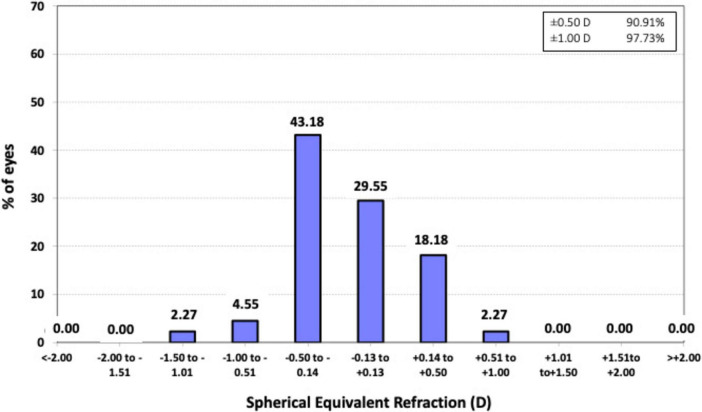
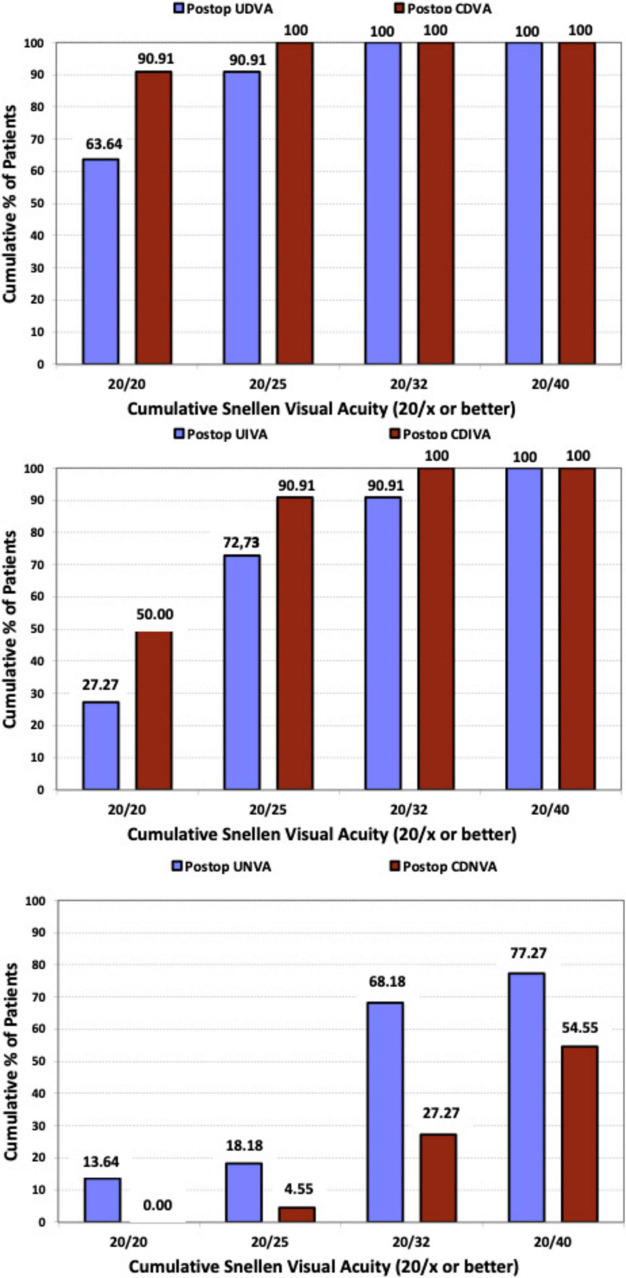
Results: The average postoperative spherical equivalent was -0.31 ± 0.30 D. Astigmatism of ≤ 1.00 D was present in all eyes (100%, n = 44), with 75% (n = 33) showing astigmatism of ≤ 0.50 D. Every patient attained a corrected distance visual acuity (CDVA) of 20/25 or better and a distance-corrected intermediate visual acuity (DCIVA) of 20/32 or better. Contrast sensitivity met or exceeded normal levels under both photopic and mesopic conditions, with and without glare, except at 12 cycles per degree under mesopic conditions with glare. Light distortion index was comparable to published reports on monofocal IOLs and other non-diffractive EDOF IOLs, and lower than diffractive multifocal IOLs. Post-surgery, 90.9% (n = 20) of patients reported being satisfied with their vision. No significant visual symptoms were reported.
Conclusion: Asqelio™ EDOF IOL offers an efficient design, providing good clinical outcomes for distance and intermediate vision, while some patients reach functional levels of near vision. Its non-diffractive design minimizes dysphotopsia and reduces light distortion compared to other presbyopia-correcting IOLs.
期刊介绍:
Frontiers in Medicine publishes rigorously peer-reviewed research linking basic research to clinical practice and patient care, as well as translating scientific advances into new therapies and diagnostic tools. Led by an outstanding Editorial Board of international experts, this multidisciplinary open-access journal is at the forefront of disseminating and communicating scientific knowledge and impactful discoveries to researchers, academics, clinicians and the public worldwide.
In addition to papers that provide a link between basic research and clinical practice, a particular emphasis is given to studies that are directly relevant to patient care. In this spirit, the journal publishes the latest research results and medical knowledge that facilitate the translation of scientific advances into new therapies or diagnostic tools. The full listing of the Specialty Sections represented by Frontiers in Medicine is as listed below. As well as the established medical disciplines, Frontiers in Medicine is launching new sections that together will facilitate
- the use of patient-reported outcomes under real world conditions
- the exploitation of big data and the use of novel information and communication tools in the assessment of new medicines
- the scientific bases for guidelines and decisions from regulatory authorities
- access to medicinal products and medical devices worldwide
- addressing the grand health challenges around the world






 京公网安备 11010802042870号
京ICP备2023020795号-1
京公网安备 11010802042870号
京ICP备2023020795号-1

 分享
分享
 求助内容:
求助内容: 应助结果提醒方式:
 扫码关注我们
