William E Janes, Noah Marchal, Xing Song, Mihail Popescu, Abu Saleh Mohammad Mosa, Juliana H Earwood, Vovanti Jones, Marjorie Skubic
{"title":"整合家庭传感器数据和电子健康记录数据预测肌萎缩性侧索硬化症的预后:探索性可行性研究方案","authors":"William E Janes, Noah Marchal, Xing Song, Mihail Popescu, Abu Saleh Mohammad Mosa, Juliana H Earwood, Vovanti Jones, Marjorie Skubic","doi":"10.2196/60437","DOIUrl":null,"url":null,"abstract":"<p><strong>Background: </strong>Amyotrophic lateral sclerosis (ALS) leads to rapid physiological and functional decline before causing untimely death. Current best-practice approaches to interdisciplinary care are unable to provide adequate monitoring of patients' health. Passive in-home sensor systems enable 24×7 health monitoring. Combining sensor data with outcomes extracted from the electronic health record (EHR) through a supervised machine learning algorithm may enable health care providers to predict and ultimately slow decline among people living with ALS.</p><p><strong>Objective: </strong>This study aims to describe a federated approach to assimilating sensor and EHR data in a machine learning algorithm to predict decline among people living with ALS.</p><p><strong>Methods: </strong>Sensor systems have been continuously deployed in the homes of 4 participants for up to 330 days. Sensors include bed, gait, and motion sensors. Sensor data are subjected to a multidimensional streaming clustering algorithm to detect changes in health status. Specific health outcomes are identified in the EHR and extracted via the REDCap (Research Electronic Data Capture; Vanderbilt University) Fast Healthcare Interoperability Resource directly into a secure database.</p><p><strong>Results: </strong>As of this writing (fall 2024), machine learning algorithms are currently in development to predict those health outcomes from sensor-detected changes in health status. This methodology paper presents preliminary results from one participant as a proof of concept. The participant experienced several notable changes in activity, fluctuations in heart rate and respiration rate, and reductions in gait speed. Data collection will continue through 2025 with a growing sample.</p><p><strong>Conclusions: </strong>The system described in this paper enables tracking the health status of people living with ALS at unprecedented levels of granularity. Combined with tightly integrated EHR data, we anticipate building predictive models that can identify opportunities for health care services before adverse events occur. We anticipate that this system will improve and extend the lives of people living with ALS.</p><p><strong>International registered report identifier (irrid): </strong>DERR1-10.2196/60437.</p>","PeriodicalId":14755,"journal":{"name":"JMIR Research Protocols","volume":"14 ","pages":"e60437"},"PeriodicalIF":1.6000,"publicationDate":"2025-03-12","publicationTypes":"Journal Article","fieldsOfStudy":null,"isOpenAccess":false,"openAccessPdf":"https://www.ncbi.nlm.nih.gov/pmc/articles/PMC11947625/pdf/","citationCount":"0","resultStr":"{\"title\":\"Integrating Ambient In-Home Sensor Data and Electronic Health Record Data for the Prediction of Outcomes in Amyotrophic Lateral Sclerosis: Protocol for an Exploratory Feasibility Study.\",\"authors\":\"William E Janes, Noah Marchal, Xing Song, Mihail Popescu, Abu Saleh Mohammad Mosa, Juliana H Earwood, Vovanti Jones, Marjorie Skubic\",\"doi\":\"10.2196/60437\",\"DOIUrl\":null,\"url\":null,\"abstract\":\"<p><strong>Background: </strong>Amyotrophic lateral sclerosis (ALS) leads to rapid physiological and functional decline before causing untimely death. Current best-practice approaches to interdisciplinary care are unable to provide adequate monitoring of patients' health. Passive in-home sensor systems enable 24×7 health monitoring. Combining sensor data with outcomes extracted from the electronic health record (EHR) through a supervised machine learning algorithm may enable health care providers to predict and ultimately slow decline among people living with ALS.</p><p><strong>Objective: </strong>This study aims to describe a federated approach to assimilating sensor and EHR data in a machine learning algorithm to predict decline among people living with ALS.</p><p><strong>Methods: </strong>Sensor systems have been continuously deployed in the homes of 4 participants for up to 330 days. Sensors include bed, gait, and motion sensors. Sensor data are subjected to a multidimensional streaming clustering algorithm to detect changes in health status. Specific health outcomes are identified in the EHR and extracted via the REDCap (Research Electronic Data Capture; Vanderbilt University) Fast Healthcare Interoperability Resource directly into a secure database.</p><p><strong>Results: </strong>As of this writing (fall 2024), machine learning algorithms are currently in development to predict those health outcomes from sensor-detected changes in health status. This methodology paper presents preliminary results from one participant as a proof of concept. The participant experienced several notable changes in activity, fluctuations in heart rate and respiration rate, and reductions in gait speed. Data collection will continue through 2025 with a growing sample.</p><p><strong>Conclusions: </strong>The system described in this paper enables tracking the health status of people living with ALS at unprecedented levels of granularity. Combined with tightly integrated EHR data, we anticipate building predictive models that can identify opportunities for health care services before adverse events occur. We anticipate that this system will improve and extend the lives of people living with ALS.</p><p><strong>International registered report identifier (irrid): </strong>DERR1-10.2196/60437.</p>\",\"PeriodicalId\":14755,\"journal\":{\"name\":\"JMIR Research Protocols\",\"volume\":\"14 \",\"pages\":\"e60437\"},\"PeriodicalIF\":1.6000,\"publicationDate\":\"2025-03-12\",\"publicationTypes\":\"Journal Article\",\"fieldsOfStudy\":null,\"isOpenAccess\":false,\"openAccessPdf\":\"https://www.ncbi.nlm.nih.gov/pmc/articles/PMC11947625/pdf/\",\"citationCount\":\"0\",\"resultStr\":null,\"platform\":\"Semanticscholar\",\"paperid\":null,\"PeriodicalName\":\"JMIR Research Protocols\",\"FirstCategoryId\":\"1085\",\"ListUrlMain\":\"https://doi.org/10.2196/60437\",\"RegionNum\":0,\"RegionCategory\":null,\"ArticlePicture\":[],\"TitleCN\":null,\"AbstractTextCN\":null,\"PMCID\":null,\"EPubDate\":\"\",\"PubModel\":\"\",\"JCR\":\"Q3\",\"JCRName\":\"HEALTH CARE SCIENCES & SERVICES\",\"Score\":null,\"Total\":0}","platform":"Semanticscholar","paperid":null,"PeriodicalName":"JMIR Research Protocols","FirstCategoryId":"1085","ListUrlMain":"https://doi.org/10.2196/60437","RegionNum":0,"RegionCategory":null,"ArticlePicture":[],"TitleCN":null,"AbstractTextCN":null,"PMCID":null,"EPubDate":"","PubModel":"","JCR":"Q3","JCRName":"HEALTH CARE SCIENCES & SERVICES","Score":null,"Total":0}
Integrating Ambient In-Home Sensor Data and Electronic Health Record Data for the Prediction of Outcomes in Amyotrophic Lateral Sclerosis: Protocol for an Exploratory Feasibility Study.
Background: Amyotrophic lateral sclerosis (ALS) leads to rapid physiological and functional decline before causing untimely death. Current best-practice approaches to interdisciplinary care are unable to provide adequate monitoring of patients' health. Passive in-home sensor systems enable 24×7 health monitoring. Combining sensor data with outcomes extracted from the electronic health record (EHR) through a supervised machine learning algorithm may enable health care providers to predict and ultimately slow decline among people living with ALS.
Objective: This study aims to describe a federated approach to assimilating sensor and EHR data in a machine learning algorithm to predict decline among people living with ALS.
Methods: Sensor systems have been continuously deployed in the homes of 4 participants for up to 330 days. Sensors include bed, gait, and motion sensors. Sensor data are subjected to a multidimensional streaming clustering algorithm to detect changes in health status. Specific health outcomes are identified in the EHR and extracted via the REDCap (Research Electronic Data Capture; Vanderbilt University) Fast Healthcare Interoperability Resource directly into a secure database.
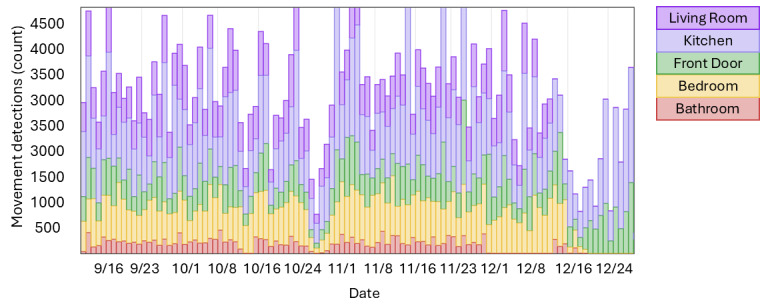
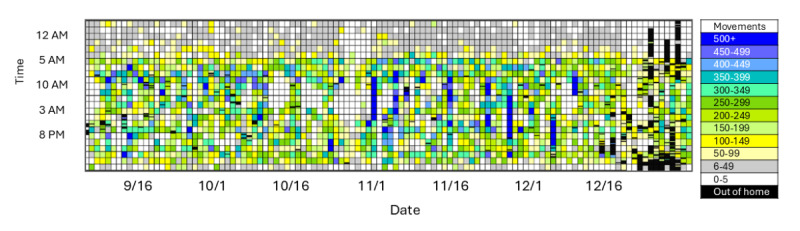
Results: As of this writing (fall 2024), machine learning algorithms are currently in development to predict those health outcomes from sensor-detected changes in health status. This methodology paper presents preliminary results from one participant as a proof of concept. The participant experienced several notable changes in activity, fluctuations in heart rate and respiration rate, and reductions in gait speed. Data collection will continue through 2025 with a growing sample.
Conclusions: The system described in this paper enables tracking the health status of people living with ALS at unprecedented levels of granularity. Combined with tightly integrated EHR data, we anticipate building predictive models that can identify opportunities for health care services before adverse events occur. We anticipate that this system will improve and extend the lives of people living with ALS.
International registered report identifier (irrid): DERR1-10.2196/60437.






 京公网安备 11010802042870号
京ICP备2023020795号-1
京公网安备 11010802042870号
京ICP备2023020795号-1

 分享
分享
 求助内容:
求助内容: 应助结果提醒方式:
 扫码关注我们
