{"title":"含咖啡因益生菌uf -伊朗白奶酪若干质量参数的研究","authors":"Hossein Jooyandeh, Behrooz Alizadeh Behbahani","doi":"10.1016/j.jafr.2025.101805","DOIUrl":null,"url":null,"abstract":"<div><div>Caffeine stimulates the central nervous system by inhibiting adenosine receptor ligands in the brain membrane. As a result, the consumption of foods containing caffeine can reduce fatigue and make a person more energetic. On the other hand, today the consumption of probiotic dairy products has attracted the attention of the general public due to their health benefits. Ultrafiltrated (UF) Iranian white cheese is a widely used dairy product in Iran. Therefore, consumption of probiotic UF cheese containing caffeine, in addition to providing nutrients needed by the body, increasing immunity and improving people's health, can increase energy and vitality. In this research, caffeine with different concentrations of 0 (control sample), 200, 400, and 600 mg/kg was added to the probiotic UF-Iranian white cheese, and some physicochemical, microbial, microstructural and sensory characteristics of the product during 45 days of storage in the refrigerator were checked. The results showed that the addition of caffeine caused a significant decrease in pH, color, taste and overall acceptance while increasing the acidity of cheese samples and count of probiotics (<em>L. fermentum</em>) (p < 0.05). However, syneresis, LAB count and other sensory properties (odor and texture) were not affected by the caffeine addition. Also, with the passage of storage time, pH values, sensory scores and the number of LAB and probiotic bacteria decreased and the syneresis value of the cheeses increased significantly. Scanning electron microscopy analysis revealed that addition of caffeine caused a significant impact on the cheese texture and leading to a more spongy structure. In general, based on the investigated characteristics, the ultrafiltrated probiotic cheese sample containing 200 mg/kg of caffeine was selected as the best sample.</div></div>","PeriodicalId":34393,"journal":{"name":"Journal of Agriculture and Food Research","volume":"21 ","pages":"Article 101805"},"PeriodicalIF":6.2000,"publicationDate":"2025-03-13","publicationTypes":"Journal Article","fieldsOfStudy":null,"isOpenAccess":false,"openAccessPdf":"","citationCount":"0","resultStr":"{\"title\":\"Investigation on some quality parameters of probiotic UF-Iranian white cheese containing caffeine\",\"authors\":\"Hossein Jooyandeh, Behrooz Alizadeh Behbahani\",\"doi\":\"10.1016/j.jafr.2025.101805\",\"DOIUrl\":null,\"url\":null,\"abstract\":\"<div><div>Caffeine stimulates the central nervous system by inhibiting adenosine receptor ligands in the brain membrane. As a result, the consumption of foods containing caffeine can reduce fatigue and make a person more energetic. On the other hand, today the consumption of probiotic dairy products has attracted the attention of the general public due to their health benefits. Ultrafiltrated (UF) Iranian white cheese is a widely used dairy product in Iran. Therefore, consumption of probiotic UF cheese containing caffeine, in addition to providing nutrients needed by the body, increasing immunity and improving people's health, can increase energy and vitality. In this research, caffeine with different concentrations of 0 (control sample), 200, 400, and 600 mg/kg was added to the probiotic UF-Iranian white cheese, and some physicochemical, microbial, microstructural and sensory characteristics of the product during 45 days of storage in the refrigerator were checked. The results showed that the addition of caffeine caused a significant decrease in pH, color, taste and overall acceptance while increasing the acidity of cheese samples and count of probiotics (<em>L. fermentum</em>) (p < 0.05). However, syneresis, LAB count and other sensory properties (odor and texture) were not affected by the caffeine addition. Also, with the passage of storage time, pH values, sensory scores and the number of LAB and probiotic bacteria decreased and the syneresis value of the cheeses increased significantly. Scanning electron microscopy analysis revealed that addition of caffeine caused a significant impact on the cheese texture and leading to a more spongy structure. In general, based on the investigated characteristics, the ultrafiltrated probiotic cheese sample containing 200 mg/kg of caffeine was selected as the best sample.</div></div>\",\"PeriodicalId\":34393,\"journal\":{\"name\":\"Journal of Agriculture and Food Research\",\"volume\":\"21 \",\"pages\":\"Article 101805\"},\"PeriodicalIF\":6.2000,\"publicationDate\":\"2025-03-13\",\"publicationTypes\":\"Journal Article\",\"fieldsOfStudy\":null,\"isOpenAccess\":false,\"openAccessPdf\":\"\",\"citationCount\":\"0\",\"resultStr\":null,\"platform\":\"Semanticscholar\",\"paperid\":null,\"PeriodicalName\":\"Journal of Agriculture and Food Research\",\"FirstCategoryId\":\"1085\",\"ListUrlMain\":\"https://www.sciencedirect.com/science/article/pii/S2666154325001760\",\"RegionNum\":0,\"RegionCategory\":null,\"ArticlePicture\":[],\"TitleCN\":null,\"AbstractTextCN\":null,\"PMCID\":null,\"EPubDate\":\"\",\"PubModel\":\"\",\"JCR\":\"Q1\",\"JCRName\":\"AGRICULTURE, MULTIDISCIPLINARY\",\"Score\":null,\"Total\":0}","platform":"Semanticscholar","paperid":null,"PeriodicalName":"Journal of Agriculture and Food Research","FirstCategoryId":"1085","ListUrlMain":"https://www.sciencedirect.com/science/article/pii/S2666154325001760","RegionNum":0,"RegionCategory":null,"ArticlePicture":[],"TitleCN":null,"AbstractTextCN":null,"PMCID":null,"EPubDate":"","PubModel":"","JCR":"Q1","JCRName":"AGRICULTURE, MULTIDISCIPLINARY","Score":null,"Total":0}
Investigation on some quality parameters of probiotic UF-Iranian white cheese containing caffeine
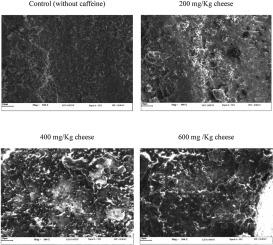
Caffeine stimulates the central nervous system by inhibiting adenosine receptor ligands in the brain membrane. As a result, the consumption of foods containing caffeine can reduce fatigue and make a person more energetic. On the other hand, today the consumption of probiotic dairy products has attracted the attention of the general public due to their health benefits. Ultrafiltrated (UF) Iranian white cheese is a widely used dairy product in Iran. Therefore, consumption of probiotic UF cheese containing caffeine, in addition to providing nutrients needed by the body, increasing immunity and improving people's health, can increase energy and vitality. In this research, caffeine with different concentrations of 0 (control sample), 200, 400, and 600 mg/kg was added to the probiotic UF-Iranian white cheese, and some physicochemical, microbial, microstructural and sensory characteristics of the product during 45 days of storage in the refrigerator were checked. The results showed that the addition of caffeine caused a significant decrease in pH, color, taste and overall acceptance while increasing the acidity of cheese samples and count of probiotics (L. fermentum) (p < 0.05). However, syneresis, LAB count and other sensory properties (odor and texture) were not affected by the caffeine addition. Also, with the passage of storage time, pH values, sensory scores and the number of LAB and probiotic bacteria decreased and the syneresis value of the cheeses increased significantly. Scanning electron microscopy analysis revealed that addition of caffeine caused a significant impact on the cheese texture and leading to a more spongy structure. In general, based on the investigated characteristics, the ultrafiltrated probiotic cheese sample containing 200 mg/kg of caffeine was selected as the best sample.




 京公网安备 11010802042870号
京ICP备2023020795号-1
京公网安备 11010802042870号
京ICP备2023020795号-1

 分享
分享
 求助内容:
求助内容: 应助结果提醒方式:
 扫码关注我们
