Aishwarya Pradeep Rao , Abani K. Pradhan , Jitendra Patel
{"title":"肠道沙门氏菌、大肠杆菌O157:H7和单核增生李斯特菌从受污染的种子转移到微蔬菜和土壤","authors":"Aishwarya Pradeep Rao , Abani K. Pradhan , Jitendra Patel","doi":"10.1016/j.jafr.2025.101761","DOIUrl":null,"url":null,"abstract":"<div><div>In recent years, the consumption of novel salad greens such as microgreens has increased tremendously around the globe because of their health and nutritional benefits. These benefits that include antioxidant activity among others have been attributed to the presence of helpful bioactive compounds. However, due to their production methods and conditions, they have a risk profile that bears a few similarities to that of sprouts. The persistence trends of <em>Salmonella enterica, Escherichia coli</em> O157:H7 and <em>Listeria monocytogenes</em> were studied over the growth period of 14 days. Seeds of daikon, mustard, broccoli, and red cabbage microgreens were contaminated with the three pathogens at high (∼5 Log CFU/g) and low (∼3 Log CFU/g) levels and the microgreens and soil were sampled on days 7 and 14. Microbiological analysis of soil and microgreen samples was carried out using spiral-plating on pathogen specific selective agars. There was a distinct increase on day 7 in the populations of all three pathogens in both the edible leafy green shoot portions and the soil of the microgreens. However, the prevalence levels of all three pathogens decreased by day 14. On day 7, there was no significant difference in the persistence of <em>E. coli</em> and <em>Salmonella</em> in all four microgreens. However, the <em>L. monocytogenes</em> populations were significantly higher in red cabbage than in broccoli, mustard and daikon. On day 14, the levels of all three pathogens did not significantly vary in the microgreens or the soil in which the microgreens were cultivated. In general, lower persistence of <em>Salmonella</em> and .<em>L.</em> <em>monocytogenes</em> was found in red cabbage and mustard microgreens on day 14, respectively. Results suggest that foodborne pathogens can be transferred from contaminated seeds to microgreens and persist in edible portions of microgreens at the point of harvest. Stringent quality assurance measures are required in maintaining microbial quality of seeds to prevent contamination and potential food safety risks.</div></div>","PeriodicalId":34393,"journal":{"name":"Journal of Agriculture and Food Research","volume":"21 ","pages":"Article 101761"},"PeriodicalIF":6.2000,"publicationDate":"2025-06-01","publicationTypes":"Journal Article","fieldsOfStudy":null,"isOpenAccess":false,"openAccessPdf":"","citationCount":"0","resultStr":"{\"title\":\"Transfer of Salmonella enterica, Escherichia coli O157:H7 and Listeria monocytogenes to microgreens and soil from contaminated seeds\",\"authors\":\"Aishwarya Pradeep Rao , Abani K. Pradhan , Jitendra Patel\",\"doi\":\"10.1016/j.jafr.2025.101761\",\"DOIUrl\":null,\"url\":null,\"abstract\":\"<div><div>In recent years, the consumption of novel salad greens such as microgreens has increased tremendously around the globe because of their health and nutritional benefits. These benefits that include antioxidant activity among others have been attributed to the presence of helpful bioactive compounds. However, due to their production methods and conditions, they have a risk profile that bears a few similarities to that of sprouts. The persistence trends of <em>Salmonella enterica, Escherichia coli</em> O157:H7 and <em>Listeria monocytogenes</em> were studied over the growth period of 14 days. Seeds of daikon, mustard, broccoli, and red cabbage microgreens were contaminated with the three pathogens at high (∼5 Log CFU/g) and low (∼3 Log CFU/g) levels and the microgreens and soil were sampled on days 7 and 14. Microbiological analysis of soil and microgreen samples was carried out using spiral-plating on pathogen specific selective agars. There was a distinct increase on day 7 in the populations of all three pathogens in both the edible leafy green shoot portions and the soil of the microgreens. However, the prevalence levels of all three pathogens decreased by day 14. On day 7, there was no significant difference in the persistence of <em>E. coli</em> and <em>Salmonella</em> in all four microgreens. However, the <em>L. monocytogenes</em> populations were significantly higher in red cabbage than in broccoli, mustard and daikon. On day 14, the levels of all three pathogens did not significantly vary in the microgreens or the soil in which the microgreens were cultivated. In general, lower persistence of <em>Salmonella</em> and .<em>L.</em> <em>monocytogenes</em> was found in red cabbage and mustard microgreens on day 14, respectively. Results suggest that foodborne pathogens can be transferred from contaminated seeds to microgreens and persist in edible portions of microgreens at the point of harvest. Stringent quality assurance measures are required in maintaining microbial quality of seeds to prevent contamination and potential food safety risks.</div></div>\",\"PeriodicalId\":34393,\"journal\":{\"name\":\"Journal of Agriculture and Food Research\",\"volume\":\"21 \",\"pages\":\"Article 101761\"},\"PeriodicalIF\":6.2000,\"publicationDate\":\"2025-06-01\",\"publicationTypes\":\"Journal Article\",\"fieldsOfStudy\":null,\"isOpenAccess\":false,\"openAccessPdf\":\"\",\"citationCount\":\"0\",\"resultStr\":null,\"platform\":\"Semanticscholar\",\"paperid\":null,\"PeriodicalName\":\"Journal of Agriculture and Food Research\",\"FirstCategoryId\":\"1085\",\"ListUrlMain\":\"https://www.sciencedirect.com/science/article/pii/S2666154325001322\",\"RegionNum\":0,\"RegionCategory\":null,\"ArticlePicture\":[],\"TitleCN\":null,\"AbstractTextCN\":null,\"PMCID\":null,\"EPubDate\":\"2025/2/23 0:00:00\",\"PubModel\":\"Epub\",\"JCR\":\"Q1\",\"JCRName\":\"AGRICULTURE, MULTIDISCIPLINARY\",\"Score\":null,\"Total\":0}","platform":"Semanticscholar","paperid":null,"PeriodicalName":"Journal of Agriculture and Food Research","FirstCategoryId":"1085","ListUrlMain":"https://www.sciencedirect.com/science/article/pii/S2666154325001322","RegionNum":0,"RegionCategory":null,"ArticlePicture":[],"TitleCN":null,"AbstractTextCN":null,"PMCID":null,"EPubDate":"2025/2/23 0:00:00","PubModel":"Epub","JCR":"Q1","JCRName":"AGRICULTURE, MULTIDISCIPLINARY","Score":null,"Total":0}
Transfer of Salmonella enterica, Escherichia coli O157:H7 and Listeria monocytogenes to microgreens and soil from contaminated seeds
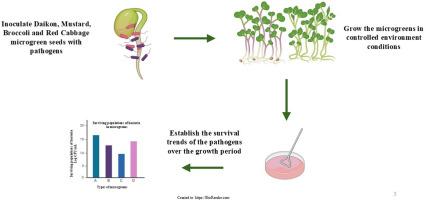
In recent years, the consumption of novel salad greens such as microgreens has increased tremendously around the globe because of their health and nutritional benefits. These benefits that include antioxidant activity among others have been attributed to the presence of helpful bioactive compounds. However, due to their production methods and conditions, they have a risk profile that bears a few similarities to that of sprouts. The persistence trends of Salmonella enterica, Escherichia coli O157:H7 and Listeria monocytogenes were studied over the growth period of 14 days. Seeds of daikon, mustard, broccoli, and red cabbage microgreens were contaminated with the three pathogens at high (∼5 Log CFU/g) and low (∼3 Log CFU/g) levels and the microgreens and soil were sampled on days 7 and 14. Microbiological analysis of soil and microgreen samples was carried out using spiral-plating on pathogen specific selective agars. There was a distinct increase on day 7 in the populations of all three pathogens in both the edible leafy green shoot portions and the soil of the microgreens. However, the prevalence levels of all three pathogens decreased by day 14. On day 7, there was no significant difference in the persistence of E. coli and Salmonella in all four microgreens. However, the L. monocytogenes populations were significantly higher in red cabbage than in broccoli, mustard and daikon. On day 14, the levels of all three pathogens did not significantly vary in the microgreens or the soil in which the microgreens were cultivated. In general, lower persistence of Salmonella and .L.monocytogenes was found in red cabbage and mustard microgreens on day 14, respectively. Results suggest that foodborne pathogens can be transferred from contaminated seeds to microgreens and persist in edible portions of microgreens at the point of harvest. Stringent quality assurance measures are required in maintaining microbial quality of seeds to prevent contamination and potential food safety risks.





 京公网安备 11010802042870号
京ICP备2023020795号-1
京公网安备 11010802042870号
京ICP备2023020795号-1

 分享
分享
 求助内容:
求助内容: 应助结果提醒方式:
 扫码关注我们
