Jie Chen, George Wandera Kisimbiri, Ivan Gladich, Nicolas Fauré, Erik S Thomson, Robert Temperton, Zamin A Kanji, Xiangrui Kong
{"title":"含氮、含硫有机化合物在硫酸铵表面形成途径的研究。","authors":"Jie Chen, George Wandera Kisimbiri, Ivan Gladich, Nicolas Fauré, Erik S Thomson, Robert Temperton, Zamin A Kanji, Xiangrui Kong","doi":"10.1021/acs.jpca.5c00332","DOIUrl":null,"url":null,"abstract":"<p><p>The formation of nitrogen- and sulfur-containing organic compounds (N-Org and S-Org) is important for atmospheric secondary organic aerosol (SOA) production, thereby influencing air quality and global climate. However, the mechanisms underlying N-Org and S-Org formation on aerosol particle surfaces are poorly understood due to the limited availability of surface-sensitive analytical techniques. This study investigates the surface interactions of glyoxal (GL), a known SOA precursor, with ammonium sulfate (NH<sub>4</sub>)<sub>2</sub>SO<sub>4</sub>, under varying relative humidity (RH) conditions, using ambient-pressure X-ray photoelectron spectroscopy (APXPS), near-edge X-ray absorption fine structure (NEXAFS) spectroscopy, and molecular dynamics (MD) simulations. N-Org species, such as imines, a key intermediate in brown carbon (BrC) formation, are identified on the (NH<sub>4</sub>)<sub>2</sub>SO<sub>4</sub> surface at low RH (≤13.3%). The formed S-Org species cannot be specified due to the difficulties in distinguishing S-Org from inorganic sulfate in the XPS spectra. Elemental ratios on (NH<sub>4</sub>)<sub>2</sub>SO<sub>4</sub> surface across the entire probing depth show increased S/O and N/O ratios upon GL exposure, indicating the formation of N-Org and S-Org species. NEXAFS measurements further confirm the surface changes of (NH<sub>4</sub>)<sub>2</sub>SO<sub>4</sub> associated with the adsorption of GL and water. These findings provide compelling evidence of surface-driven N-Org and S-Org formation pathways, demonstrating that heterogeneous reactions on (NH<sub>4</sub>)<sub>2</sub>SO<sub>4</sub> particle surfaces could be an active source of atmospheric BrC and SOA.</p>","PeriodicalId":59,"journal":{"name":"The Journal of Physical Chemistry A","volume":" ","pages":"2922-2931"},"PeriodicalIF":3.0000,"publicationDate":"2025-03-27","publicationTypes":"Journal Article","fieldsOfStudy":null,"isOpenAccess":false,"openAccessPdf":"https://www.ncbi.nlm.nih.gov/pmc/articles/PMC11956130/pdf/","citationCount":"0","resultStr":"{\"title\":\"Surface Formation Pathway of Nitrogen- and Sulfur-Containing Organic Compounds on Ammonium Sulfate.\",\"authors\":\"Jie Chen, George Wandera Kisimbiri, Ivan Gladich, Nicolas Fauré, Erik S Thomson, Robert Temperton, Zamin A Kanji, Xiangrui Kong\",\"doi\":\"10.1021/acs.jpca.5c00332\",\"DOIUrl\":null,\"url\":null,\"abstract\":\"<p><p>The formation of nitrogen- and sulfur-containing organic compounds (N-Org and S-Org) is important for atmospheric secondary organic aerosol (SOA) production, thereby influencing air quality and global climate. However, the mechanisms underlying N-Org and S-Org formation on aerosol particle surfaces are poorly understood due to the limited availability of surface-sensitive analytical techniques. This study investigates the surface interactions of glyoxal (GL), a known SOA precursor, with ammonium sulfate (NH<sub>4</sub>)<sub>2</sub>SO<sub>4</sub>, under varying relative humidity (RH) conditions, using ambient-pressure X-ray photoelectron spectroscopy (APXPS), near-edge X-ray absorption fine structure (NEXAFS) spectroscopy, and molecular dynamics (MD) simulations. N-Org species, such as imines, a key intermediate in brown carbon (BrC) formation, are identified on the (NH<sub>4</sub>)<sub>2</sub>SO<sub>4</sub> surface at low RH (≤13.3%). The formed S-Org species cannot be specified due to the difficulties in distinguishing S-Org from inorganic sulfate in the XPS spectra. Elemental ratios on (NH<sub>4</sub>)<sub>2</sub>SO<sub>4</sub> surface across the entire probing depth show increased S/O and N/O ratios upon GL exposure, indicating the formation of N-Org and S-Org species. NEXAFS measurements further confirm the surface changes of (NH<sub>4</sub>)<sub>2</sub>SO<sub>4</sub> associated with the adsorption of GL and water. These findings provide compelling evidence of surface-driven N-Org and S-Org formation pathways, demonstrating that heterogeneous reactions on (NH<sub>4</sub>)<sub>2</sub>SO<sub>4</sub> particle surfaces could be an active source of atmospheric BrC and SOA.</p>\",\"PeriodicalId\":59,\"journal\":{\"name\":\"The Journal of Physical Chemistry A\",\"volume\":\" \",\"pages\":\"2922-2931\"},\"PeriodicalIF\":3.0000,\"publicationDate\":\"2025-03-27\",\"publicationTypes\":\"Journal Article\",\"fieldsOfStudy\":null,\"isOpenAccess\":false,\"openAccessPdf\":\"https://www.ncbi.nlm.nih.gov/pmc/articles/PMC11956130/pdf/\",\"citationCount\":\"0\",\"resultStr\":null,\"platform\":\"Semanticscholar\",\"paperid\":null,\"PeriodicalName\":\"The Journal of Physical Chemistry A\",\"FirstCategoryId\":\"1\",\"ListUrlMain\":\"https://doi.org/10.1021/acs.jpca.5c00332\",\"RegionNum\":2,\"RegionCategory\":\"化学\",\"ArticlePicture\":[],\"TitleCN\":null,\"AbstractTextCN\":null,\"PMCID\":null,\"EPubDate\":\"2025/3/13 0:00:00\",\"PubModel\":\"Epub\",\"JCR\":\"Q3\",\"JCRName\":\"CHEMISTRY, PHYSICAL\",\"Score\":null,\"Total\":0}","platform":"Semanticscholar","paperid":null,"PeriodicalName":"The Journal of Physical Chemistry A","FirstCategoryId":"1","ListUrlMain":"https://doi.org/10.1021/acs.jpca.5c00332","RegionNum":2,"RegionCategory":"化学","ArticlePicture":[],"TitleCN":null,"AbstractTextCN":null,"PMCID":null,"EPubDate":"2025/3/13 0:00:00","PubModel":"Epub","JCR":"Q3","JCRName":"CHEMISTRY, PHYSICAL","Score":null,"Total":0}
Surface Formation Pathway of Nitrogen- and Sulfur-Containing Organic Compounds on Ammonium Sulfate.
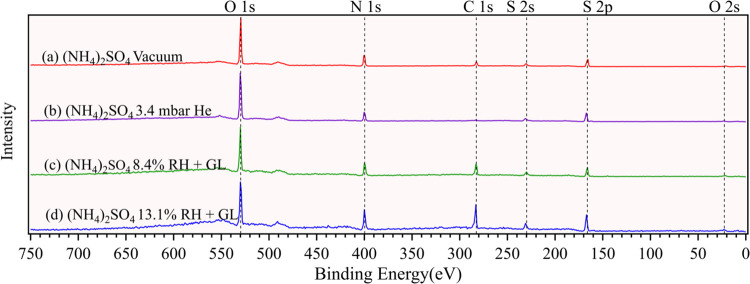
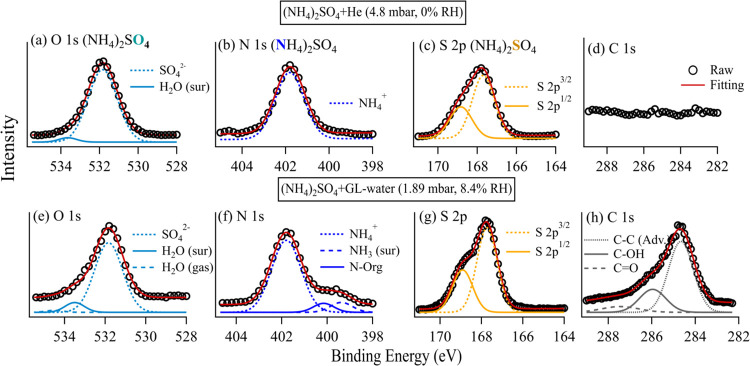
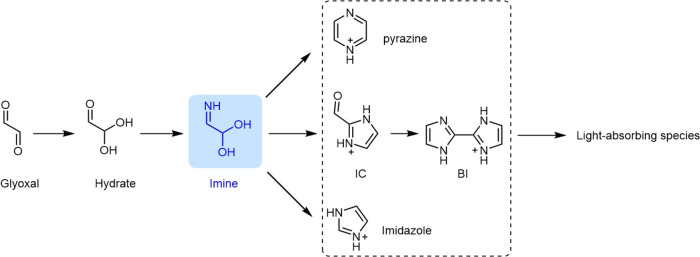
The formation of nitrogen- and sulfur-containing organic compounds (N-Org and S-Org) is important for atmospheric secondary organic aerosol (SOA) production, thereby influencing air quality and global climate. However, the mechanisms underlying N-Org and S-Org formation on aerosol particle surfaces are poorly understood due to the limited availability of surface-sensitive analytical techniques. This study investigates the surface interactions of glyoxal (GL), a known SOA precursor, with ammonium sulfate (NH4)2SO4, under varying relative humidity (RH) conditions, using ambient-pressure X-ray photoelectron spectroscopy (APXPS), near-edge X-ray absorption fine structure (NEXAFS) spectroscopy, and molecular dynamics (MD) simulations. N-Org species, such as imines, a key intermediate in brown carbon (BrC) formation, are identified on the (NH4)2SO4 surface at low RH (≤13.3%). The formed S-Org species cannot be specified due to the difficulties in distinguishing S-Org from inorganic sulfate in the XPS spectra. Elemental ratios on (NH4)2SO4 surface across the entire probing depth show increased S/O and N/O ratios upon GL exposure, indicating the formation of N-Org and S-Org species. NEXAFS measurements further confirm the surface changes of (NH4)2SO4 associated with the adsorption of GL and water. These findings provide compelling evidence of surface-driven N-Org and S-Org formation pathways, demonstrating that heterogeneous reactions on (NH4)2SO4 particle surfaces could be an active source of atmospheric BrC and SOA.
期刊介绍:
The Journal of Physical Chemistry A is devoted to reporting new and original experimental and theoretical basic research of interest to physical chemists, biophysical chemists, and chemical physicists.




 京公网安备 11010802042870号
京ICP备2023020795号-1
京公网安备 11010802042870号
京ICP备2023020795号-1

 分享
分享
 求助内容:
求助内容: 应助结果提醒方式:
 扫码关注我们
