Yi-Tao Yang, Zhuo Wang, Chen-Yang Meng, Xing-Hao Deng, Yi Long, Jing-Yi Hou, Rui Yang
{"title":"关节镜下应用h -环技术修复上第三肩胛下肌肌腱:一个病例系列。","authors":"Yi-Tao Yang, Zhuo Wang, Chen-Yang Meng, Xing-Hao Deng, Yi Long, Jing-Yi Hou, Rui Yang","doi":"10.1111/os.70014","DOIUrl":null,"url":null,"abstract":"<p><strong>Objective: </strong>Arthroscopic repair of upper one-third subscapularis tendon tears remains challenging due to suture management difficulties and repair quality limitations. We proposed a simpler knotless technique-the H-Loop technique. This study evaluates its early clinical and imaging outcomes.</p><p><strong>Method: </strong>This is a case series of 38 patients (9 males and 29 females), who underwent arthroscopic H-Loop technique repair for upper one-third subscapularis tendon tears between January 2021 and August 2023. Postoperative assessments include the American Shoulder and Elbow Surgeons (ASES) score, the University of California, Los Angeles (UCLA) shoulder score, the Constant-Murley score, the visual analog scale (VAS), range of motion (ROM) (internal and external rotation), and internal rotation strength. In addition, MRI (30 patients) evaluated fatty infiltration, re-tears, and subscapularis integrity, comparing tendon dimensions and signal-to-signal ratios with a control group of patients with normal subscapularis tendons.</p><p><strong>Result: </strong>Preoperative symptom duration ranged from 3 to 36 months, with an average of 9 months. Follow-up ranged from 12 to 14 months, with an average duration of 12.6 months. No complications were observed in any patient. Postoperative ASES scores increased significantly compared to preoperative scores (55.63 ± 15.85 vs. 88.92 ± 8.24), as did UCLA scores (21.82 ± 4.44 vs. 29.74 ± 3.55) and Constant-Murley scores (69.76 ± 15.30 vs. 86.34 ± 14.48). VAS scores decreased significantly (5.16 ± 1.84 vs. 0.89 ± 0.76). Postoperative ROM showed significant improvement in internal rotation (7.79 ± 2.07 vs. 8.45 ± 1.33) and external rotation (57.63° ± 15.84° vs. 66.58° ± 9.08°) (p < 0.05). Internal rotation strength ratios increased markedly (78.00% ± 15.86% vs. 91.97% ± 6.62%). MRI indicated no re-tears or fatty infiltration in the 30 patients, and compared to the control group, there were no statistically significant differences in the vertical diameter of the subscapularis muscle (62.89 mm ± 9.30 mm vs. 59.41 mm ± 7.55 mm; p = 0.153), transverse diameter of the upper subscapularis muscle (17.82 mm ± 3.79 mm vs. 19.43 mm ± 4.76 mm; p = 0.395), transverse diameter of the lower subscapularis muscle (24.09 mm ± 5.84 mm vs. 25.23 mm ± 5.41 mm; p = 0.870), cross-sectional area of the subscapularis muscle (1338.54 mm<sup>2</sup> ± 277.26 mm<sup>2</sup> vs. 1247.94 mm<sup>2</sup> ± 210.55 mm<sup>2</sup>; p = 0.098), signal-to-signal ratio of the upper subscapularis muscle (1.18 ± 0.28 vs. 1.24 ± 0.28; p = 0.792), or the signal-to-signal ratio of the lower subscapularis muscle (1.02 ± 0.24 vs. 1.03 ± 0.16; p = 0.128).</p><p><strong>Conclusion: </strong>The arthroscopic H-Loop technique significantly restores function, improves range of motion, and enhances internal rotation strength, maintaining good tendon integrity in the early postoperative period.</p>","PeriodicalId":19566,"journal":{"name":"Orthopaedic Surgery","volume":" ","pages":"1525-1535"},"PeriodicalIF":2.1000,"publicationDate":"2025-05-01","publicationTypes":"Journal Article","fieldsOfStudy":null,"isOpenAccess":false,"openAccessPdf":"https://www.ncbi.nlm.nih.gov/pmc/articles/PMC12050182/pdf/","citationCount":"0","resultStr":"{\"title\":\"Arthroscopic Upper Third Subscapularis Tendon Repair Using H-Loop Technique: A Case Series.\",\"authors\":\"Yi-Tao Yang, Zhuo Wang, Chen-Yang Meng, Xing-Hao Deng, Yi Long, Jing-Yi Hou, Rui Yang\",\"doi\":\"10.1111/os.70014\",\"DOIUrl\":null,\"url\":null,\"abstract\":\"<p><strong>Objective: </strong>Arthroscopic repair of upper one-third subscapularis tendon tears remains challenging due to suture management difficulties and repair quality limitations. We proposed a simpler knotless technique-the H-Loop technique. This study evaluates its early clinical and imaging outcomes.</p><p><strong>Method: </strong>This is a case series of 38 patients (9 males and 29 females), who underwent arthroscopic H-Loop technique repair for upper one-third subscapularis tendon tears between January 2021 and August 2023. Postoperative assessments include the American Shoulder and Elbow Surgeons (ASES) score, the University of California, Los Angeles (UCLA) shoulder score, the Constant-Murley score, the visual analog scale (VAS), range of motion (ROM) (internal and external rotation), and internal rotation strength. In addition, MRI (30 patients) evaluated fatty infiltration, re-tears, and subscapularis integrity, comparing tendon dimensions and signal-to-signal ratios with a control group of patients with normal subscapularis tendons.</p><p><strong>Result: </strong>Preoperative symptom duration ranged from 3 to 36 months, with an average of 9 months. Follow-up ranged from 12 to 14 months, with an average duration of 12.6 months. No complications were observed in any patient. Postoperative ASES scores increased significantly compared to preoperative scores (55.63 ± 15.85 vs. 88.92 ± 8.24), as did UCLA scores (21.82 ± 4.44 vs. 29.74 ± 3.55) and Constant-Murley scores (69.76 ± 15.30 vs. 86.34 ± 14.48). VAS scores decreased significantly (5.16 ± 1.84 vs. 0.89 ± 0.76). Postoperative ROM showed significant improvement in internal rotation (7.79 ± 2.07 vs. 8.45 ± 1.33) and external rotation (57.63° ± 15.84° vs. 66.58° ± 9.08°) (p < 0.05). Internal rotation strength ratios increased markedly (78.00% ± 15.86% vs. 91.97% ± 6.62%). MRI indicated no re-tears or fatty infiltration in the 30 patients, and compared to the control group, there were no statistically significant differences in the vertical diameter of the subscapularis muscle (62.89 mm ± 9.30 mm vs. 59.41 mm ± 7.55 mm; p = 0.153), transverse diameter of the upper subscapularis muscle (17.82 mm ± 3.79 mm vs. 19.43 mm ± 4.76 mm; p = 0.395), transverse diameter of the lower subscapularis muscle (24.09 mm ± 5.84 mm vs. 25.23 mm ± 5.41 mm; p = 0.870), cross-sectional area of the subscapularis muscle (1338.54 mm<sup>2</sup> ± 277.26 mm<sup>2</sup> vs. 1247.94 mm<sup>2</sup> ± 210.55 mm<sup>2</sup>; p = 0.098), signal-to-signal ratio of the upper subscapularis muscle (1.18 ± 0.28 vs. 1.24 ± 0.28; p = 0.792), or the signal-to-signal ratio of the lower subscapularis muscle (1.02 ± 0.24 vs. 1.03 ± 0.16; p = 0.128).</p><p><strong>Conclusion: </strong>The arthroscopic H-Loop technique significantly restores function, improves range of motion, and enhances internal rotation strength, maintaining good tendon integrity in the early postoperative period.</p>\",\"PeriodicalId\":19566,\"journal\":{\"name\":\"Orthopaedic Surgery\",\"volume\":\" \",\"pages\":\"1525-1535\"},\"PeriodicalIF\":2.1000,\"publicationDate\":\"2025-05-01\",\"publicationTypes\":\"Journal Article\",\"fieldsOfStudy\":null,\"isOpenAccess\":false,\"openAccessPdf\":\"https://www.ncbi.nlm.nih.gov/pmc/articles/PMC12050182/pdf/\",\"citationCount\":\"0\",\"resultStr\":null,\"platform\":\"Semanticscholar\",\"paperid\":null,\"PeriodicalName\":\"Orthopaedic Surgery\",\"FirstCategoryId\":\"3\",\"ListUrlMain\":\"https://doi.org/10.1111/os.70014\",\"RegionNum\":2,\"RegionCategory\":\"医学\",\"ArticlePicture\":[],\"TitleCN\":null,\"AbstractTextCN\":null,\"PMCID\":null,\"EPubDate\":\"2025/3/13 0:00:00\",\"PubModel\":\"Epub\",\"JCR\":\"Q2\",\"JCRName\":\"ORTHOPEDICS\",\"Score\":null,\"Total\":0}","platform":"Semanticscholar","paperid":null,"PeriodicalName":"Orthopaedic Surgery","FirstCategoryId":"3","ListUrlMain":"https://doi.org/10.1111/os.70014","RegionNum":2,"RegionCategory":"医学","ArticlePicture":[],"TitleCN":null,"AbstractTextCN":null,"PMCID":null,"EPubDate":"2025/3/13 0:00:00","PubModel":"Epub","JCR":"Q2","JCRName":"ORTHOPEDICS","Score":null,"Total":0}
引用次数: 0
摘要
目的:关节镜下修复上三分之一肩胛下肌腱撕裂由于缝合管理困难和修复质量的限制仍然具有挑战性。我们提出了一种更简单的无结技术——H-Loop技术。本研究评估其早期临床和影像学结果。方法:这是一个病例系列,38例患者(9男29女),在2021年1月至2023年8月期间接受关节镜H-Loop技术修复上三分之一肩胛下肌腱撕裂。术后评估包括美国肩关节外科医生评分(ASES)、加州大学洛杉矶分校(UCLA)肩关节评分、Constant-Murley评分、视觉模拟评分(VAS)、活动范围(ROM)(内、外旋转)和内旋转强度。此外,MRI(30例患者)评估了脂肪浸润、再撕裂和肩胛下肌完整性,并与正常肩胛下肌的对照组患者进行了肌腱尺寸和信号比的比较。结果:术前症状持续时间3 ~ 36个月,平均9个月。随访12 ~ 14个月,平均12.6个月。无并发症发生。与术前相比,术后as评分(55.63±15.85比88.92±8.24)、UCLA评分(21.82±4.44比29.74±3.55)和Constant-Murley评分(69.76±15.30比86.34±14.48)均显著升高。VAS评分显著降低(5.16±1.84比0.89±0.76)。术后ROM显示内旋(7.79±2.07 vs 8.45±1.33)和外旋(57.63°±15.84°vs 66.58°±9.08°)显著改善(p 2±277.26 mm2 vs 1247.94 mm2±210.55 mm2;P = 0.098),肩胛下肌信号比(1.18±0.28∶1.24±0.28;P = 0.792),肩胛下肌信号比(1.02±0.24∶1.03±0.16;p = 0.128)。结论:关节镜下H-Loop技术可明显恢复关节功能,提高关节活动度,增强内旋强度,术后早期维持良好的肌腱完整性。
Arthroscopic Upper Third Subscapularis Tendon Repair Using H-Loop Technique: A Case Series.
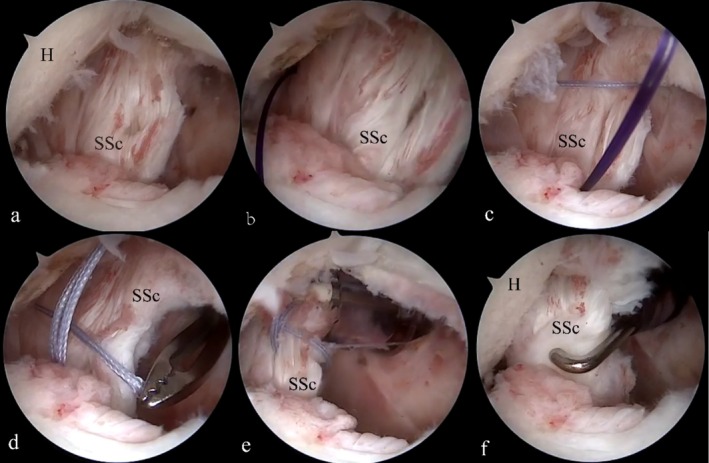
Objective: Arthroscopic repair of upper one-third subscapularis tendon tears remains challenging due to suture management difficulties and repair quality limitations. We proposed a simpler knotless technique-the H-Loop technique. This study evaluates its early clinical and imaging outcomes.
Method: This is a case series of 38 patients (9 males and 29 females), who underwent arthroscopic H-Loop technique repair for upper one-third subscapularis tendon tears between January 2021 and August 2023. Postoperative assessments include the American Shoulder and Elbow Surgeons (ASES) score, the University of California, Los Angeles (UCLA) shoulder score, the Constant-Murley score, the visual analog scale (VAS), range of motion (ROM) (internal and external rotation), and internal rotation strength. In addition, MRI (30 patients) evaluated fatty infiltration, re-tears, and subscapularis integrity, comparing tendon dimensions and signal-to-signal ratios with a control group of patients with normal subscapularis tendons.
Result: Preoperative symptom duration ranged from 3 to 36 months, with an average of 9 months. Follow-up ranged from 12 to 14 months, with an average duration of 12.6 months. No complications were observed in any patient. Postoperative ASES scores increased significantly compared to preoperative scores (55.63 ± 15.85 vs. 88.92 ± 8.24), as did UCLA scores (21.82 ± 4.44 vs. 29.74 ± 3.55) and Constant-Murley scores (69.76 ± 15.30 vs. 86.34 ± 14.48). VAS scores decreased significantly (5.16 ± 1.84 vs. 0.89 ± 0.76). Postoperative ROM showed significant improvement in internal rotation (7.79 ± 2.07 vs. 8.45 ± 1.33) and external rotation (57.63° ± 15.84° vs. 66.58° ± 9.08°) (p < 0.05). Internal rotation strength ratios increased markedly (78.00% ± 15.86% vs. 91.97% ± 6.62%). MRI indicated no re-tears or fatty infiltration in the 30 patients, and compared to the control group, there were no statistically significant differences in the vertical diameter of the subscapularis muscle (62.89 mm ± 9.30 mm vs. 59.41 mm ± 7.55 mm; p = 0.153), transverse diameter of the upper subscapularis muscle (17.82 mm ± 3.79 mm vs. 19.43 mm ± 4.76 mm; p = 0.395), transverse diameter of the lower subscapularis muscle (24.09 mm ± 5.84 mm vs. 25.23 mm ± 5.41 mm; p = 0.870), cross-sectional area of the subscapularis muscle (1338.54 mm2 ± 277.26 mm2 vs. 1247.94 mm2 ± 210.55 mm2; p = 0.098), signal-to-signal ratio of the upper subscapularis muscle (1.18 ± 0.28 vs. 1.24 ± 0.28; p = 0.792), or the signal-to-signal ratio of the lower subscapularis muscle (1.02 ± 0.24 vs. 1.03 ± 0.16; p = 0.128).
Conclusion: The arthroscopic H-Loop technique significantly restores function, improves range of motion, and enhances internal rotation strength, maintaining good tendon integrity in the early postoperative period.
期刊介绍:
Orthopaedic Surgery (OS) is the official journal of the Chinese Orthopaedic Association, focusing on all aspects of orthopaedic technique and surgery.
The journal publishes peer-reviewed articles in the following categories: Original Articles, Clinical Articles, Review Articles, Guidelines, Editorials, Commentaries, Surgical Techniques, Case Reports and Meeting Reports.






 京公网安备 11010802042870号
京ICP备2023020795号-1
京公网安备 11010802042870号
京ICP备2023020795号-1

 分享
分享
 求助内容:
求助内容: 应助结果提醒方式:
 扫码关注我们
